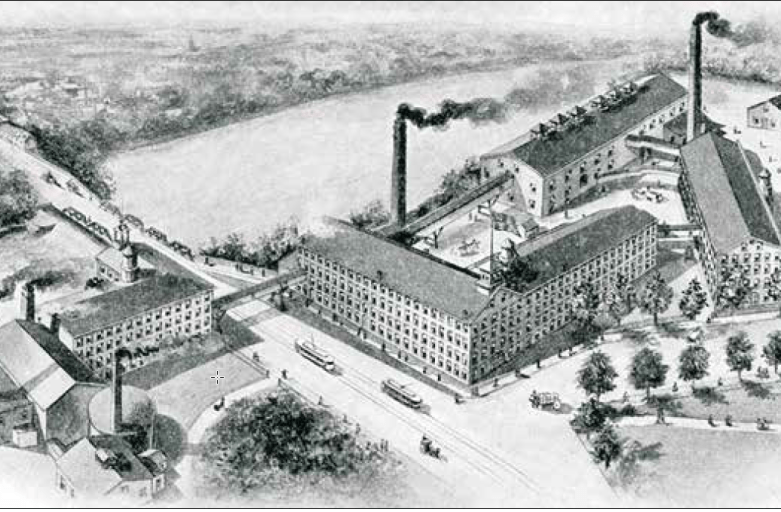

TIRE WORKS FIRE WON’T STOP WORK
The storehouse of the International at Milltown was destroyed, but the main works are saved—the damage well covered by insurance.
The six-story frame structure, approximately 70 by 100 feet, which was the plant of the original Meyer Rubber Co., situated at Milltown, burned last night. So great was the danger to surrounding property that help was sought from this city, with Raritan Engine Company and Liberty Hose Company responding.
Although the building destroyed was the real factory in the time of Christian Meyer, it had only been used as a storehouse for some years past by the International Automobile Vehicle and Tire Company. The brick structure opposite, where active manufacturing is carried out, was not harmed, even though it seemed at risk as the flames were moving across the covered bridge connecting the old building with the new brick structure.
The origin of the flames is a mystery, but it is thought to have started on the fifth floor around 6:30 PM when the employees were leaving, spreading rapidly due to the building’s age and the inflammable nature of the stock. The fourth floor was used as storage by the Jersey Rubber Specialty Company.
The assistance of the New Brunswick firemen was pivotal in controlling the fire. Sergeant Kelly, upon receiving the news and call for help, notified Chief Kidney, who dispatched the Raritan Engine Company and Liberty Hose Company. The latter made remarkable time, and the route taken was via Livingston avenue, recently cut through to the Cranbury Turnpike, and on to Milltown.
Raritan Engine Company’s engine, drawn by Walter Flavel’s horses, went out in record time. Second Assistant Chief Puerschner, in charge at Milltown, deployed a crew to the connecting bridge, beating back the flames despite suggestions to tear it down. Fire shutters on the main building helped contain the danger until the firemen arrived.
The plant’s overhead sprinkling system activated upon the fire’s start, with three streams from the building’s fire connections playing on the flames, although their impact was limited. Minor explosions occurred when the fire reached particularly flammable materials, necessitating continued water application until nearly midnight.
The electrical current for trolleys was shut off due to the fire’s proximity to the overhead bridge and feed wire. No. 4 engine was stationed on the other side, with hoses crossing the tracks. Water was pumped from a pond, and the stationary engine in the brick building, installed for firefighting, proved effective. The dense smoke from burning rubber products and appliances made the firefighters’ work more difficult.
The building, valued at $15,000 and built quickly after its predecessor’s destruction, was part of the original rubber factory of Christian Meyer. Insurance, managed by Weed and Kennedy in New York, covered the entire property at $500,000. The destroyed building was insured for $125,000 across several companies.
Howard DeHart, a trolley conductor, was the first to see the flames, raising the alarm as he crossed the old wooden bridge to North Milltown.