This Day in History: March 16th, 1908

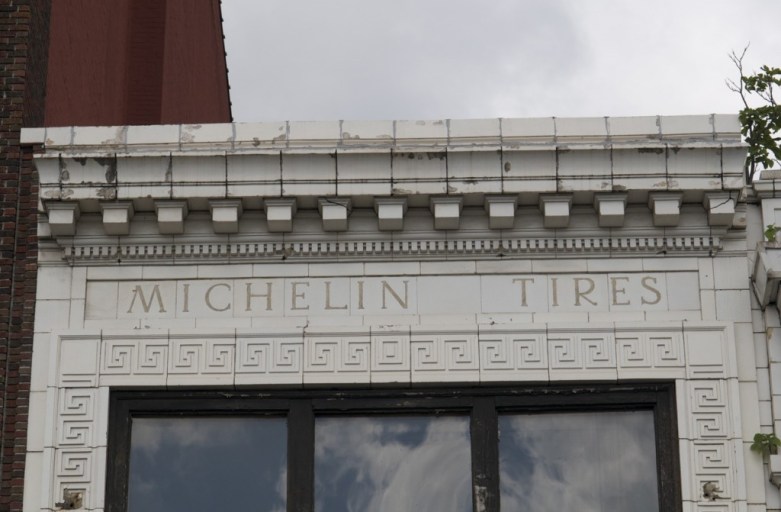
Michelin-Tires-802-N-Broad-Philadelhia-hidden-city-peter-woodall

MICHELIN CO. TO HAVE STRING OF SALESROOMS

Will Have an Individuality About Them -1,000 Now Employed at Milltown.

The world’s record of one hundred miles in 1:12:56 was established by a Renault car, driven by Brenin, and equipped with American made Michelin tires at the auto races held at Ormond Beach, Fla., recently.

The tires with which the car was equipped were made at Milltown. The newly established record, which speaks highly for the Michelin tire, gives an average of 81 7-100 miles per hour.

Despite the financial pressure of late, the factory at Milltown has been working day and night in an effort to get ahead with orders on hand. Over a thousand people are employed at the factory now and more are being taken on daily.

The company expects to open salesrooms in connection with the New York branch at 1763 Broadway, and the decorations of the new salesroom will excel any of those in the auto quarter wherein the new branch store is to be located.

The salesrooms of the Michelin Company throughout the United States will have their own individual design so that they can be instantly recognized. The walls, counters and painting of the various salesrooms will be of the same hue. The colors of the signs of the company which have been plentifully distributed about the country are blue and yellow.

The Michelin Company have now six salesrooms, Boston, New York, Buffalo, Detroit, Cleveland and Chicago. Salesrooms will be opened shortly at Philadelphia, San Francisco and Denver.


Now for an analysis….


At the beginning of the twentieth century the Michelin Tire Company embarked on an ambitious attempt to establish itself within the rapidly expanding American automobile industry. The decision to create a manufacturing base in Milltown, New Jersey in 1907 represented a decisive step in Michelin’s broader strategy of international expansion. During this period the French company established subsidiaries in key global markets, including Great Britain, Italy, and the United States, with the Milltown plant serving as the center of Michelin’s American production from 1907 until 1930.

Milltown offered a strategic location for the company’s American operations. Situated in Middlesex County along the Lawrence Brook and less than thirty miles from New York City, the town provided access to rail transport, waterways, and major commercial networks connected to the Atlantic seaboard. The factory complex occupied several hectares and included multiple industrial buildings capable of producing pneumatic automobile tires for the growing American market.

The establishment of the Milltown plant reflected Michelin’s determination to participate directly in the transformation brought about by the automobile. In the first decade of the twentieth century the American tire industry was expanding at an extraordinary pace as automobile production increased and new manufacturers entered the field. Michelin, already well known in Europe for its innovations in pneumatic tire technology, sought to translate its reputation for engineering excellence into success in the United States.

One of the most effective ways tire companies demonstrated the performance of their products during this era was through automobile racing. Before the construction of permanent racing circuits, early speed competitions were frequently held on the hard-packed sands of Florida’s Atlantic coast, particularly at Ormond Beach, which later became closely associated with the racing traditions of nearby Daytona Beach. These beach races attracted international attention and provided manufacturers with an ideal stage to showcase the durability and speed of their vehicles and tires.

Contemporary reports describe a record-setting run at Ormond Beach in which a Renault automobile equipped with Michelin tires manufactured at the Milltown factory achieved a remarkable speed record over a one-hundred-mile distance. Such events were not merely sporting spectacles but carefully publicized demonstrations of industrial capability. By emphasizing that the tires used in the race were produced in the United States at the Milltown facility, Michelin was able to promote its American-made products while reinforcing the prestige of the brand. Racing achievements thus served as a bridge between technological performance and commercial promotion.

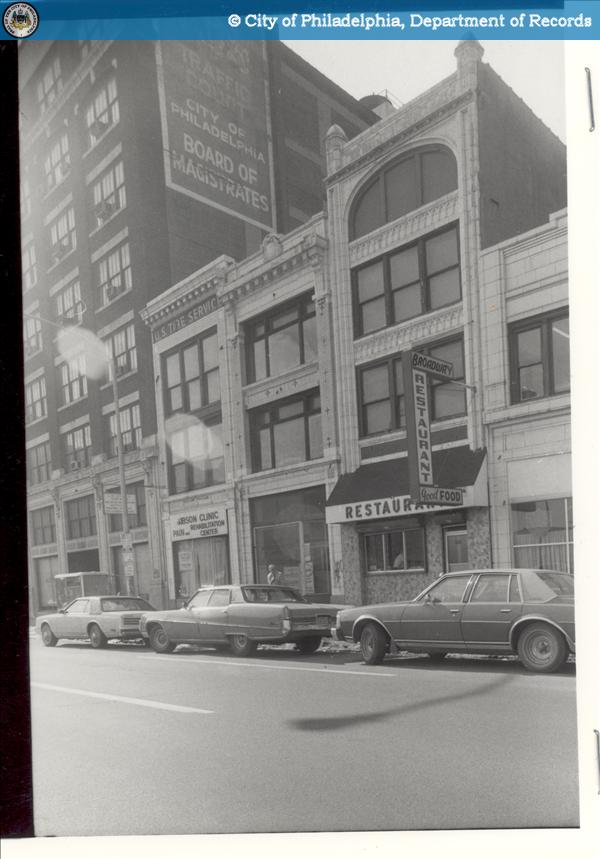
At the same time that Michelin was promoting its tires through racing successes, the company was constructing a national commercial presence through a network of salesrooms and distribution centers. The early automobile industry was concentrated in urban districts where manufacturers, parts suppliers, and dealerships clustered along prominent commercial streets. These areas became known as “Automobile Row” districts, and they represented a new form of urban retail landscape created by the rise of the motorcar.

Cities across the United States developed such automotive corridors, and Philadelphia’s North Broad Street became one of the most notable examples. By the early twentieth century the street had evolved into a dense concentration of automobile showrooms, repair facilities, and suppliers of related equipment such as tires and accessories. Michelin’s commercial strategy involved placing branded salesrooms within these districts so that motorists could encounter the company’s products alongside the rapidly expanding array of automobiles entering the American market.

The presence of Michelin offices and salesrooms in cities like Philadelphia demonstrates how the company attempted to integrate itself into the infrastructure of American motoring. These locations served not only as retail outlets but also as centers for advertising and brand visibility. The distinctive colors associated with Michelin—blue and yellow—and the recognizable figure of Bibendum, the Michelin Man, helped the company create a consistent identity across its growing network of urban showrooms.

Although much of the physical infrastructure of these early automotive districts has disappeared, traces of their history remain embedded in the urban landscape. In Philadelphia, for example, the legacy of North Broad Street’s Automobile Row has been documented through historical research and preservation efforts, including those highlighted by Hidden City Philadelphia, which examines the surviving buildings and architectural remnants of the city’s early automotive industry.

Michelin Tires – 802 N Broad Philadelphia – Hidden City – Peter Woodall https://hiddencityphila.org/2011/09/auto-zone/

When viewed together, the stories of Milltown, Ormond Beach, and Automobile Row reveal different dimensions of Michelin’s American venture. The Milltown factory represented the industrial foundation of the enterprise, where tires were manufactured for the American market. The racing events at Ormond Beach demonstrated the technological performance of those products and provided a powerful form of advertising. Meanwhile, the salesrooms located within Automobile Row districts connected Michelin directly to consumers in the urban centers where automobile culture was rapidly taking shape.

These interconnected efforts illustrate the scale of Michelin’s ambitions during its first American expansion. The company invested simultaneously in manufacturing, promotion, and retail distribution, attempting to position itself among the dominant tire manufacturers of the United States. Although the Milltown factory ultimately closed in 1930 after years of intense competition within the American tire industry, the historical record shows that Michelin’s early presence in the United States was marked by considerable innovation and determination.

Today the surviving archival material—from newspaper accounts of racing victories to photographs of the Milltown factory and the remaining architecture of Automobile Row—allows researchers to reconstruct this largely forgotten chapter of industrial history. Through these fragments, the story of Michelin’s early American venture emerges as a compelling example of how global companies sought to navigate the technological and commercial transformations of the automobile age.

This Day in History: May 5th, 1909

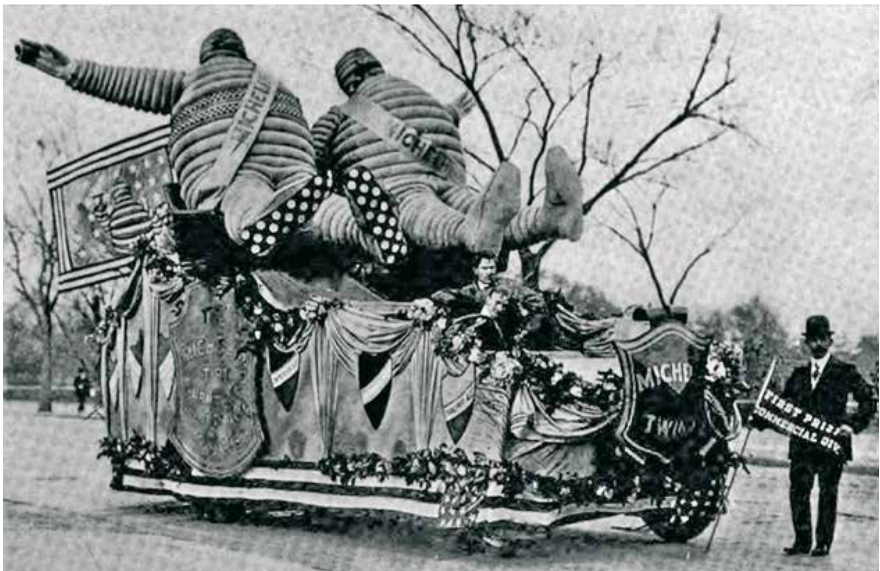
Michelin Tire Company promotional postcard, 1909.

The Michelin Tire Co. was represented in the Automobile Carnival recently held in New York. Their advertising float carried the Michelin Bibendum Twins, which are a huge mechanical device and said to have been hatched by an ostrich and nursed by a cannibalistic maid of Africa on a diet of nails and broken glass. This diet seems to have harmed them as little as such things do Michelin Tires — those marvels of tire durability.

The fourteen-feet-high twins carried off first prize in the advertising department.

The Crescents are beginning to get their baseball diamond in shape for their first home game on May 31st.

A new fence is being erected along the frontage of Mr. J. C. Matlack’s residence on Main Street.

The mission study class under the auspices of the Epworth League will be held in the lecture room of the church this evening, at eight o’clock. A full attendance is desired.

Prayer service was held in the M.E. Church last evening. It was followed by the study of the Sunday school lesson.

We are pleased to hear that Mrs. Wm. H. Kuhlthau, who returned home last Sunday, is steadily improving.

The new home of William Ells, on Van Liew Avenue, is nearing completion.

Prill Brothers have discontinued their wholesale candy route for the present on account of the severe illness of two of the boys.


The Forgotten Years of Bibendum. Michelin’s American Period in Milltown: Design, Illustration and Advertising by Pioneer Tire Companies (1900-1930)

https://diposit.ub.edu/dspace/bitstream/2445/126382/132/26.pdf: This Day in History: May 5th, 1909
AWARD-WINNING DEBUT. The float with the gigantic figures of the Michelin Twins won first prize in the category of
advertising vehicles. The appearance of this achievement in newspapers and generalist magazines as well as in specialized
press of the automotive sector—publically displaying the outlandish figures when the article included images—
turned out to be a a highly efficient promotional tool. Michelin contributed to their own notoriety by publishing
commemorative postcards and press advertisements.  Michelin Tire Company promotional postcard, 1909.

This Day in History: April 12th, 1918

This Day in History: April 12th, 1918

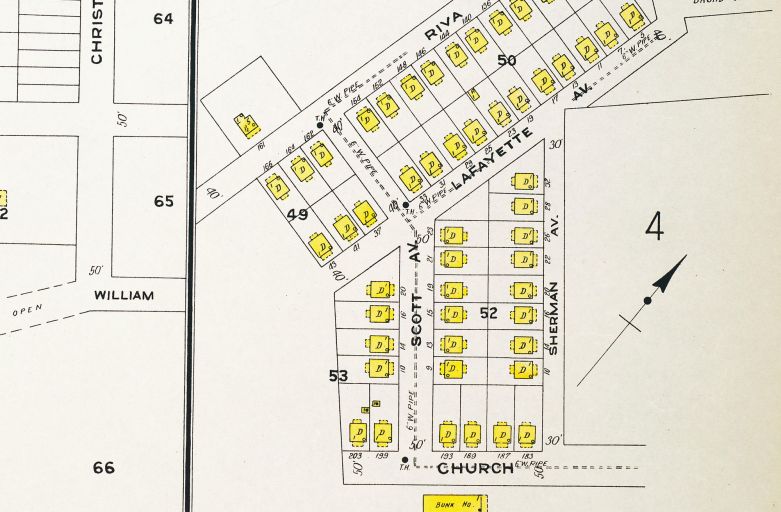
Michelin Tire Co. To Erect Fifteen More Dwellings


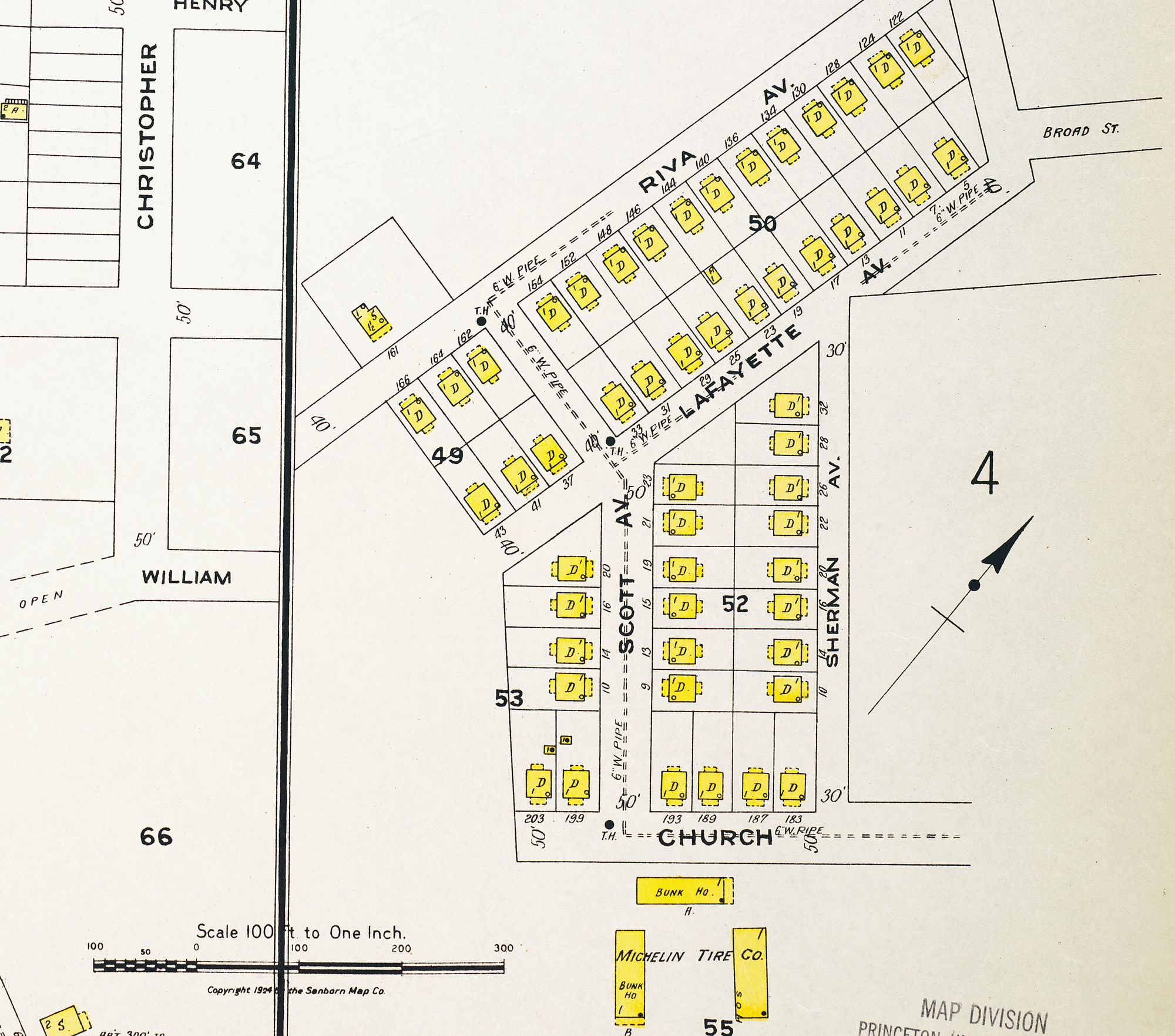
MILLTOWN, April 12. — Evidence of building activities to solve the housing problem in Milltown was manifest at a meeting of the Borough Council on Wednesday evening when application from the Michelin Tire Company was received asking the extension of sewer and water mains on Sand street on the westerly side of Main street, to a point where they propose to erect fifteen more dwellings. There has been some building going on at the Glass Founders Corporation property on Washington avenue but other than this there is little or no evidence of any big building booms during the Spring.


This Day in History April 7th, 1911

This Day in History April 7th, 1911

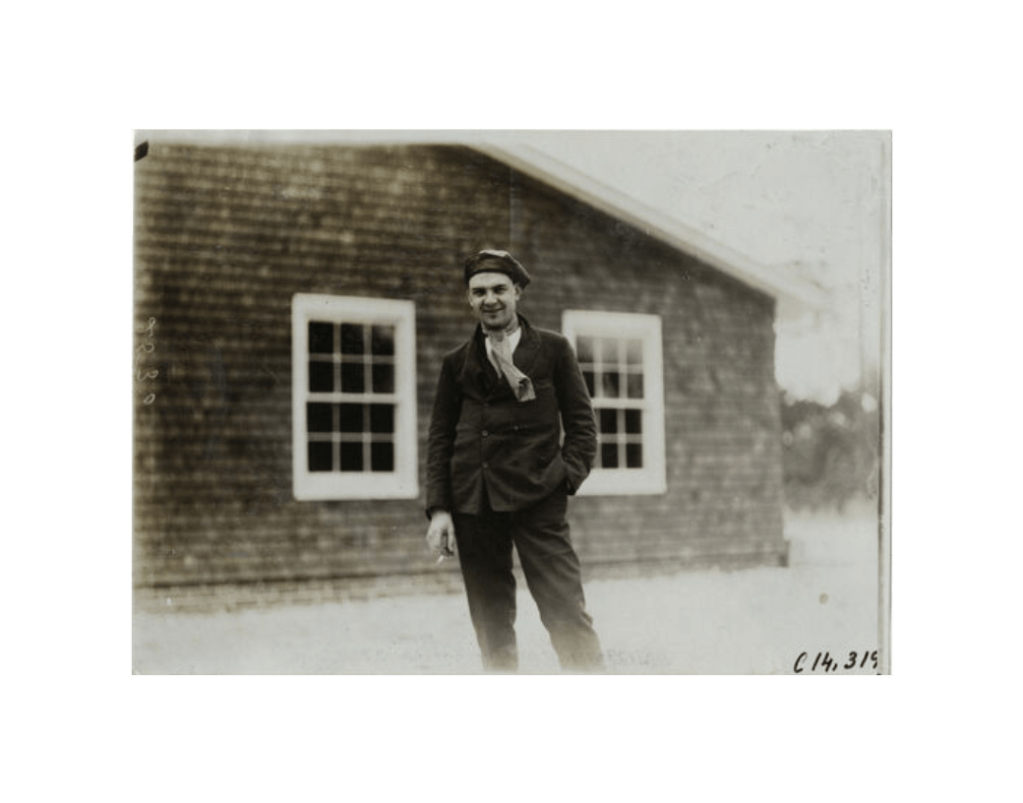
WAS SHOCKED AT MICHELIN WORKS
Aliks Brooks Sues for $5,000, Claiming He Was Not Warned of Presence of Electric Switch—Unable to Perform Manual Labor.


Claiming that he was injured so seriously while at work in the Michelin tire factory at Milltown, last August, that he has since been unable to perform manual labor, and alleging that his injuries were due to the failure of his employers to notify him of the dangerous character of work given him to do, Aliks Brooks began suit yesterday, before Judge Lloyd and a jury, for $5,000 damages.

According to the story told by the plaintiff on the stand, he was instructed by James Gibson, his foreman, to clean the overhead steam pipes in one of the mills, and while crawling along on these pipes he came in contact with an electrical switch, from which he received such a shock that he was precipitated to the floor, 22 feet below.

The witness exhibited a big bruise on the left side of his forehead where he had struck the concrete flooring, and bared his back for the jury to see three large contusions on his spine, which remain as a result of the fall.

Clifford I. Voorhees and Alan H. Strong appeared as counsel for the plaintiff, who is a Russian, and whose testimony was given through interpreter Frankel. Frederick S. Kellogg, of Bedle & Kellogg, a Newark law firm, represents the defendant company.

The jury drawn to try the case consisted of Jacob H. Hoagland, Geo. St. Andrassy, Frank Buote, Joseph B. Quick, Frank Van Nuis, Joseph Deagan, Louis Hildebrandt, Harvey Dey, William Stokes, George Everitt, Charles Holstein and Walter Compton.

Questioned by Mr. Strong, the plaintiff asserted that no one had warned him of the presence of the switch that caused the accident. He said that he had been employed at the Michelin Works for two years and a half, his principal duties being to lift the heavy moulds into which rubber is poured in the making of tires. He was also called upon to act as a general “helper” in any necessity that might arise.

The witness said that he was unconscious for several hours following the accident, and had spent a week in one of the local hospitals. He was confined to his home for a month after leaving the hospital. Upon returning to the Michelin Works, the witness said that he was called upon to wheel coal, which duty he was unable to perform because of his weakened condition.

Later, he had obtained employment in the Old Bridge Glass Works, but found this too arduous also, and he has been out of employment for several months. Mr. Brooks swore that he suffers constant pain, and has been informed by Dr. Selover, of South River, and Dr. Smith, of this city, that he has been permanently disabled. At the time of his injury he was getting 18 cents per hour, his weekly pay varying from $9 to $14, according to the number of hours he had worked.

Under cross-examination, the witness denied that he, with four other employees had waited upon Superintendent Henry Young at the Tire Works, and announced that he wouldn’t wheel coal for a living. He was questioned concerning remarks he was alleged to have made to a fellow employee who accompanied him to New Brunswick in an auto immediately following the accident, but declared he couldn’t remember speaking to anyone at the time mentioned. At this point adjournment was taken for the day.

Can’t Straighten Fingers.
The cross-examination of the plaintiff was resumed this morning, when Attorney Kellogg questioned him at length concerning his sensations when he received the alleged shock.

“I don’t remember how it felt, only I know I was knocked down as soon as I touched the switch.” The witness swore that he is still unable to straighten two fingers on the left hand that came in contact with the electric current, and exhibited the marks on his hand to the jury.

A motion by Mr. Kellogg that the testimony of the plaintiff concerning a “shock” be stricken out on the ground that it was simply hearsay evidence, was refused by Judge Lloyd.

Counsel for the defense failed in an endeavor to secure from the witness an admission that he knew of his own knowledge the dangerous nature of the electric switches near which he was called to work.

Nickola Silka, a fellow workman, testified that he heard the order given Brooks to clean the pipes, and had heard nothing said by the foreman concerning the electric switch.

The witness said that he had accompanied the injured man to the hospital. He had noticed that Brooks was unconscious and bleeding from the wounds in his head and back. Similar testimony was given by Walter Schitz and Joseph Wanslopsky, fellow employees who had witnessed the accident. The cross-examination of these witnesses developed nothing of special moment.

Plaintiff’s Wife Testifies.
Mrs. Alice Brooks, wife of the plaintiff, took the stand in her husband’s behalf. The witness bore in her arms a few months’ old infant and, like the other witnesses, testified through an interpreter. Mrs. Brooks told of the care she had given her husband. No cross-examination.

Dr. J. Warren was called to tell of two occasions on which he had examined the plaintiff since his injury, and declared that he found Mr. Brooks suffering severe pain. In his opinion the injuries were likely to be of a lasting character, as the nerves affecting the muscles of the back were badly injured.


This Day in History: August 27th, 1907

This Day in History: August 27th, 1907

MILLIONS BEING SPENT ON NEW TIRE INDUSTRY


WORK BEING RUSHED ON THE MICHELIN TIRE PLANT DAY AND NIGHT—THE BOROUGH’S BIGGEST BOOM IS NOW ON.

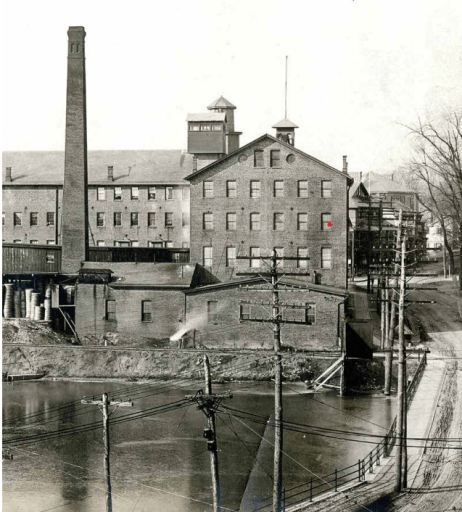
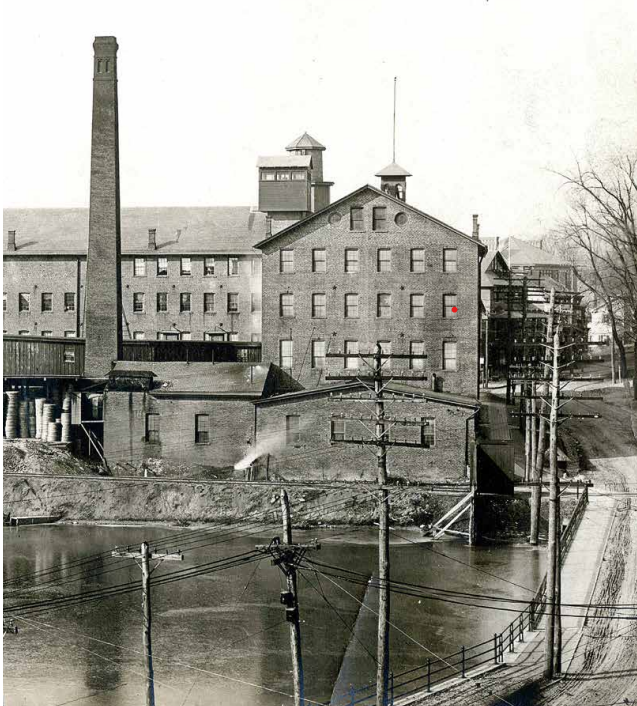
The greatest boom that the borough of Milltown has seen is on foot at the present time with the completion of a part of the new Michelin Tire factory. People are hurrying about and the current gossip is, “What’s going to happen next?” About five hundred men are busy on the job, divided into a day shift and a night shift, hence the work never ceases. The first four sections of the factory, which were begun on June 2 last, and which were specified to be finished about September 1, are well under way and will be in readiness by that date.

People are rushing to Milltown daily in quest of rooms, and these are only to be had at a very high rental.

The new sections will be adjacent to the present structure used by the International A. & V. Tire Co. They are designated as sections Nos. 4, 5, 6, and 7, and their dimensions are: 276 feet by 104 feet; 109 feet by 69 feet; 51 feet by 137 feet; and 81 feet by 104 feet, respectively. Two other buildings, which are to be used in the manufacture of the company’s tires, are known as sections No. 12 and 13. Their dimensions are 82 feet by 104 feet and 124 feet by 104 feet, respectively.
Section No. 8 is a small brick structure used for storage purposes; section No. 9 is to be the engine room; section No. 10 will be the power house of the plant, in which there will be four 500-horsepower boilers and two powerful turbine engines. Section No. 11 will be a repository for benzine.

Machinery from France.

Five large presses and five lathes have been shipped from France to the scene of activity, and the machinery that has been received is being erected with the same rapidity as has characterized the erection of the buildings.

The new additions will give about 80,000 square feet of floor space, and buildings will be erected from time to time as more room is required.

The work is being done by the John W. Ferguson Contracting Co. of Paterson, and George L. Kyle, the company’s superintendent, is supervising the work.

With the completion of the work after the merger with the French company is consummated, the offices of the firm will be moved from Ford Avenue, where they are now located, to the second floor at the corner of Ford Avenue and Main Street.

In all, nine sections have been added to the present plant, whereas only four sections were contemplated when ground was broken on June 2 last. The factory will be run night and day, and will be illuminated at night by 8,000 powerful lamps.

Branch offices of the company will be established in all the leading cities throughout the United States.

Houses will be erected by the firm for employees that they will bring here and every advantage will be offered to those who will make Milltown their future home and engage in work at the factory. Some 2,500 hands will be required when the factory is completed.

The cost of the factory and machinery included will run well up in the millions, but as yet no definite figure will be given out.


This Day in History: May 18th, 1919

This Day in History: May 18th, 1919

Milltown’s Splendid Possibilities for Adoption of Beautiful Civic Plan Shown by Architect and Town Planner of U. S. Housing Corporation

(By H. M. Olmsted, Architect and Town Planner of U. S. Housing Corporation.)

Six months ago the writer was asked by one of the engineers of the U. S. Housing Corporation, what kind of a place Milltown was for one to make it his home. Not having then visited Milltown, I could not answer him. A passer-by overhearing the question, promptly and officiously answered by stating that the town was a mill-hand section and not fit to live in. So Milltown lost the opportunity of gaining one more good citizen.

At the request of the editor, the writer visited Milltown several days ago. The few intervening miles between New Brunswick and Milltown were covered rapidly and comfortably. Arriving at the north end of Main street, we drove to Kuhlthau Avenue and alighting there proceeded on foot over the village.

For a town of which I had heard unfavorable reports, I can only say that I was delightfully surprised at everything I saw, from the moment of my arrival upon its well-paved sidewalks. On every hand one finds substantial and attractive homes—real homes, not imitation ones—real lawns, gardens, orchards, with trees and shrubbery of all kinds in profusion. To add to the effect, there is much water, many brooks, and the lake with its interesting waterfall just below the Main street bridge.

My first, hence lasting, impression of Milltown is that it occupies an envious and unique position in the ranks of suburban towns, as well as in its natural and beautiful surrounding country.

A Stroll Through the Town

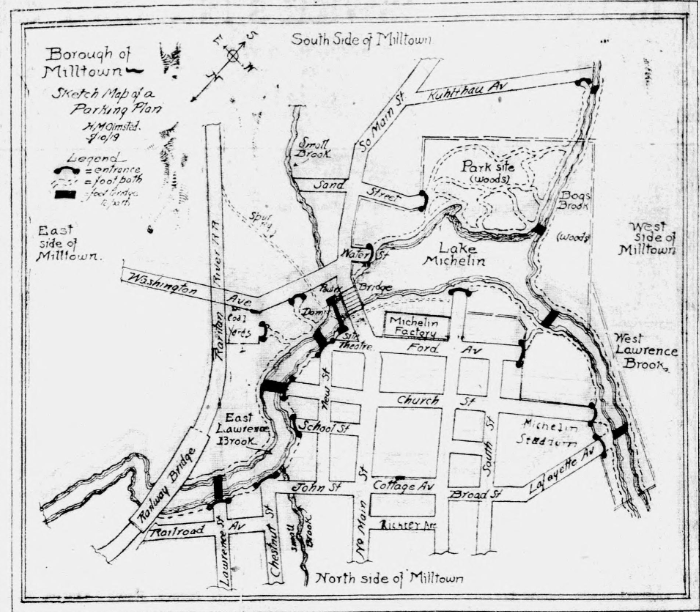
Our way led down Main to Sand street, thence through the woods, south of the lake, to Bogs Brook, back along the shore of the lake, to Main street bridge and waterfalls and from there out over the portion of the town lying north of the bridge.

We saw about 500 real homes with 100-foot square lawns, having gardens, orchards, and grape arbors. We saw some dozen or more substantial stores, several churches, schools, factories, etc.

On every hand the properties are well laid out and excellently maintained. Along north Main street there are many homes which might be called pretentious, were it not for the fact that their owners evidently placed more importance on the value of a “real home place” than on pretentiousness. Holding the same opinion, I agree with that policy.

A “home” is better than a pretense. When one sees so many uniformly charming houses, lawns, and gardens, it is evident that the citizens have not only high civic pride but an excellent knowledge of how a home and a town should be conducted.

We saw but one building actually needing paint and minor repairs, and I strongly suspect that that one was deserted.

Almost without exception, front and rear yards were charming. The arrangement of trees and shrubs was natural and pleasing.

As we passed house after house and found solely trim lawns and gardens, our surprise grew steadily, because here was a town of which we had heard just the opposite of the reality.

Splendid Views Obtainable

Milltown is located in a hilly country of considerably higher altitude than her neighbor, New Brunswick. From these hills and in between them, charming glimpses of the setting of the town are obtainable. The soil is a rich sandy loam and on the sides of the slopes in the woodland are a number of good gravel and sand pits. Water is abundant as evidenced by the lake and its tributary brooks. On every side the eye of the artist and nature lover may drink in sight of a country that charms and delights. At the west end of Sand street along the slopes of the hill there, leading down 100 feet or so to the lake, picturesque views of the lake and its setting may be had. A clever artist could reproduce that scene upon his canvas and command practically his own price for the work.

Standing on the bridge or below the waterfalls, another pleasing view is had of the valley and rising hillside off to the southeast. It was at about such a spot that my business eye lingered for considerable time, on account of its possibilities for the location of a villa building and grounds, which the public might decide to erect and use as a holiday and evening dining place.

On the trestle below the waterfalls, another pleasing view is of Lawrence Brook, as it leaves the falls and winds in and out across one of the prettiest of little valleys, until it finds its way outside the town limits under the railroad bridge, some distance from the falls. Another delightful valley crosses the line of Vanderbilt avenue; its center line carrying a small stream leading into Lawrence Brook. A number of attractive cottages dot the hillside between the Raritan River railroad and Ryder’s Lane.

Along northern Main street are located many spacious and charming homes surrounded by large, well-trimmed lawns. Here, as elsewhere, equal refinement and beauty predominate. I judge the larger places belong to the most substantial citizens of Milltown. These homes are indeed charming.

The Small Cottages

Along Ford avenue or rather boulevard—for in reality, it is a 100-foot or more wide boulevard—with its stately rows of trees, we walked to the ballpark and thence north along South street, past the Michelin line of frame cottages. It is remarkable that here, too, even in these factory properties, with their plots of 50 by 150 feet, we found none but pretty lawns and gardens and all seemed filled with a bounteous supply of flowers and vegetables, sufficient to keep the average family all summer and longer.

A Part of the Secret of Beauty

After repeated exclamations from my wife, she had me inquire of a friendly citizen as to the reason for the unusual uniformity of the beauty of the gardens and homes.

Said the native: “Friend, I hardly know just how to answer your question, because I have lived here so long that it has not seemed unusual to me, however, now that you point it out, I must admit, that it is an unusual sight, when compared with many other villages. I believe the sights which you compliment are due to a number of different causes. First, the citizens of this town take a big civic pride in their town, its government, and their homes. These things mean a great deal to them. Then, too, the town authorities and leading business men as well as the stores and factories have taken a keen interest in having this town a home-like and beautiful place, and they have succeeded. The people are united and back of the movement.”

Prizes for Gardens and Homes

Continuing, the citizen informed us that the authorities and factories had a regularly constituted prize committee, and that it was the custom to make unannounced visits to the homes and gardens of the citizens and award substantial prizes, not only for the best lawn and garden but for the best-kept house, both exterior and interior.

This competition, aided by a strong spirit of civic pride, had caused a wonderful change in the town. He told us that twelve years ago, the streets of the village were overgrown with grass and weeds. If this is correct, then indeed, a miracle has been wrought and it is doubtless due not only to the cooperation of citizens and their authorities but to a much bigger and finer thing, namely, a refinement of brain and heart, which evidently exists throughout the village, else all we witnessed, could not have been accomplished in so brief a period.

Improvements Contemplated

Another citizen stated that a number of improvements were in contemplation. In the main, these consisted of a new pavement on Main street, both north and south of the bridge, and a brand new theater building where only first-class pictures will be shown and at merely a nominal cost as compared with the prices obtained in other towns.

Sidewalks and curbs are being laid in the town as fast as necessity demands. As to the roads, I judge the sandy-gravelly earth where no pavement exists prevents a muddy condition, so that unpaved roadways are not such a bad feature as one might be led to suppose. Even without more concrete roadways the city is pretty well off as it is in this respect. It would be an unusual condition, indeed, if the town should determine to concrete pave all of its streets, but I would not be surprised to learn that such a step was contemplated.

Government of Milltown

I was informed that the town is governed by a mayor and board of councilmen, and that the town owns the power plant, a perfect sewer system and water plant as well. The sewer system cost over $100,000 to construct.

Milltown is exceedingly thrifty. It maintains a good bonding margin and is, I believe, practically free of indebtedness. This shows excellent management. Should a new pavement be laid in Main street, there will doubtless be a straightening and realignment of all curbs and gutters. In connection with curbing, it is worthy of comment that in the thirty or more U. S. housing projects, erected during the war, the streets of such projects invariably had installed a one-piece concrete curb and gutter, curb being six inches thick with an 18-inch wide gutter. This was made for pleasing effect and perfect alignment.

What the Future Might Bring

It would not be surprising to learn that the citizens of Milltown had decided to take a stronger grip on their opportunities for home and civic advancement and would soon start a larger campaign to utilize all of their storehouse of opportunities surrounding the town. If such a movement is once started, then in my opinion, their village will assume rightfully a leading place throughout the entire state in the matter of prosperity, civic progressiveness and attractiveness.

From the viewpoint of the town planner and landscape architect, Milltown has a long way to go ‘ere the possibilities for further advancement be exhausted. This is due to Milltown’s natural resources and her surroundings.

Town Planner’s Viewpoint

Regarding Milltown from this point of view, I should say that her future is fraught with excellent possibilities. I noticed that the center of town seems to be at the bridge and here almost nothing in the nature of real town planning or improvement has been done. The bridge, Main street, the lake, brooks, falls, and woods south of the lake present an excellent array of points upon which a good start might be made if such were the wish of the citizens.

As your town grows in population and prosperity it must progress, as every thinking man knows, or it will lapse upon itself and go backwards. So along the thought of a progressive policy, naturally, it occurs to anyone engaged in town planning that after the repaving and realigning of curbs etc., along Main street, a natural thing to do would be to erect along that street electric light standards at intervals of, say, 15 feet, each one having a cluster of globe lights. This one step would transform the street into a beautiful boulevard—make of it a delightful promenade in the evening and would have the effect of advancing prosperity by attracting more business to stores in the town. Another thought, which will occur to everyone, is that all of the large buildings near the bridge might, with almost no expense, plant English ivy and shrubbery across the front, sides, and rear of these buildings, and thus make them pleasing and charming to the eye of the citizen and the motorists who pass that way in ever-increasing numbers. This refers particularly to the Michelin factories, the power plant, car barns, and two large hotel buildings just south of the bridge.

I am sure my readers will not think me guilty of naming any superior knowledge or too personal assertiveness in this matter, because no doubt the people and authorities of Milltown have long thought of these possibilities and may even now have them in process of installation, but as one requested to write on the subject, I am sure no offense will be taken in exposing the natural thoughts likely to occur to everyone at the same time.

The Bridge and Water Falls

What an artistic setting for a town bridge of concrete with separated pedestrian and vehicle passages. With clusters of globe electric lights strung along each side of it and to add to the effect, an eastern and western walkway, leading on either side and from the summit, below the waterfalls. With a few concrete benches and concrete flower boxes properly arranged, that spot would be indeed artistic and effective as a natural center of the town.

A Site for the Theater

Doubtless such a site has been decided upon, ‘ere this, but the thought came to me unaided, that rose bespied by the old mill building or remnants at the waterfalls. The lot north of the power plant also might be cleaned up and made very charming.

A Site for a City Park

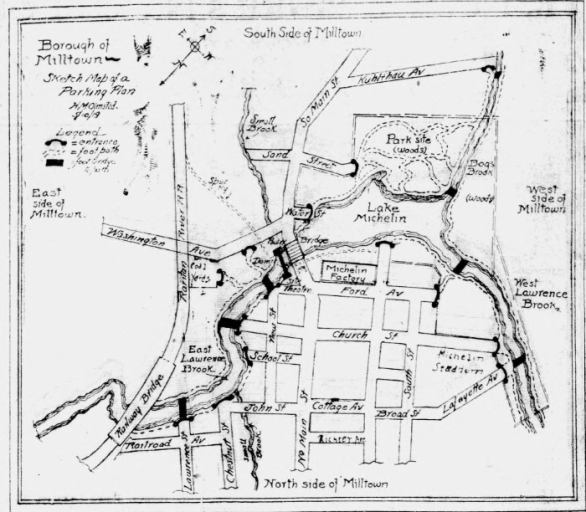
I feel certain that the idea has long since been advanced to build a city park in the large woodlands south of the lake. It is an ideal place, and I have endeavored to roughly complete my thought in this matter in the drawing accompanying this article. This plan illustrates a parking system devised to take in both branches of Lawrence Brook, and using both would also take in Bogs Brook, besides three sides of the lake, the bridge, and waterfalls, and all of the woods west of Main street and other land west of the lake as well as Lawrence Brook to the Raritan River railroad tracks. The plan would afford three Main street entrances to the woods, namely Pond, Sand, and Bogs street, besides would be entrances to the public along the brook from no less than 10 streets and areas.

Of course, the average citizen will throw up his hands and say that such a project is impracticable and that other rights are involved and that it cannot be done and all the comment will be against it, but then, it could be done, providing all of the people agreed upon it and the plan was wanted. As for the expense, it would be practically nominal, for the work to be done, outside of the securing of the land. The land requirement might prove a stumbling block, but under intelligent cooperative direction all of the people could be brought into accord on the plan and the project would attract the state’s attention with interest over the newness and attractiveness of the scheme. Besides this, I was assured that the 500 people of Milltown would take pride and happiness. It would bring to Milltown a desirable number of new citizens with their scale of prosperity.

I know of no plan so effective and so slight in cost to place Milltown in the center of all New Jersey in point of progressiveness and attractiveness. I am not Job’s comforter when I write this because I also have under contract to help better a city like the one which the Housing Corporation has built in New Brunswick, and which is now tenanted, though only so completed after a month of hard work. I am writing this because of love of the work, and because we and all the corporations run by and for their city’s happiness.

In next Sunday’s Times, the writer will continue the foregoing article and tell of the unique history of this fine water supply, the importance of street lighting, bounteous trees and shrubs, beautifying the factories, thought of a restaurant, and summary of the advantages of the borough.

A Stranger’s First Impressions of Milltown Borough

Briefly put, here are the impressions that came to H. M. Olmsted, architect and town planner, when he visited Milltown, our neighbor, to give The Sunday Times his ideas of its possibilities for the adoption of a civic plan. He found:

A clean, orderly, tidy place attractively situated on high ground with unusually pretty surrounding country.

A town with remarkably easily adaptable advantages including a pretty lake, which could be a feature of a charming park.

A town with a fine street for the principal thoroughfare to be ideally set off by the use of clusters of electric lights on street poles, etc.

Plenty of civic pride, and encouragement to keep it up on the part of town officials.

Well-maintained homes and pretty gardens, vastly improved through the stimulus of prizes offered.

Plenty of plans for future improvements in the town that show an interest in making Milltown grow.

Big possibilities that would follow the adoption of a new name for the village.

A healthful place with a climate that holds great possibilities for making it an ideal residence place.

That beautifying factories would do a whole lot to promote the town’s attractiveness.

An idea for a wayside restaurant that could be run on a cooperative plan.