MILLTOWN SEWAGE PLAN DISAPPROVED Council Appoints Advisory Water Commission to Carry Protest Against Lawrence Brook Pollution to State Board of Health.
Following a strong appeal from the Advisory Water Commission last night, Common Council passed a resolution, offered by Alderman Goodwin, protesting against the plan Milltown has evolved of sewering into settling beds along Lawrence Brook, because it is believed that the overflow would still pollute the stream.
Mr. Goodwin also moved that the advisory commission be named to carry New Brunswick’s protest to the State Board of Health. This motion was carried and Chairman Burt appointed the commission. The members are: Drury W. Cooper, Alfred E. Titsworth, Alfred S. March, Eugene P. Darrow, W. H. Benedict and Frederick Schneider.
The communication of the Advisory Commission stated that Milltown had filed plans as stated above which the Commission deemed dangerous to the water supply, and likely to bring the city’s name into bad repute. The commission suggested that Council demand a hearing in the matter before the State Board.
Commissioner Darrow was given the floor to explain the matter more fully. He said that Milltown proposed to sewer through a 15-inch pipe to a point just below where the Raritan River Railroad crosses Lawrence Brook, into three settling tanks, each of 30,000 gallons capacity, and overflow into four filter beds with a three-foot layer of sand and gravel, and finally discharge into the head of Weston’s Mill pond. The distance from the sewage bed to the pond would be 100 feet, Mr. Darrow said.
“The discharge would be pure when treated,” Mr. Darrow continued, “but when floods came the plant would not work properly. The thick sediment from the sludge beds would be washed into the pond. We consider this plan dangerous and certainly not creditable to the city, and that it can be avoided. We recommended to the city that the sewage be pumped to a point below the pond, and still favor that plan. The city should take some action to protect the water supply, and we believe that if this is done some other plan will be provided. The city is in a position where it can fight the matter successfully.”
Give and Take. “Milltown feels that if it puts in a sewerage system it must have a water supply. The town also thinks that as New Brunswick is to be benefitted it ought to bear a portion of the expense.
“One suggestion is that if Milltown puts in the sewerage system, New Brunswick should give the town a water system, charging the same rates as in New Brunswick. Another suggestion is that New Brunswick pay the cost of filter beds for Milltown.
“Besides an official protest to the State Board, there should be a conference with Milltown officials as to the best way to get together in the matter.”
A protest against the Milltown plan was also received from the Filtration Commission.
Assistant Superintendent to Replace Work of Borough Clerk and Official Tapper — Other Items at Council Meeting.
MILLTOWN, Jan. 12 — One of the most radical, though economical and efficient changes in the administration of borough affairs took place at a regular meeting of the Borough Council last night when Councilman William R. Evans offered resolutions in behalf of the finance committee, abolishing the collection of electric light money and water rents by Clerk R. A. Harkins, for which he was annually paid $450, and at the same time abolishing the engagement of Henry A. Christ as official tapper, creating a further saving to the borough of $1.50 for every tap made.
A third resolution by the same committee provided for engaging John T. Barlow, of this place, as of January 15 to act in the capacity of assistant to Superintendent Samuel Spears, to act as tapper under the direction of the superintendent and also to take care of collections of water rents, light money, and general assistant to the superintendent.
The salary of the new man was set at $720 per annum, but when the matter of salary of $450 paid to the clerk for collection of water rents and light money is taken into consideration it will bring the new man’s salary down to $270 without taking into consideration what the borough might save on each tap that is made and furthermore the borough will have the services of a much-needed assistant to the superintendent in case of sickness, accident, or other difficulties that may arise.
In connection with this change, the adoption of a new system of keeping accounts was also advocated and passed upon, the same to take effect at such time when the proper stationery, etc., is procured.
At the time of the installation of the sewer and water systems the borough council purchased a tapping machine which had been used by the official tapper at a small rental to the borough for each tap made, thus the borough will not be put to any additional expense in this direction but will benefit by an increased profit for each and every tap made.
The surprising change was not made for any political reasons, but from the interest of the borough from an economical point of view and the officials are deserving of praise for their action, which no doubt will be viewed by many as a wise move.
While the assistant superintendent will take up his duties on the 15th, no definite time has been set for the expiration of terms of present collectors of water rents and light money although it is anticipated it will take place shortly after the old year books are audited and the new system is inaugurated.
Another change was made at the meeting last night in so far as giving the superintendent authority to direct the work of the general utility man. This action was also taken with a view of a saving to the borough in many instances, and also with a view of having someone who is on the job all the time to account for the actions of those employed by the borough.
An Ordinance
An ordinance to amend an ordinance to regulate the use of water rates in the Borough of Milltown was adopted on the first and second readings last night, the document setting forth that all bills for water shall be payable to the superintendent of public works quarterly, on the first day of March, June, September, and December; in each year, and if not paid within thirty days thereafter the water shall be shut off and will not again be turned on except upon payment of the arrearage, with interest at the rate of six per cent per annum, and an additional fee of one dollar for turning on the water, and that before water is turned on for building purposes a payment of three dollars to the borough is required. The ordinance is to take effect immediately.
Upon a request from Van Liew avenue residents council authorized the street committee to place several loads of ashes on the sidewalk through the well-known gulley on the avenue.
From complaint received the clerk was authorized to notify C. W. Kuhlthau to have the sidewalk in front or near his place of business put in condition for pedestrians.
A check was received from the Employers Liability Assurance Corporation on account of injuries sustained by Superintendent Samuel Spears in falling from a light pole sometime ago.
Better Trolley Service?
Better trolley service was another matter which was briefly brought before council at their busy session held last night and after hearing many complaints as to the manner in which extra cars are run, the overcrowded conditions of cars during the rush hours, the non-compliance with the borough’s request to stop at street corners, etc., a motion was passed that the clerk write Mr. Gates, asking what night during the next two weeks either he or his representative could meet with the councilmen to thoroughly discuss the problem of interest to the residents of Milltown with a view of getting satisfactory adjustment to all.
That the councilmen mean business in this instance is emphasized by the fact that they propose to take it up with the State Utility Commission if they cannot get an adjustment otherwise.
The bonds of Recorder Jos. A. Bradley and Marshal Jos. F. Ruppert, Sr., were received and approved.
Charles Bauries, chairman of the light committee, reported that Mack’s garage had been connected up as well as Michelin House No. 52 during the past month.
While the books of the collector and treasurer have not as yet been audited reports rendered last night showed a balance of $34,341.10, of which $1,800 of this was secured interest derived through the wise disposition of sewer and water bonds. This balance is accounting for many of the ideas now under way in the way of town improvement. Upon the judgment of the reports as to the legal end recent financing of the borough is practically self-sustaining.
The total receipts during the past year were entirely sufficient to meet all growth of the borough and obligations incurred through the increased expansion of improvements without affecting the ideas of the estimated amounts to be used, it is intimated.
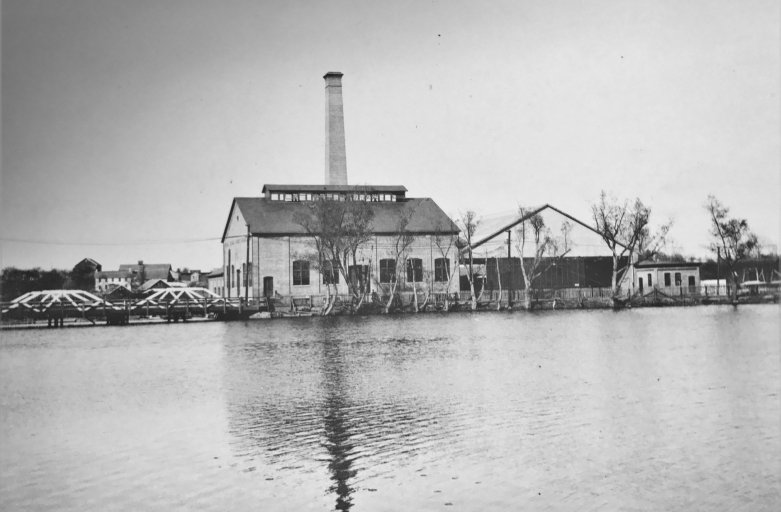
The concrete arch dam for the city water supply has been completed and is now ready to be put into service so the supply of stored water will be largely increased. The dam is located six hundred feet above the old dam and is built in the form of an arch spanning the mill pond from bank to bank. The spillway of the new dam is two hundred feet in length which is forty-six feet longer than the spillway of the old dam. The new dam will raise the water behind it four and a half feet higher than the previous level of the pond and will back the water as far as the dam at Milltown. The water in the new pond will overflow forty acres in addition to the area now covered. most of which is located between. Ryder’s Lane and Milltown. The amount of water which was available in the old pond which could be drawn to a depth of five feet below the dam was 87 million gallons. The new dam will add 146 million gallons to the capacity of the pond so there will be an available storage in the Weston’s Mill pond of 233 million. gallons.
The dam is built in the form of an arch. This form where the site is suitable makes it possible to build a dam with greater strength with much. less material than the form of dam which depends on the weight of the structure only to resist the water pressure. The older type of dam usually has a factor of safety of two while the arch dam which has been constructed has a factor of safety of ten. An unusual feature of the dam was that it was constructed in the water of the pond which was over eighteen feet deep and which could not be drained on account of having to maintain the city water supply during the construction of the dam. The construction under these difficult conditions was carried on by building the dam in twenty-five sections which were surrounded by a tight cofferdam of steel sheet piling.
Concrete Poured in Movable Forms.
After pumping out the cofferdam the concrete was poured in movable forms which were used for the whole. structure.
The dam has a spillway with. a length of 200 feet which is held by abutments of twenty-five and thirty feet in length at the two banks. The j dam rests on the solid shale rock and the abutments reach to the shale in each bank. The crest of the dam is three feet wide and the base is nine) feet wide. The height of the dam in the pond is twenty-three feet. The normal difference of water level above and below the dam is four and a half feet but the structure is designed to hold the water for the full height of the dam if the water in the lower pond is entirely drained.
In fixing the location of the structure complete plans and estimates! were made for the dam as built and also for raising the old dam. It was found that it would take more labor and material to raise the old dam than to build an entirely new structure in the adopted location. In addition to the cost of the work there. would be a very great risk of accident during the construction of the dam which might wipe out the pumping station. There would also have! been the work of caring for the ice;” house property which was located Just above the old dam and which would have involved serious expense,
The question of additional storage has been a pressing one for sometime. In 1911 the advisory water commission, the members of which were Drury Cooper, E. P. Darrow, W. H. Benedict, A. A. Titsworia, F. C. Schneider and A. S. March, strongly advised the immediate raising of the present dam three feet to provide the additional storage. They stated. at
that time that this would take care of the immediate need and that additional provisions could be taken after some years had passed. The present structure raising the level of the pond four and a half feet adds over) fifty percent to the additional storage contemplated by their recommendations.
Plans Made in 1914.
The plans for the dam were made! in 1914 at the time of the serious water famine which occurred in:” September of that year and it was strongly urged that the structure be, built at once so sufficient water could be stored to prevent the recurrence. of the shortage. On account of the authority to build being withheld je from the Board of Water Commissioners by the Board of Aldermen, the work was postponed until Commission Government took hold of t matter. The building of the dam was again postponed by the judgment of the advisory water board until after the completion of the filter plant as it was thought that building operations would cause the water to be made turbid. The work was finally started in the fall of 1917, The necessity of the work was shown last fall when all of the storage was used up and temporary pumping was required from the creek below the dam to maintain the necessary amount of water.
During a dry time all the water required beyond that furnished by the flow of Lawrence brook must be taken from storage. The flow of the brook was estimated by the state as given in the report on water supply as a minimum of five and a half gallons a day for the driest period. This estimate is largely in excess of the actual amount which was observed in the dry periods of 1914 and 1918. A careful measurement of the individual streams of the watershed. show that the minimum flow of the Lawrence brook area amounts to only 1,800,000 gallons for 24 hours. The consumption last September, due largely to war conditions perhaps, required seven million gallons a day so five million under these conditions must be taken from storage. City Can Supply 100,000 Population With Water by Damming Near Milltown.
When the water consumption of the city again exceeds the present provision additional storage will have to be sought by a dam somewhere above Milltown or by taking water from the Raritan River. The late Dr. Cook reported on a project for a high dam at a site near Parsons pond which would impound 1,640,000,000 gallons of water. The cost of the dam at that time was $347,000, but under present conditions, it would be two or more times that figure. As everyone has great faith in the steady growth of the city of New Brunswick which is largely dependent on the water supply the necessity of looking! forward is apparent. With the above] storage a population of 100,000 could be supplied with an adequate amount of water.
Advisory Commission Recommends That City and Borough Get Together- Pollution of Lawrence Brook New Brunswick’s Greatest Danger.
Co-operation with Milltown on the basis of a bargain by which that borough may obtain a water supply from this city in return for its establishing a sewage disposal plant to prevent contamination of Lawrence Brook, is the fundamental plan proposed for the purification of the city water supply proposed by the Advisory Water Commission to Common Council last night.
A filtration plant is also recommended, but as a matter of secondary importance “The necessity does not depend,” says the report. “upon present conditions at Milltown, for that situation must be changed in any event. But that (pollution) being eliminated, a suitable filter will not only tend to protect the water from sporadic or possible contamination elsewhere, but will remove vegetable matter which now causes objectionable color, odor, and sometimes taste.”
The commission as side issues recommends the raising of the dam at Weston’s Mills three feet to increase the reserve supply and also the reformation of rates by which Highland Park is supplied, that borough actually getting water cheaper than the inhabitants of New Brunswick.
In the event that the Milltown pollution cannot be stopped, the commission recommends a storage reservoir at Parson’s pond, which would cost the city $347.000, or about three times the estimate for the purification and filtration plant. The artesian well plan is dismissed because of uncertainty as to amount of supply.
The Commission.
The commission, which was appointed on April 17 last, consists of Former Mayor Drury W. Cooper Eugene P Darrow, William H. Benedict, Alfred A. Titsworth, Frederick C. Schneider and Alfred S March
The commission visited Council in a body last evening, and the report was presented by its president, Mr. Cooper, who expressed the thanks of the members for the honor conferred upon them, also for Council’s support in the matter of appropriations for necessary expenses, of which, he said. a balance would be returned to the city.
“Our recommendations,” said Mr. Cooper, “do not entail the expenditure of any great amount. We have not sought ideal conditions, but simply to advise the city to under- take just such work as is actually necessary
“The report lays particular emphasis upon conditions at Milltown. which are not due to any fault or intention on the part of Milltown, nor to any inattention on the part of the officials of New Brunswick, but to the ordinary growth of the neighboring community. We hope that means will be found, acceptable to all parties, so that the matter can be attended to with the least possible expense and trouble”
Milltown Mayor Willing.
City Attorney Weigel, who is also borough attorney of Milltown, said that Mayor Conrad Richter, of the latter place, had attended sessions of the commission, and had informed him of an intention to appoint a similar commission in Milltown to consider a disposal plant.
On motion of Mr. Ridgeway the report was received and referred to the Finance Committee.
The report in its opening reviews the history of the commission and says that co-operation by Milltown was invited, but that the commission did not feel justified in waiting longer than it had for such co-operation. Continuing the report says:
Possible Sources of Supply.
“Aside from the present source of supply, we have Investigated the Raritan river and the driving of artesian wells. The river, while furnishing an abundant supply, is harder in quality of water than Lawrence Brook, besides containing a greater percentage of mineral matter, and showing higher color: in addition, it is open to the same objection raised against the present supply: Danger of pollution from settlements above us
“Repeated attempts have been made in this vicinity by private users to drive artesian wells, but the results are far from encouraging
“On the other hand, the city now enjoys water of admirable softness. supplied by a system that has been enlarged as the city has grown, and drawn from a water shed having much less density of population than the Raritan valley; there is an investment of more than $150,000 in the present pumping station and its mains to the reservoir, which would be lost if the supply were changed.
“From these considerations (which have been greatly amplified in the commission’s investigations) It is clear that, unless serious objection be raised, regarding either limitation of present supply or unavoidable pollution, the city should not change either to river or to driven wells,
“The city’s supply is drawn from the lowest of a series of five ponds, the highest of which lies on the south side of the Pennsylvania Railroad’s main line, a little more than a mile east of Monmouth Junction. The storage capacities of these ponds, as now dammed, are given in the following table:
Pond No. 1 . . . . . . . . . . . 26,542,000
Davison’s Pond . . . . . . . 10,557,000
Parson’s Pond. . . . . . . . 39.455,000
Milltown Pond . . . . . . . 9.765,000
Weston’s Mill Pond. . . 130.399,000
Total . . . . . . . . . . . . . . . .226.718.000
“From this it will be seen that, of the total stored by dams now built on the watershed, more than one- half is in our own pond: secondly, that, although it is the lowest of the series, its storage capacity is only equal to about 5 days maximum production of the entire shed, or cording to the estimates of the State Board: furthermore, that our pond holds less than 50 days’ supply at the present rate of consumption-in other words, that the amount actually stored behind the present dam would last the city a little over a month If the flow into it should stop.
“We are clearly of the opinion that the capacity of the city’s storage should be substantially increased by one of the plans that will be discussed presently.
Character of the Water.
“As stated above, the water is of unusual and most desirable softness, and so is especially adapted to domestic and factory uses. It teems with organic life, both animal and vegetable Something like 15 species of alga and other forms of vegetable growth have been identified. From the changes incident to the life and growth of these organisms arise the color, odor and taste which at times reach a point where they are very objectionable and deleterious
“Color, odor, and taste are chiefly. the results of decaying vegetation On the average there is very small mineral content.
“These objections, while serious enough to require attention, are of far less importance than the matter now to be considered.
Sanitation.
“Were it not for Milltown and the dangerous and intolerable nuisances there, our citizens need have no special anxiety as to the contamination of their water supply
“The conditions at Milltown are these:
“Some 2,000 people dwell on the banks of Lawrence Brook, about the dam of Milltown pond: there are the large rubber mills of the Michelin Tire Co., situated just above the dam: a card factory and the power house and car barns of the Public Service Corporation just below it: and several hotels, all crowded close to the water’s edge. The borough has no sewerage system, so that the danger of fecal matter flowing, by natural surface or subsoll drainage, into our water supply, is constant and growing. The daily washing of cars in the car barns and a large number of employees daily at the factories augment the danger. Part of the surface drainage from Milltown is into the pond above the dam. Part below the dam and directly into Weston’s pond
Superficial examination shows a number of pipes leading from the Michelin factory to or into the water and a free discharge of more or less offensive fluid from them.
Analysis of Samples.
The report then tells of analysis of duplicate sets of samples taken on June 7 last, one set being submitted to the State Board of Health at Trenton, the other to Prof North and Mr. Doryland, of Rutgers
Present Conditions Are Dangerous.
“The only safeguards that New Brunswick has at present from an epidemic of any communicable disease affecting the Intestinal tract- typhoid and typhus, for example, that may exist in Milltown are, first. the two miles or so of flow down the city’s pond; second, such rough and ready means as are now employed at the pump house to purify the water before drinking it. But these means are Inadequate.
Thus, with reference to treatment of water by calcium hypochlorite, where the water is not filtered, there may be minute particles of matter enclosing bacteria which are not affected by the chemical, besides, there is always danger of incomplete mixture of hypochlorite with the water in any scheme of application. We believe that this means of treating our water should be continued pending the permanent improvements referred to.
Likewise, the two mile now in our pond, although sluggish and thereby increasing the tendency to self purification by exposure to air and sun- light and by sedimentation, is insufficient, according to experience, to eliminate colon or typhoid bacteria. It is understood that in the case of the typhoid epidemic Scranton, Pa. the bacilli were carried a greater distance than that, while a recent writer cites a similar epidemic that caused 69 deaths out or a total of 1.067 typhoid cases, which was traced to sewage from towns and mills dumped into the water supply at various points the nearest of which was only about eight miles away”
The boiling of water is, of course, efficient, but as it makes it unpalatable in many mouths, imposes an easily shirked duty upon those who are either indifferent or already over-burdened with household cares, and distributes among all the inhabitants a duty or an essentially public nature, this safeguard is least of al to be relied on.
The Remedy.
“The question naturally arises. why should Milltown be permitted to pollute our water supply and thus constantly menace the health of New Brunswick? Apparently, the only answer is, that what is everybody’s business is nobody’s business.
“Ample authority to Institute suitable action to suppress such nuisances was given the Board of Water Commissioners by the statute under which the City acquired the property and franchises of the New Brunswick Water Company, which company by the statutes of 1859 and subsequent years had been clothed with very extensive and valuable powers to establish and acquire water-rights in Middlesex and Somerset Counties.
“Although, by some recent legislation, the State Board of Health is given the power to initiate and enforce action to prevent or stop pollution of the potable water within the State, nevertheless the health of the city should not be jeopardized because of the laxity or inaction of any State authorities.
“The prime requisite to any scheme of betterment is the total elimination of pollution by sewage at Milltown in our judgment, this can be accomplished only by the erection and maintenance by Milltown of a sewage disposal plant, located at some point outside the water-shed of Lawrence Brook.
Recommendations
In the present are your Commisions recommended to following plan as
Adequate to meet all present conditions, and future requirements, so far as they are now foreseen:
“1. That the pollution by sewage at Milltown be eliminated by persuading or encouraging, that Borough to erect a sewage disposal plant outside the water-shed.
“2. When that is done, we recommend that the dam at Weston’s Millpond be ramed 7 foot in height. This will increase the storage capacity of the pond from 120,000,000 gallons to 200,000,000 gallons approximately, Because of the step banks this would not materially widen the pond or overflow adjacent lands. The advantage of this will be not merely in the increased available — which in seasons as dry as that of 10 would be immensely valuable to the city but, regulating the flow of the stream will give greater opportunity for sedimentation, and consequent self-purification of the water.
It is estimated that the cost of the work necessary for the additional height of dam and retaining walls the sides of the pond will not exceed fifteen thousand dollars $15,000, or fall below thirteen thousand dollars $13,000.
“3. The necessity of filtration does not depend, in our judgment, upon the present conditions at Milltown, for that situation must be changed in any event. A filtration plant should not be relied upon to safeguard against manifest pollution. But, that being eliminated, a suitable filter will not only tend to protect the water from sporadic or possible. contamination elsewhere, but will remove vegetable matter which now causes objectionable color, odor and sometimes taste,
“4. In the event that sewage at Milltown cannot be dealt with as heretofore recommended because of legal obstacles not apparent from our Investigations, or because those charged with the duty of acting fail to protect the city’s interests, there is no safe recourse for the city except to acquire land and build a large storage reservoir at Parsons Pond, and pipe from there to our present pumping station. Provisional plans and estimates were made for such a scheme some 30 years ago by the late Dr. George H. Cook and having reviewed his plans and figures (which are filed herewith, we are of opinion that his estimate of maximum storage capacity of 1,640, 000,000 gallons and of probable cost of $347,000, including cost of land, dam and piping, are fair and just now.
“But this plan is open to patent objections; among them these: It saddles upon the city an expense that Is avoidable if pollution at Milltown be eliminated; it does not avoid the necessity of filtering in order to rid the water of odor, color and taste: and it reduces the drainage area by more than 25 per cent and that means a lowering in that proportion of the average daily flow available for our uses, in dry seasons.
“Such a storage reservoir may, in years to come, be necessitated by large increase In population, as an auxiliary to Weston’s Pond: but no such necessity now exists, in our Judgment.
“5. Contain matters of relatively minor importance claim attention. The city has the right to assess and collect water taxes on all lands fronting on lines of pipe, whether or not the owners use the supply. We understand that this power has not been exercised in the practice of the Water Department.
“The city at present delivers water to the neighboring Borough of Highland Park at less net rates than in our own city. We have examined the contract, executed about two years ago, and find that, upon its face it provides for equal rates in both places; but Highland Park taxes our city for the value of the piping system that is laid there, so that the Borough has a preference despite the facts that our citizens own the plant, and that the average distance of delivery in Highland Park greatly exceeds the average distance of delivery to our own townspeople. We can find little to commend in the terms of the Highland Park contract: In case of threatened famine. this city should have a preference In the use of its own water, but that is specifically excluded: no lien is given against property in the Borough for unpaid water rates, so that the city’s ability to collect seems to depend entirely upon the willingness of the users there to remit; and apparently no right is given our Board to charge property there that abuts our lines unless the owners connect with them. We strongly recommend that, if possible, this contract be rescinded, or reformed, in order to give New Brunswick its due.
“It is believed by the members of this Commission that, with the improvements in plant that we have recommended, the Borough of Milltown may agree to take water from our plant. For obvious reasons, It has no present interest In doing s But if that Borough will remove its sewage from the watershed, Its suspicions of the purity of the supply will be gone; and, it if then becomes a customer of our water department, the individual and collective interest there in avoiding pollution, will be as great a sin this city.
“Without making a specific recommendation on this point, we leave it to the good judgment and self-interest of both communities to determine whether co-operation is not the best course. Having examined the physical conditions, we are satisfied. that a workable scheme is entirely feasible
Respectfully submitted, DRURY W. COOPER, Pres, EUGENE P. DARROW WILLIAM H. BENEDICT, ALFRED A. TITSWORTH, FREDERICK C. SCHNEIDER, ALFRED S. MARCH, Sec. November, 1911.