The Interesting History of The Pneumatic Tire, Which Dates Way Back to 1845
(By R. B. Bramwell.)
In reply to the request of the Home News the writer takes pleasure In writing an authoritative sketch of the pneumatic tire, going away back to 1846 when the pneumatic principle was first adapted experimentally to the wheels of road vehicles, and taking up the story again forty-three, years later, when the development of the safety bicycle revived an interest in a tire more resilient than the ordinary solid rubber tire of that period, and contributing to a later era when the pneumatic was first applied to automobiles.
The story is a romantic tale, like so many stories of the early struggles of the pioneers, whether they be adventurers for adventure’s sake, or pioneers cast In the more practical mold of Industrial discovery and Invention.
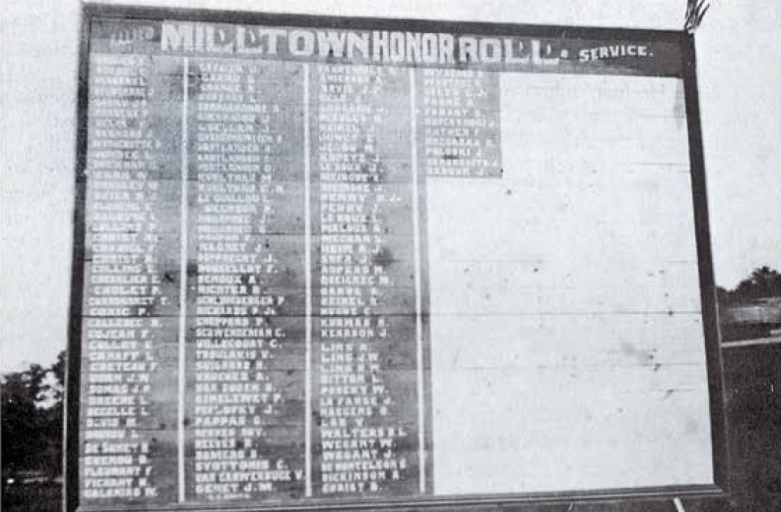
Furthermore the story of the pneumatic tire is of particular interest to New Brunswick readers, as one of the pioneers in this field whose visiou many years ago foresaw the great Importance of the pneumatic tire, and who after many reverses founded In Prance the great Industry that bears his name, has for eight years been quietly building up another great tire making factory In Milltown, our thriving neighbor to the south.
In the summer of 1913 the writer made a careful study of the early history of the pneumatic tire, and lotted down much Interesting data taken from many works of reference’, and from old flies of foreign newspapers and magazines, besides running across certain interesting exhibits in the South Kensington museum in London.
The pneumatic tire had Its origin In England, and Its birth certificate will be found in the patent registered on December 10, 1845, by R. W. Thomson. He describes it as a means of “perfecting the wheels of carriages and other rolling bodies.” Turning to the actual text of the patent we find a fuller description as follows: “The nature of my said invention consists in the application of elastic bearings round the tires of the wheels of carriages for the purpose of lessening the power required to draw the carriages, rendering their motion easier, and diminishing the noise they make then in motion.
I prefer employing for the purpose a hollow belt composed of some air and water-tight material, such as caoutchouc or gutta percha, and inflating it with air, whereby the wheels will in every part of their revolution present a cushion of air to the ground or rail or track on which they run.”
First Tried on Carriages
The invention was naturally first tried on carriages, and in the “Mechanics’ Magazine,” Nos. 1,235 and 1,239 of April and May, 147 Nearly seventy years ago we find the following announcement.
“Messrs. Whltohurst & Co., coach builders, have acquired from Mr. Thomson, the patentee of aerial wheels, the rights for applying them to all kinds of vehicles. These wheels give to carriages a gentleness of motion absolutely impossible to obtain by any sort of spring; they effectually deaden all noise from the wheels; they prevent bumping and shaking, and render traction considerably more easily than with ordinary wheels, especially on bad roads.”
We have seen that Thomson invented the pneumatic tire in 145, but we find that it fell into such complete oblivion that the Irish veterinarian, Dunlop, might well have thought that he discovered the Pneumatic principal when in 1888 he first applied his single tube tire to a bicycle.
Early Tires Not Detachable.
But the early pneumatic bicycle tire introduced by Dunlop was far from being perfect; its worst fault was that It was not detachable, so that with the first puncture it was done for and had to be torn from the rim and replaced. Numerous experiments were made by different makers, but the first practical pneumatic tire put on the market, a tire that was easily detached on the road by the rider, was made by Michelin, a large rubber goods manufacturer of France who had been in business since 1832. It was thus that Michelin earned the tittle in France of “Pere des Demintables” – father of
In 1894, Michelin tires reached their definitive and final form, the same as are used today by both bicycles and cars.
Michelin not only perfected the bicycle tire but was also the pioneer in the application of the pneumatic to horse vehicles and automobiles. He felt that having proved its worth in the service of bicycles, his tire was capable of bigger things and believed he might succeed where Thomson had failed.
His first attack was made on the Paris cabs. On February 10, 1896, the first cab to be fitted with pneumatic tires was sent out, and so great was the added comfort, that by 1903 there were as many as 4,500 cabs in Paris using pneumatic tires, and today it is a rare thing to see one without them.
Auto Makers Shy at First.
Still Michelin was not satisfied; he sought still other conquests, and his greatest victory was in widening the scope of the pneumatic tire by applying it to motor care. But wonderful as was his conception, certain as seemed the advancement it was bound to give to the growing industry of motor car building, it shared the lot of all great discoveries— discouragement and apparent failure.
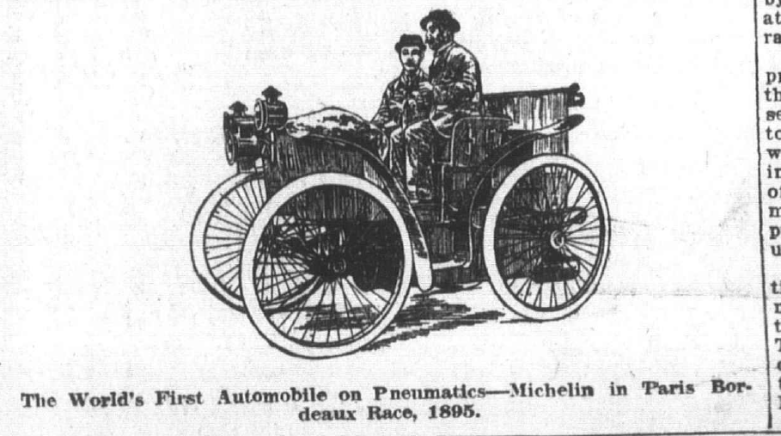
No manufacturer would risk his car by fitting it with such apparently frail tires, but Michelin did not lose confidence: he was certain of ultimate success, and in order to give a public demonstration as to what his tires could do be had to build a car for himself. The occasion was the historic Paris-Bordeaux race of 1896 when Michelin was represented by a rough sort of motor car made at his own works at Clermont-Ferrand. His triumph was complete.
From that day the progress of the pneumatic tire was coincident with the development of the motor car Itself. The story Is too well known to need repeating. Inventors the world over have worked for years to improve the old Paris-Bordeaux type of tires, and while many Improvements In details have been made, the principles laid down in 1895 remain unchanged.
One of the most recent advances In tire design has been the new rubber nonskid Just being introduced by the Michelin Company at Milltown. The French Michelin factory brought out the first pneumatic tire for automobile, but It remained for the Milltown organization to produce the latest type of tire, the new Universal Tread. This fact Is surely well calculated to develop a feeling of local pride in the minds of New Brunswick citizens.