This Day in History: November 28th, 1924

This Day in History: November 28th, 1924

BROKEN RIB PROVES FATAL TO ROBERT MILLS

The death of Robert J. Mills of R.F.D. No. 5, in Middlesex Hospital yesterday, was investigated by Chief County Detective Ferd A. David today, when it was learned that the man had been struck by a Public Service trolley car near Heinz’s Switch, Milltown, Monday evening.

No report of the accident was received at the prosecutor’s office from either the Milltown police or the Public Service Railway Company.

As soon as the death occurred the hospital authorities notified Chief County Detective David. His investigation showed that Mills was struck by an Amboy car being run toward this city by LeRoy Higley. The accident is said to have occurred at 10:30 o’clock Monday night. William Haggerty of this city is said to have been in charge of the car, with Higley operating it, who was being instructed.

According to the information secured from the Public Service employees, the car was approaching Foch Street when Mills walked out of the woods into the path of the car. He was picked up and taken to the office of Dr. Forney at Milltown, where he was treated and then removed to the Middlesex Hospital.

Mills’ body was removed to the morgue of Coroner Hubbard this morning, where County Physician John L. Suydam performed an autopsy. This showed that Mills had died from hemorrhages of the lungs, which had been punctured by a broken rib.

Mills boarded with Mrs. H. B. Oswald. His body will be taken by Undertaker Hubbard to La Plata, Md., on Monday for burial.


This Day in History: July 16, 1912

This Day in History: July 16, 1912

Milltown-bridge-and-dam

MILLTOWN SEWAGE PLAN DISAPPROVED
Council Appoints Advisory Water Commission to Carry Protest Against Lawrence Brook Pollution to State Board of Health.

Following a strong appeal from the Advisory Water Commission last night, Common Council passed a resolution, offered by Alderman Goodwin, protesting against the plan Milltown has evolved of sewering into settling beds along Lawrence Brook, because it is believed that the overflow would still pollute the stream.

Mr. Goodwin also moved that the advisory commission be named to carry New Brunswick’s protest to the State Board of Health. This motion was carried and Chairman Burt appointed the commission. The members are: Drury W. Cooper, Alfred E. Titsworth, Alfred S. March, Eugene P. Darrow, W. H. Benedict and Frederick Schneider.

The communication of the Advisory Commission stated that Milltown had filed plans as stated above which the Commission deemed dangerous to the water supply, and likely to bring the city’s name into bad repute. The commission suggested that Council demand a hearing in the matter before the State Board.

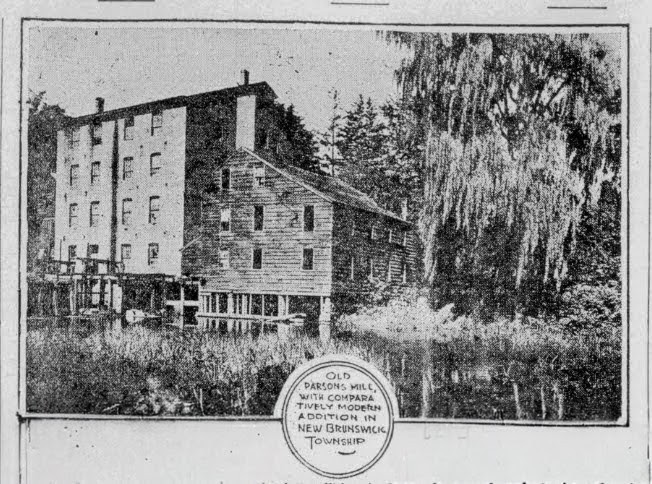
Commissioner Darrow was given the floor to explain the matter more fully. He said that Milltown proposed to sewer through a 15-inch pipe to a point just below where the Raritan River Railroad crosses Lawrence Brook, into three settling tanks, each of 30,000 gallons capacity, and overflow into four filter beds with a three-foot layer of sand and gravel, and finally discharge into the head of Weston’s Mill pond. The distance from the sewage bed to the pond would be 100 feet, Mr. Darrow said.

“The discharge would be pure when treated,” Mr. Darrow continued, “but when floods came the plant would not work properly. The thick sediment from the sludge beds would be washed into the pond. We consider this plan dangerous and certainly not creditable to the city, and that it can be avoided. We recommended to the city that the sewage be pumped to a point below the pond, and still favor that plan. The city should take some action to protect the water supply, and we believe that if this is done some other plan will be provided. The city is in a position where it can fight the matter successfully.”

Give and Take.
“Milltown feels that if it puts in a sewerage system it must have a water supply. The town also thinks that as New Brunswick is to be benefitted it ought to bear a portion of the expense.

“One suggestion is that if Milltown puts in the sewerage system, New Brunswick should give the town a water system, charging the same rates as in New Brunswick. Another suggestion is that New Brunswick pay the cost of filter beds for Milltown.

“Besides an official protest to the State Board, there should be a conference with Milltown officials as to the best way to get together in the matter.”

A protest against the Milltown plan was also received from the Filtration Commission.


This Day in History: May 19th, 1909

This Day in History: May 19th, 1909

WILL DECIDE ASPARAGUS CHAMPIONSHIP
Farmers James Parsons and John Edward Clark Will Meet Saturday to Decide Important Question — Who Will Challenge the Winner?

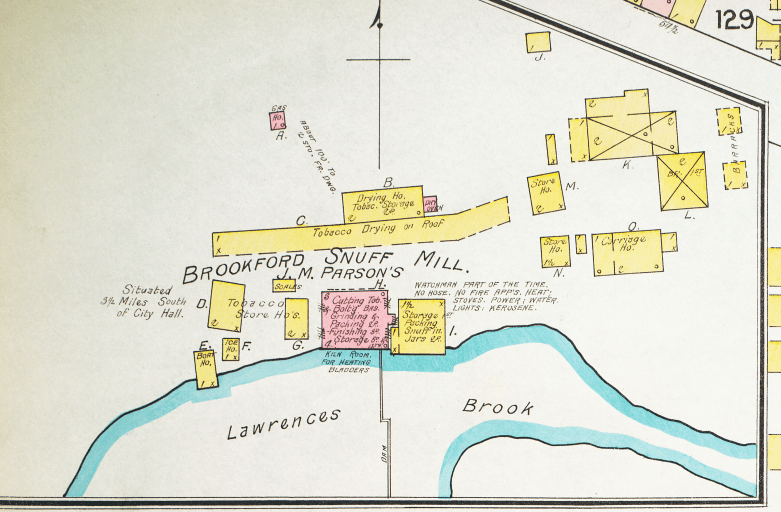
“Yes,” said Farmer James M. Parsons, of Milltown, assertively and somewhat aggressively this morning, in the hearing of John Edward Clark, of Piscataway township, “there isn’t a bit of doubt that I raise the finest asparagus in Middlesex county.”

Now Mr. Clark has an asparagus patch he thinks quite a lot of, and he took exception to Farmer James’ remarks and made some of his own decidedly disparaging to the Milltown patch.

“You don’t know what asparagus is out there,” said Farmer Ed’ard. “It makes me laugh to hear little bits of grass spears called asparagus.

“Huh, I throw away asparagus better than you bring to market, because I wouldn’t have the nerve to try to sell it.

“Maybe you’d like to prove you raise better than I do.”

“I wouldn’t want to tackle anything easier.”

So they agreed to each produce a sample of asparagus at Mansion House at 10 a.m. Saturday. Proprietor Jean Brivoul, who is an expert in everything in the eating line, is to be umpire and will declare the owner of the best bunch of asparagus champion of Middlesex county.

To make it interesting the owner of the worst bunch is to buy the other a new hat.

Interest in the competition is running high and applications for reserved seats are already pouring in upon Mr. Brivoul. It is expected that there will be several challenges for the winner.

Both Messrs. Parsons and Clark were observed to go home soon after the contest was arranged and to get out on the asparagus beds with sprinkling pots to make the “grass” grow faster.


W. C. T. U. MEETS AT MILLTOWN
The spring institute of the W. C. T. U. of Middlesex County was held in the Milltown M. E. church to-day. Morning session began at 10 with devotions, led by Mrs. George Taylor. Milltown members welcomed the guests and Mrs. Benson Crowcroft, of Metuchen, responded. The institute then organized by the appointment of committees. Talks were given by Mrs. May Barned, Mrs. Elizabeth Pierce, Mrs. A. R. Fisher, Miss Ada Wilmurt, Mrs. Whitaker, Mrs. J. Whiting, Mrs. G. D. Runyon, Mrs. W. J. Lyle, Mrs. I. H. Demarest.

At 10:30 p.m. an executive session was held. Devotions were led by Mrs. Parker. Mrs. Leon Chamberlain and Mrs. Phineas Searle rendered solos and Mrs. F. Overhiser recited. The address was by State President Mrs. Emma Bourne.

To-night the address will be by Mrs. Demarest, on “Why I Belong.”


This Day in History: May 8th, 1909

Michelin victory

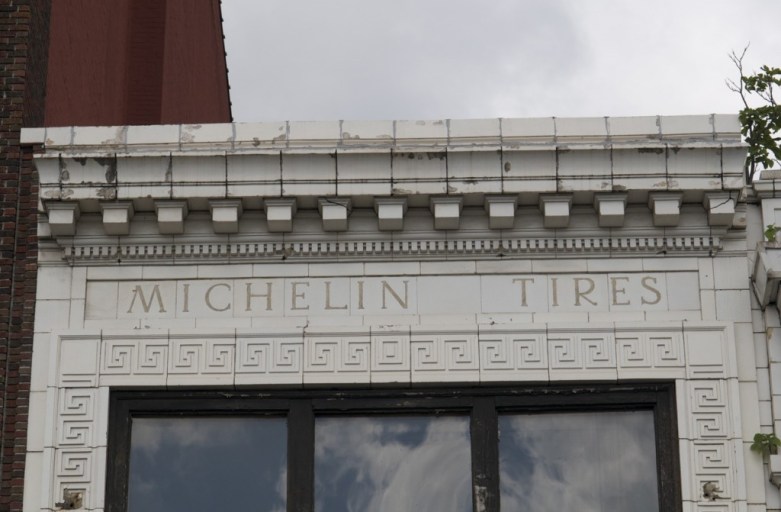
MARVELOUS ARE THE MICHELIN TIRES
One of Our Wonderful Industries of French Extraction Has Made a Record That Helps to Spread the Fame of New Brunswick and Neighboring Milltown, Where the Factory is Located.

Every famous car that flashes across town, a suburb of New Brunswick. Almost every American tourist who takes his automobile through the lands of the Aztecs; or through the vineyards of Italy; or across the Pyrenees; or over the Alps of Switzerland; or through the waving fields of Brittany; or into Russia, the Caucasus, India or other parts of the world carries the story of New Brunswick with him because he has provided himself with Michelin tires in order to get the utmost pleasure out of his journey.

It is needless to say that the Michelin factory at Milltown is one of New Brunswick’s proudest boasts. The entire establishment covers eighty acres of land. There are fifteen separate buildings covering nine acres of floor space. Six of the buildings have been enlarged within the last year. Two shifts of employees have been working every day since December 1907. The Michelin company has ten branches on the principal thoroughfares in ten of our largest cities as follows: New York, Boston, Philadelphia, Buffalo, Cleveland, Detroit, Chicago, Denver, San Francisco and Seattle.

The Michelin factory near New Brunswick is the fourth of the great plants built by the company since the business was started in Clermont-Ferrand, France, away back in 1832. The other Michelin factories, in addition to the French establishment and that in New Jersey, are in London, England, and Turin, Italy. It is the proud boast of the company that Michelin tires are for sale in every country in the world where cars are used.

The closest possible manufacturing relations exist between all the Michelin factories. All the tire-making machinery used at Milltown, and all the materials that go into the construction of Michelin tires are imported. The materials, processes of manufacture, and the many exclusive or secret formulae developed after eighty years’ experience in the handling of rubber, are identical in all the Michelin establishments even to the minutest details.

The officers and department heads of the American factory are: President, Edouard Michelin, whose headquarters are in France; vice president, John C. Matlack; treasurer, E. Fontaine; assistant treasurer, R. E. Glass; sales manager, F. W. Libby. The factory is in charge of J. Hauvette Michelin. The purchasing agent is M. L. Cramer, and the advertising manager, R. B. Bramwell.

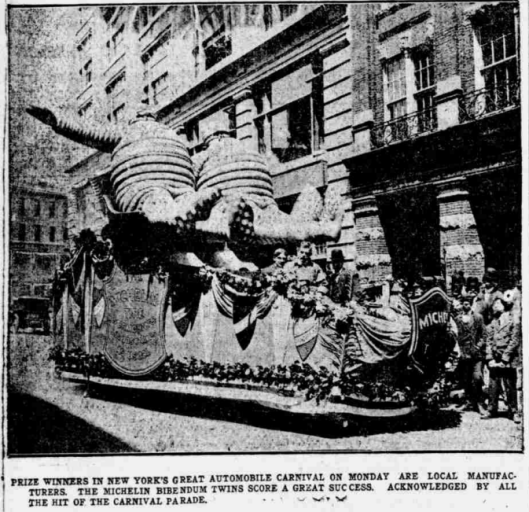
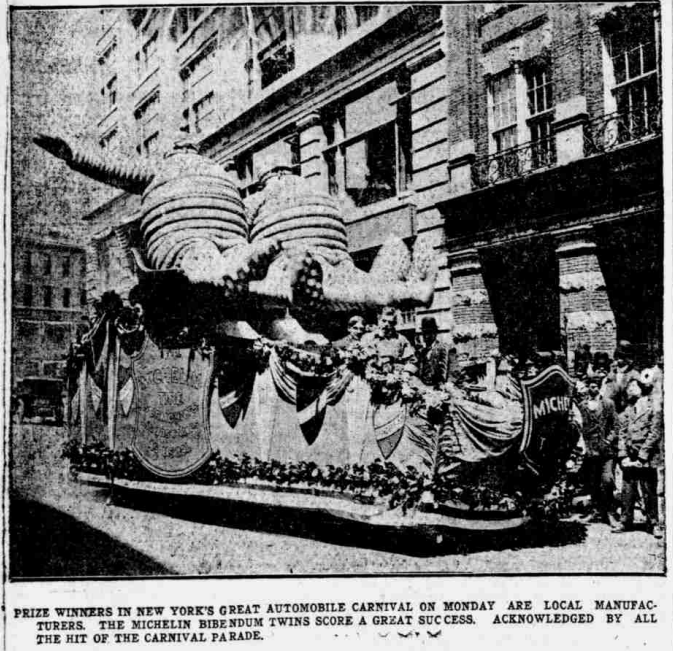
On Monday of this week the New York Automobile Trade Association held its second annual Carnival parade in which over four hundred gaily and grotesquely decorated cars participated. The Michelin Tire Company, of Milltown, N.J., which is a suburb of New Brunswick, won the first prize in the most important division, and thus once more attracted the attention of the automobile and sporting world to a home industry.

The Michelin float carried two rollicking rubber comedians from South France, known throughout the world as the Bibendum Twins, the same pair that were the heroes of the 1908 Carnival at Nice.

These rubber giants from Clermont-Ferrand were seated comfortably, surrounded by flags and bunting and many shields, each carrying the name of some proud Michelin victory. This unique exhibit added greatly to the general carnival spirit and won not only the first prize but the additional approval of all New York’s great newspapers, which is unique, as it is seldom that all the papers agree on anything.

The Bibendums were apparently built up from tires. Each figure carried a giant cigar. By most ingenious pneumatic operation their faces at one time reflected the utmost happiness and tranquility, and again they would assume every appearance of melancholia and distress.

The Bibendums, absolutely motionless at times, would rise suddenly to full height, throwing up their arms, and with bodies swaying and heads bent back, their faces would brighten up as if they knew in advance that the coveted first prize was to be their award at the end of the parade. The street urchins were quick to “catch on,” and they went rolling and laughing along Broadway in imitation of the antics of the Twins, much to the amusement of the older and more dignified, who enjoyed the day, however, no less than the children.

There is an elaborate and interesting story connected with the history of the Bibendum Twins. As the tale is told in France, these mighty curios were reared in Africa, the unusual offspring of a sturdy ostrich. Without injury to themselves they soon learned to devour or drink anything and everything, hence the name Bibendum. Broken glass, old horseshoes, nails, metals of all kinds and automobile trophies wherever offered are their regular diet, but, as the story goes, nothing satisfies their omnivorous appetites. Serious, grotesque, strong, weak, imperious, yielding, severe, comic, all in turn, the prize-winning Bibendum Twins were without doubt the most curious and most talked of travelers in all New York.


This Day in History: April 23rd, 1920

This Day in History: April 23rd, 1920

ROAD IMPROVEMENT WILL BE PUSHED BY MILLTOWN BOARD

MILLTOWN, Apr. 23. — Launching their second striking move for the improvement of Milltown, the Chamber of Commerce men in session on Wednesday night went into conference with representatives from the Chamber of Commerce of South River and East Brunswick Township in regard to the improvement of the road between Milltown and South River which for the past number of years has been in wretched condition despite the fact that it is the main roadway connecting these fast growing communities.

The attitude of the local Chamber of Commerce in instigating a move of this kind impresses the community residents with the fact that the new body of men is lending toward the every effort possible rapid progress of the borough and the people of the two connecting communities are looking forward with interest to the outcome of their new project.

The terrific storms of the past winter blocked traffic in those sections on a number of occasions and as a result limited the usual daily productions in the local manufacturing plants due to the employees, many of whom come from South River, being unable to get to Milltown. When the fact is known that the buses ran nearly on time on the Weston’s Mill road to South River from New Brunswick, the local men were led to believe that with a good road between here and South River, caution could be made against another setback.

A general belief is that if a good roadway was laid between Milltown and South River, more wholesale trucks would come through the borough, thereby enabling the local business houses to have a wider range of choice and give to the people the advantages derived from it. At the present time the big trucks literally ignore this community and take the Weston’s Mill road to South River.

Mayor Burton and Borough Clerk Fred Quad represented the South River Chamber of Commerce at the meeting Wednesday, and the delegation from East Brunswick Township consisted of Charles Herbert, Elias Conover, Henry Warnsdorfer and Russell Herbert.

The South River representatives assured the local men that they would assist all they possibly could toward having the road fixed between the two places, for it will be of distinct benefit to their community in general as well as to Milltown.

The East Brunswick representatives said they attempted to have the road fixed a number of years ago, in fact they went to the expense of having it surveyed and presented a map to the Freeholders, yet their presentation was passed over without any definite action. The roadway in question lies between Herbert’s Corner on the Milltown side and Tanner’s Corner on the South River side.

Steps were taken to have representatives of Milltown, South River and East Brunswick attend the session of the Board of Freeholders on next Thursday afternoon at the County Record Building at 3 o’clock. Many local business men will attend the meeting and the other places will be represented just as strong. These men will back the East Brunswick men, as the territory in question is under their jurisdiction.

Banquet Wednesday.
The plans for the first annual banquet of the Chamber of Commerce were gone over and the affair promises to be one of the greatest ever held in the borough. Nothing will be left undone to make it a success, the speaker of the evening has not been selected as yet, but the committee is seeking the best possible orator. The supper will be served at 6:30 and tickets are selling for $2.50. Music has been secured, a gala array of entertainers will be on hand and all in all it promises to be a notable event.

The applications of Fred Wagner and Earl F. Seaman, manager of the Realty and Construction Company, were received and passed upon.


This Day in History: January 28th, 1922

This Day in History: January 28th, 1922

WOMAN APPEARS AS COMPLAINANT AGAINST BAGOYNE

A few minutes after he had gotten off a train here yesterday afternoon, Eugene J. Bagoyne was arrested on George street by Deputy Sheriff Frank P. Kirby on a warrant issued some time ago by Justice of the Peace Charles W. Sedam and which charges fraud.

During October and November 1920, Bagoyne, who is pastor of spiritualist churches in Newark and Elizabeth, is alleged to have obtained from Victoria Okertz the sum of $150 under the pretense that he could by spiritual power get her in communication with her husband, said to be dead.

Mrs. Okertz, who is a resident of Perth Amboy, is complainant in the case. Her husband disappeared some time previous to the alleged experiment with Bagoyne, and it is not known whether he is dead or alive. The complainant alleges that she had no communication with her husband and that the money has not been returned to her.

Bagoyne was arraigned before Justice Sedam and was released under bail. A somewhat similar complaint was made against Bagoyne some time ago while he kept a chapel on Ryder’s Lane near Milltown, but no indictment was found.