This Day in History: October 24th, 1913

This Day in History: October 24th, 1913

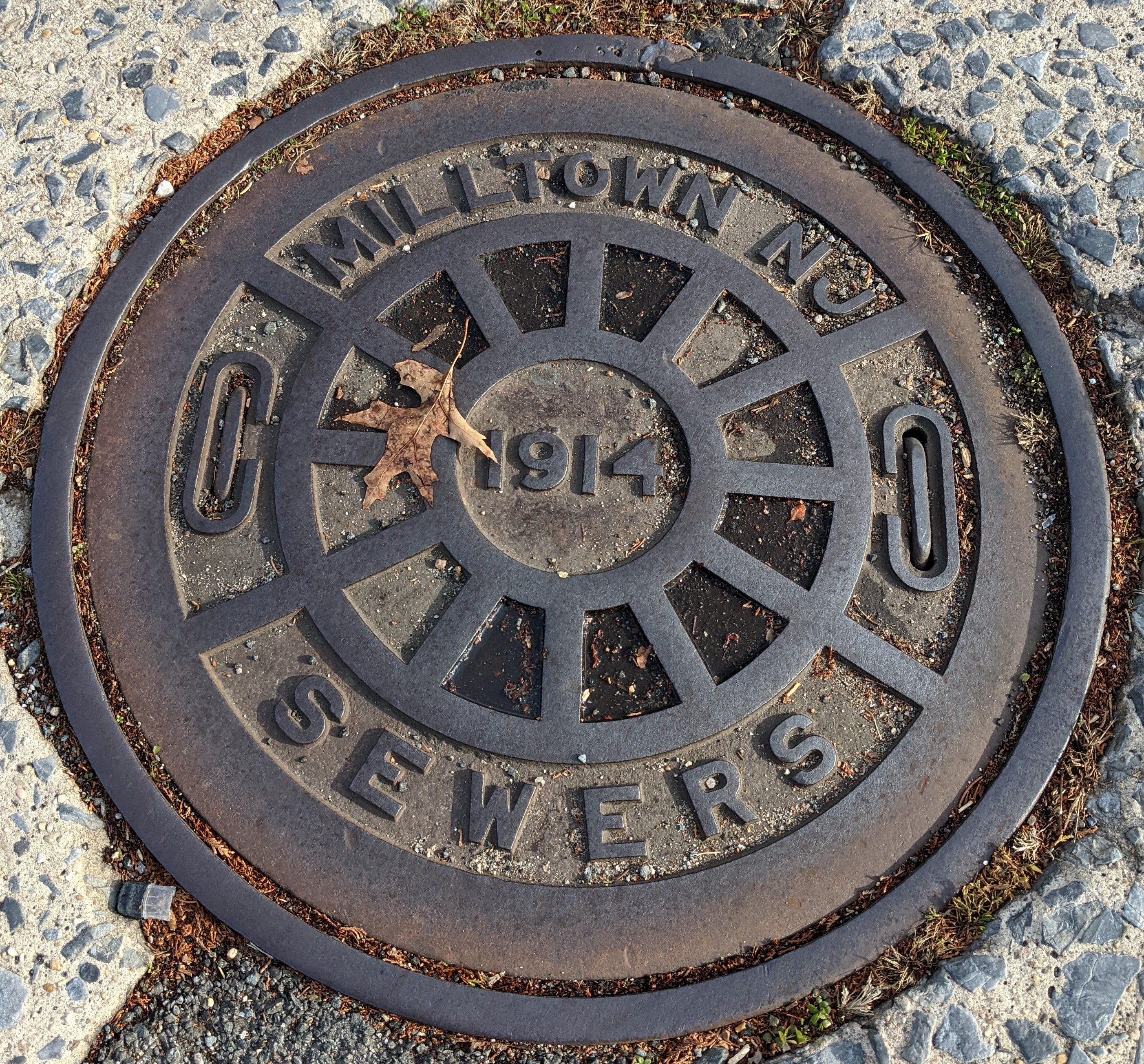
MILLTOWN GETS PLANS FOR NEW SEWER SYSTEM

Plans meet with the approval of the Commission. A special election will soon be called.

MILLTOWN, Oct. 24 – A meeting of the Milltown Sewer and Water Commission was held last night. Present at the meeting were Mayor Conrad Richter, Charles Richter, John Booream, E. J. Jaeger, C. W. Waddington, R. B. Sheppard, and Engineer Clyde Potts.

The plans and specifications, drawn up by Engineer Clyde Potts and approved by the State Board, were accepted by the local commission. It is likely that a special meeting will be called soon to make a report for submission to the Borough Council. Once the final report is received by the Council, steps will be taken to hold a special election, allowing the residents to make the final decision.

Engineer Clyde Potts provided the following report to the commission:

“On August 3, 1912, I presented complete plans for a water and sewerage system in the Borough of Milltown to your commission. Copies of these plans were filed with the State Board of Health. The water plans were approved in July 1912. Application was made to the State Water Supply Commission for approval of the source of supply, which was granted on August 13, 1912. However, plans for the sewerage works were taken under advisement by the Board of Health. A public hearing was held in the State House at Trenton on August 27. Various citizens and officials from New Brunswick objected to Milltown’s plans, fearing it would contaminate New Brunswick’s water supply.

Post the hearing, negotiations were held with New Brunswick authorities about altering the plan. On January 3, at a joint meeting of the sewerage committees of both Milltown and New Brunswick, it was proposed to pump Milltown’s sewage into New Brunswick’s sewers. This proposal formed the basis for an agreement on September 16. According to this agreement, Milltown will dispose of its sewage by pumping it through a force main on Main street to New Brunswick’s sewers at the Musical String factory. New Brunswick will share the cost of this force main and pumping station, contributing $12,500.

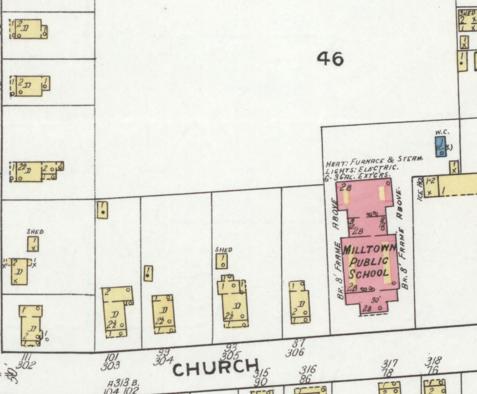
Supplemental plans were prepared in line with this agreement and filed with the State Board of Health on September 30. They were approved on October 7. These plans include a map showing the pumping station’s location and the force main’s route, a profile of the force main, and details of the proposed sewage pumping station near Lawrence Brook at the foot of Church street.

Due to the change in plans, it becomes necessary to modify the specifications attached to the August 3, 1912, report. Appended is a schedule of the necessary changes in the specifications for the sewers and sewage disposal works from the original report. The original specifications have not been rewritten. However, when printed for distribution among contractors, the printer can make corrections by referring to Appendix 1.”

The estimated cost of the sewage disposal works, as originally planned, was $21,505. The cost for the pumping station and force main to the New Brunswick sewers was estimated at $22,775. Of this amount, the City of New Brunswick will contribute $12,500. This leaves the net cost to the Borough of Milltown at $20,275. Regarding the operation of the pumping plant, the costs are estimated not to exceed $1,000 per annum for the first three years. For the fourth and fifth years, the cost is projected to be about $1,500 per annum.

In conclusion, I’d like to state that if the sewerage contract between the Borough of Milltown and the City of New Brunswick contains a clause where New Brunswick agrees to handle and dispose of Milltown’s sewage indefinitely (or as long as Lawrence Brook’s water is used by New Brunswick), I believe this plan, as proposed in the supplemental report, is superior to the original plan from August 1912. The members of your commission should be commended for finding an effective solution to this sewerage issue.

This Day in History: October 23rd, 1918

This Day in History: October 23rd, 1918

Few New Cases of Influenza Develop; Help For Registrants


MILLTOWN, Oct. 23 – The number of new cases of influenza in the borough that has developed during the past several days shows a decrease. It was stated yesterday by a member of the Board of Health that if no increase took place and the State Board of Health lifted the ban on gatherings and permitted the saloons and ice cream parlors to reopen, it would likely be possible to also lift the ban in Milltown.

The report for Sunday and Monday showed 14 new influenza cases and 2 pneumonia cases, which indicated the epidemic in the borough was on the wane.

Help for Registrants

With the sending out of the questionnaires to the balance of the men by the draft boards, the need arises again for assistance in filling out the forms. No one has been delegated by the Legal Advisory Board of Middlesex County to attend to the work, but arrangements are underway to have assistants at the school house for the next week or ten days to help anyone desiring assistance with their questionnaire. There will be no one on hand tonight, but a notice will appear in this column when the assistants will be at the school. No charge is made for the assistance and neither is there any charge, as a rule, by the persons taking the required affidavits. In the past, the registrants desiring to pay for the help received have been given the suggestion a donation to the War Relief would be acceptable and in that way, the treasury of the War Relief has been helped. The money is used by the War Relief Committee to supply Milltown boys in the service with various articles.

Contributions are still being received by the War Relief, the latest being a donation of $5 from Fred W. DaVoe.

Former Milltown Resident Dies

The death of Thomas J. Collins, of Millville, Mass., a former resident of Milltown occurred on Monday, Oct. 21st. He will be buried on Thursday afternoon at Millville. In addition to his wife, the deceased is survived by seven children and a number of grandchildren, also three brothers, Horatio Collins in Vanderbilt Avenue, Milltown, and Hamlet and Robert Collins, of New Brunswick.

Mrs. Chris Dunn is now able to be about again after an attack of influenza. Mrs. J.J. Keller is convalescing from influenza. Miss Bertha Oehl spent Sunday at Summerhill, at the home of her sister, Mrs. R.J. Smith. Several members of the Eib family, of Fresh Ponds Road, are suffering from influenza. Harold Glines has recovered from an attack of pneumonia and is able to be around. Miss Mamie Schlachter is confined to her home with an attack of Spanish influenza.

The Lawrence Brook school will reopen on Monday, October 28. All pupils report for work.

ELECTION Day presents a glorious opportunity to better the living conditions of your children. Vote “YES” on the question of abolishing saloon licenses. Milltown No-License League. 021-41


This Day in History: October 21st, 1907

This Day in History: October 21st, 1907

$10,000 Building for Milltown

Milltown Lodge to Construct and Provide a Hall for Public Meetings

The Wickatunk Tribe, No. 135, I.O.R.M. of Milltown, is planning to erect a hall and lodge room at the corner of Main and Ford streets in Milltown. The proposed structure, measuring 36×60 feet, is set to be a handsome addition to the town, equipped with the latest improvements, and estimated to cost about $10,000.

The ground floor will accommodate two stores. The second floor is designated for the upper sporting class of Milltown, while the top floor will house the lodge rooms and provide space for public meetings. The community of Milltown has long felt the need for a large hall, and this building aims to fulfill that need.

With 155 members and $7,000 in the treasury, the order’s prospects are very favorable.


The Unholy Reverend: The Mystical Life and Trials of Eugene Bagonye

The Unholy Reverend: The Mystical Life and Trials of Eugene Bagonye

1914 – 1919: Early Endeavors and Military Service

July 9, 1914
At the young age of 19, Eugene I. Bagonye married 33-year-old widow Emily M. Hodge from England in a ceremony held at St. Patrick’s Cathedral in New York City after a whirlwind romance lasting six days. However, the marriage soon faced troubles owing to their age difference, leading to their separation just three months later.

May 2, 1916
In a heartwarming display of friendship, Eugene Bagonye witnessed his friend Henry Stern convert to Christianity, abandoning his ancient Hebraic faith in a ceremony officiated by Rev. John Szabo of the Hungarian Catholic Church in South River. This change of faith was inspired by their close bond, emphasizing the depth of their friendship. Stern and Bagonye had plans to attend the American University in Chicago to study chiropractic, with aspirations to open a practice in Milltown.

October 1917
Bagonye enlisted in the army, initially continuing his work as a faculty member at the Palmer School in Davenport, Iowa, before beginning regular army training in early 1918. Bagonye’s tenure in the army saw him rise to the rank of sergeant, with his service majorly stationed at Camp Dix.

January 21, 1919
Sergeant Bagonye was honorably discharged from the army. Shortly after, he re-enlisted, planning to return to his duties at the Palmer School before resuming his responsibilities in the army, taking charge of six other individuals for their trip to Iowa.

1921-1923: Legal Troubles and Divorce

April 25, 1921
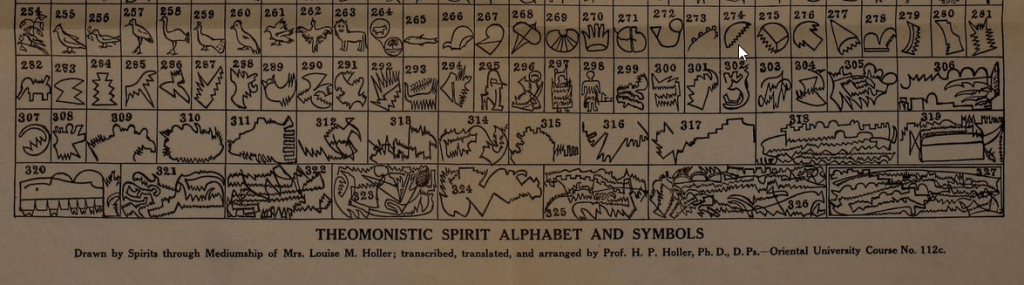
Bagonye, who now bore the title “Professor” and dabbled in spiritualistic practices, found himself arrested under the “Section 71; Witchcraft” clause of the New Jersey Penal Code. Despite the arrest, Bagonye held services at Begonia Health House in Hungry Hill, Milltown, New Jersey. Dubbed the “necromancer of Hungry Hill,” he was accused of fraudulent activities, involving the sale of a “good luck powder” and alleged theft. Bagonye’s colorful career history came to light during this time, including his experience as an assistant pastor, employment agency owner, real estate dealer, and cook’s instructor in the army, among other roles.

January 23, 1923
The clergyman Bagonye, now serving at the Themomistic Church in Milltown, was advised to be granted a divorce from his estranged wife Emily M. Hodge on grounds of her infidelity and their irrevocable differences. Their tragic marital history surfaced, highlighting Hodge’s criminal background and subsequent deportation.

January 26, 1922
Desiring to commence his new role as a Theomentatie minister with a clear conscience, Bagonye initiated divorce proceedings against Hodge, invoking her unfaithfulness as the primary reason. The divorce proceedings revealed the rapid progression of their relationship, which moved from acquaintance to marriage within a span of six days. Bagonye emphasized his commitment to his ministerial duties and expressed a strong desire to start afresh, rid of the troubled marriage that haunted his past.

1925: The Supernatural Remedy Proposal

September 2, 1925
Amidst a water shortage crisis in Milltown, Bagonye penned a letter to Mayor Herbert, offering his supernatural assistance to solve the problem. He proposed a contractual agreement wherein, for $8,000, he would employ his purported divine abilities to increase the water supply in the borough’s wells to meet current and future demands for the next three to five years. The proposal, which promised a continual and increased supply of water through supernatural means, sought to provide a cheaper alternative to drilling a new well, estimated to cost $30,000.

September 15, 1925
Bagonye’s proposal was deliberated in a borough council session, during which the desperate circumstances of the water supply were discussed in detail. The critical situation involved the emergency sourcing of water from Lawrence Brook, and restrictions imposed on water usage for car washing and lawn sprinkling. Bagonye’s solution, which brought a glimmer of hope in a trying time, was referred to the Superintendent of Water, Samuel Spiers, for careful consideration, showcasing the council’s open-mindedness in exploring diverse solutions to address the pressing issue.


This detailed chronological recount encompasses the significant events in Eugene Bagonye’s life, bringing a rich context to his personal and professional journey, marked by both service and controversy. It covers his romantic endeavors, deep friendships, military service, brushes with the law involving an arrest for witchcraft, and his rather unconventional offer of employing supernatural means to solve a community crisis, depicting a life certainly full of ups and downs.

Here is a link to his Grave location in Long Island. https://www.findagrave.com/memorial/310287/eugene-i-bagonye

Compiled and arranged by: Randy Ruth


This Day in History: September 13th, 1909

This Day in History: September 13th, 1909

Milltown Proud of the New M. E. Parsonage


MILLTOWN, Sept. 13-William Jaeger, of New York, was a week-end guest at the home of Charles Smith. Mrs. Charles Herrmann, of Main street, entertained out of town guests over Sunday.

The manager of the football team of the Crescent A. C. has asked that all candidates for the 1909 football eleven appear ready for light practice next Thursday evening. As the Crescents are quite enthusiastic over the game, it is expected that there will be a large number of candidates on hand. Mrs. William C. Kuhlthau, who has been quite ill, is convalescing under the care of Dr. N. N. Forney.

The congregation of the German Reformed Church listened to a very excellent sermon given by Rev. J. M. C. Garmo, of Buffalo, yesterday morning. Miss Mamie Glock assumed her duties as teacher in the South River public school to-day.

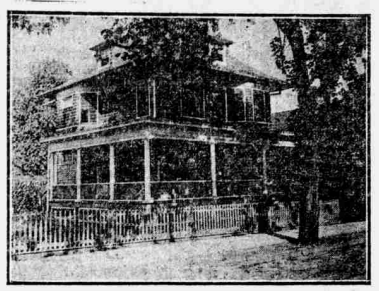
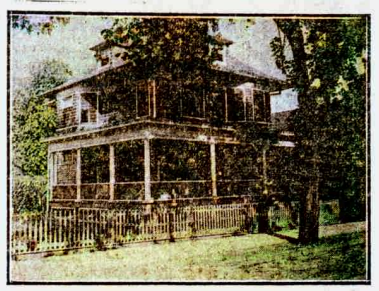
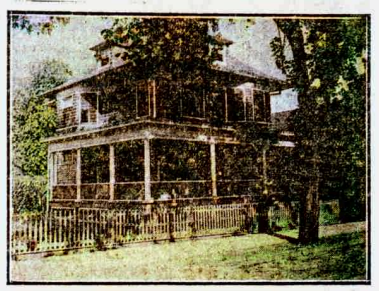
The above sketch is a true representation of the new M. E. parsonage at Milltown. It presents quite an imposing appearance, and is one of the finest residences in the town.

It is provided with all the modern improvements, steam heat, electric lights, Kewanee water system, a well equipped laundry, together with a gas heating range for the kitchen. On the first floor are the reception hall, parlor, library, dining room and kitchen.

On the second floor are five good-sized sleeping apartments besides a fair-sized bathroom. The trimming is of red oak, with hardwood floors throughout.

The reception hall and parlor are separated by artiste grill work, and the winding stairway running through the center of the house makes the hall very attractive. The cost of the building is estimated at $5,500, the architect of said building being George K. Parsell, of this city.

The pastor and family are now occupying the parsonage, and expect, with the aid of the ladies of the church. to hold a reception in the very near future, to which all members and friends of the congregation will be welcome.


This Day in History: August 15th, 1919

This Day in History: August 15th, 1919

CHURCHES PUT BAN ON SUNDAY BASEBALL

MILLTOWN Aug. 15 – There was an air of expectancy pervading to borough Council meeting on Wednesday evening caused by the an unexpected appearance of a petition tor Sunday baseball. The petition, however failed to make its appearance, whether it became lost in the rain or whether its sponsors thought it advisable to present it at this time is not known. There were, however, resolutions presented from both the Methodist and the German Reformed Churches urging the Mayor and councilmen to set aside any such petitions presented, as the playing of Sunday baseball would be most detrimental to the best interests of the community. The resolutions were received by Council and placed on file.

Another matter which caused the Council to take prompt action was the report that the American Railway Express Company was contemplating abandoning its agency at town, and taking deliveries through New Brunswick. It was the unanimous opinion of Council that this would be a severe setback to the borough, and a resolution was passed urging the American Railway Express Company to reconsider this matter, as the business interests of the borough required the continued deliveries as now in effect. The Chamber of Commerce and the business concerns will no doubt take similar action at once.

The “garbage” disposal matter which occupied so much attention late yesterday, was again discussed, and the matter was referred to the finance. committee to ascertain the cost and A possibility of a garbage disposal plant for Milltown. They will report back at a later meeting of Council.

An agreement with the Public Service Hallway Company was approved and the Mayor and Borough a Clerk directed to execute same on n the part of the borough. This provides for the consolidation of certain borough and street railway company’s poles, and will mean the y elimination of at least six poles.  

A communication was received from the Michelin Band, asking for the advice of Council as to the most suitable place for the public band concerts, and also for the privilege of having connection made for electric lighting from the borough wires. Upon motion the borough clerk was requested to acknowledge receipt of to the communication, and assure them of Council co-operation so far as the lighting was concerned: it was also thought that as a general rule the ball park would be the most suit able location for the concert.

The difficulty experienced at the sewerage pumping to recent rainy weather, as well as that experienced normal was discussed. and it was thought that some action would have to be taken in order to assure the plant taking care of the sewerage Matter was left in the hands of the finance committee who will report later with recommendations The Public Service Gas Co. was given the privilege of opening up Van Liew avenue for the purpose of laying 160 feet gas extension, to serve the property owners on that street. The New York Telephone Co. was given permission to make attachments to poles School street. The report of the collector indicated there is a balance on hand of $7,524 as of August 1st..


Warning AI Summary

The Milltown borough Council meeting on August 15th involved several significant matters. Firstly, there was anticipation surrounding a petition for Sunday baseball, which ultimately did not appear. However, resolutions from the Methodist and German Reformed Churches were presented, advising against Sunday baseball due to its negative impact on the community. The Council also addressed concerns regarding the possible abandonment of the American Railway Express Company’s agency in town and the potential consolidation of certain borough and street railway company’s poles. Additionally, discussions took place regarding garbage disposal, the location for public band concerts, sewerage pumping issues, gas extensions on Van Liew avenue, telephone company attachments, and the financial status of the borough. The details can be found in the provided newspaper article.


Leave a Reply