This Day in History: May 8th, 1909

Michelin victory

MARVELOUS ARE THE MICHELIN TIRES
One of Our Wonderful Industries of French Extraction Has Made a Record That Helps to Spread the Fame of New Brunswick and Neighboring Milltown, Where the Factory is Located.

Every famous car that flashes across town, a suburb of New Brunswick. Almost every American tourist who takes his automobile through the lands of the Aztecs; or through the vineyards of Italy; or across the Pyrenees; or over the Alps of Switzerland; or through the waving fields of Brittany; or into Russia, the Caucasus, India or other parts of the world carries the story of New Brunswick with him because he has provided himself with Michelin tires in order to get the utmost pleasure out of his journey.

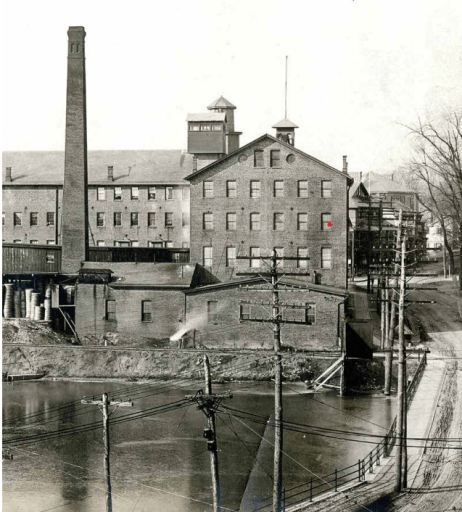
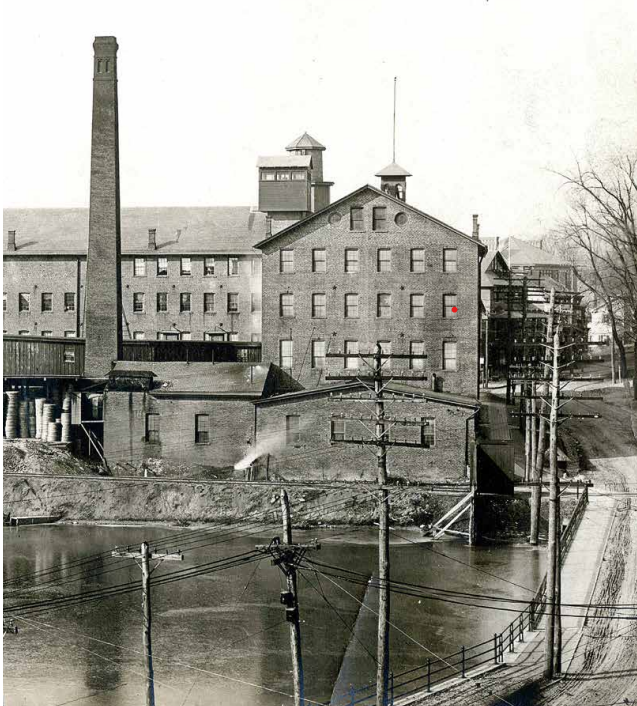
It is needless to say that the Michelin factory at Milltown is one of New Brunswick’s proudest boasts. The entire establishment covers eighty acres of land. There are fifteen separate buildings covering nine acres of floor space. Six of the buildings have been enlarged within the last year. Two shifts of employees have been working every day since December 1907. The Michelin company has ten branches on the principal thoroughfares in ten of our largest cities as follows: New York, Boston, Philadelphia, Buffalo, Cleveland, Detroit, Chicago, Denver, San Francisco and Seattle.

The Michelin factory near New Brunswick is the fourth of the great plants built by the company since the business was started in Clermont-Ferrand, France, away back in 1832. The other Michelin factories, in addition to the French establishment and that in New Jersey, are in London, England, and Turin, Italy. It is the proud boast of the company that Michelin tires are for sale in every country in the world where cars are used.

The closest possible manufacturing relations exist between all the Michelin factories. All the tire-making machinery used at Milltown, and all the materials that go into the construction of Michelin tires are imported. The materials, processes of manufacture, and the many exclusive or secret formulae developed after eighty years’ experience in the handling of rubber, are identical in all the Michelin establishments even to the minutest details.

The officers and department heads of the American factory are: President, Edouard Michelin, whose headquarters are in France; vice president, John C. Matlack; treasurer, E. Fontaine; assistant treasurer, R. E. Glass; sales manager, F. W. Libby. The factory is in charge of J. Hauvette Michelin. The purchasing agent is M. L. Cramer, and the advertising manager, R. B. Bramwell.

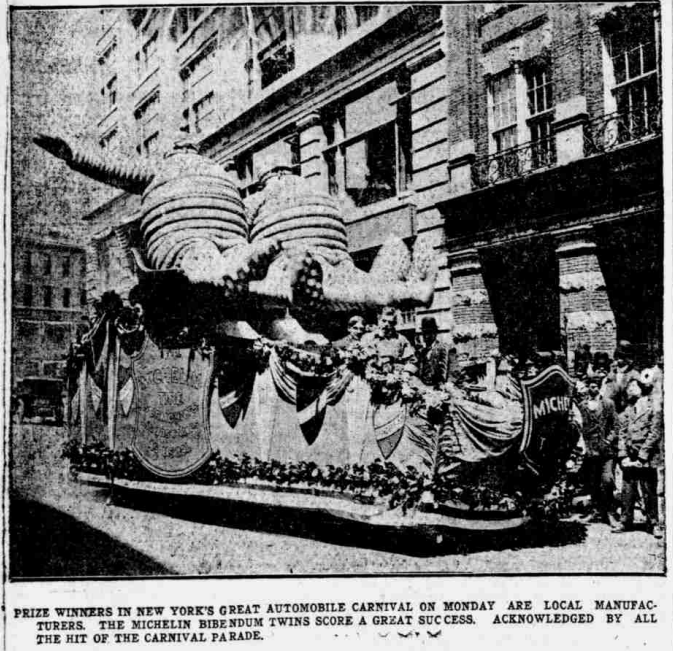
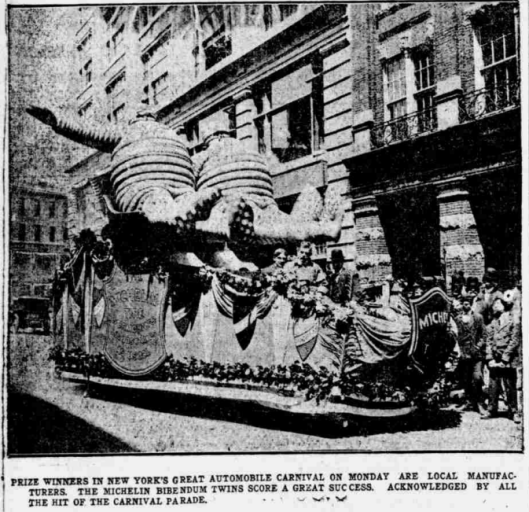
On Monday of this week the New York Automobile Trade Association held its second annual Carnival parade in which over four hundred gaily and grotesquely decorated cars participated. The Michelin Tire Company, of Milltown, N.J., which is a suburb of New Brunswick, won the first prize in the most important division, and thus once more attracted the attention of the automobile and sporting world to a home industry.

The Michelin float carried two rollicking rubber comedians from South France, known throughout the world as the Bibendum Twins, the same pair that were the heroes of the 1908 Carnival at Nice.

These rubber giants from Clermont-Ferrand were seated comfortably, surrounded by flags and bunting and many shields, each carrying the name of some proud Michelin victory. This unique exhibit added greatly to the general carnival spirit and won not only the first prize but the additional approval of all New York’s great newspapers, which is unique, as it is seldom that all the papers agree on anything.

The Bibendums were apparently built up from tires. Each figure carried a giant cigar. By most ingenious pneumatic operation their faces at one time reflected the utmost happiness and tranquility, and again they would assume every appearance of melancholia and distress.

The Bibendums, absolutely motionless at times, would rise suddenly to full height, throwing up their arms, and with bodies swaying and heads bent back, their faces would brighten up as if they knew in advance that the coveted first prize was to be their award at the end of the parade. The street urchins were quick to “catch on,” and they went rolling and laughing along Broadway in imitation of the antics of the Twins, much to the amusement of the older and more dignified, who enjoyed the day, however, no less than the children.

There is an elaborate and interesting story connected with the history of the Bibendum Twins. As the tale is told in France, these mighty curios were reared in Africa, the unusual offspring of a sturdy ostrich. Without injury to themselves they soon learned to devour or drink anything and everything, hence the name Bibendum. Broken glass, old horseshoes, nails, metals of all kinds and automobile trophies wherever offered are their regular diet, but, as the story goes, nothing satisfies their omnivorous appetites. Serious, grotesque, strong, weak, imperious, yielding, severe, comic, all in turn, the prize-winning Bibendum Twins were without doubt the most curious and most talked of travelers in all New York.

This Day in History: May 5th, 1909

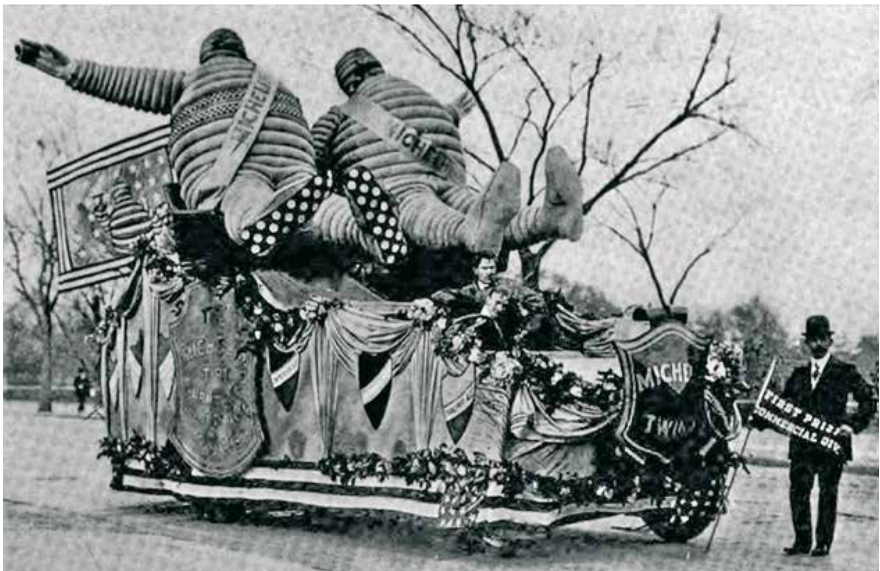
Michelin Tire Company promotional postcard, 1909.

The Michelin Tire Co. was represented in the Automobile Carnival recently held in New York. Their advertising float carried the Michelin Bibendum Twins, which are a huge mechanical device and said to have been hatched by an ostrich and nursed by a cannibalistic maid of Africa on a diet of nails and broken glass. This diet seems to have harmed them as little as such things do Michelin Tires — those marvels of tire durability.

The fourteen-feet-high twins carried off first prize in the advertising department.

The Crescents are beginning to get their baseball diamond in shape for their first home game on May 31st.

A new fence is being erected along the frontage of Mr. J. C. Matlack’s residence on Main Street.

The mission study class under the auspices of the Epworth League will be held in the lecture room of the church this evening, at eight o’clock. A full attendance is desired.

Prayer service was held in the M.E. Church last evening. It was followed by the study of the Sunday school lesson.

We are pleased to hear that Mrs. Wm. H. Kuhlthau, who returned home last Sunday, is steadily improving.

The new home of William Ells, on Van Liew Avenue, is nearing completion.

Prill Brothers have discontinued their wholesale candy route for the present on account of the severe illness of two of the boys.


The Forgotten Years of Bibendum. Michelin’s American Period in Milltown: Design, Illustration and Advertising by Pioneer Tire Companies (1900-1930)

https://diposit.ub.edu/dspace/bitstream/2445/126382/132/26.pdf: This Day in History: May 5th, 1909
AWARD-WINNING DEBUT. The float with the gigantic figures of the Michelin Twins won first prize in the category of
advertising vehicles. The appearance of this achievement in newspapers and generalist magazines as well as in specialized
press of the automotive sector—publically displaying the outlandish figures when the article included images—
turned out to be a a highly efficient promotional tool. Michelin contributed to their own notoriety by publishing
commemorative postcards and press advertisements.  Michelin Tire Company promotional postcard, 1909.

This Day in History: April 23rd, 1920

This Day in History: April 23rd, 1920

ROAD IMPROVEMENT WILL BE PUSHED BY MILLTOWN BOARD

MILLTOWN, Apr. 23. — Launching their second striking move for the improvement of Milltown, the Chamber of Commerce men in session on Wednesday night went into conference with representatives from the Chamber of Commerce of South River and East Brunswick Township in regard to the improvement of the road between Milltown and South River which for the past number of years has been in wretched condition despite the fact that it is the main roadway connecting these fast growing communities.

The attitude of the local Chamber of Commerce in instigating a move of this kind impresses the community residents with the fact that the new body of men is lending toward the every effort possible rapid progress of the borough and the people of the two connecting communities are looking forward with interest to the outcome of their new project.

The terrific storms of the past winter blocked traffic in those sections on a number of occasions and as a result limited the usual daily productions in the local manufacturing plants due to the employees, many of whom come from South River, being unable to get to Milltown. When the fact is known that the buses ran nearly on time on the Weston’s Mill road to South River from New Brunswick, the local men were led to believe that with a good road between here and South River, caution could be made against another setback.

A general belief is that if a good roadway was laid between Milltown and South River, more wholesale trucks would come through the borough, thereby enabling the local business houses to have a wider range of choice and give to the people the advantages derived from it. At the present time the big trucks literally ignore this community and take the Weston’s Mill road to South River.

Mayor Burton and Borough Clerk Fred Quad represented the South River Chamber of Commerce at the meeting Wednesday, and the delegation from East Brunswick Township consisted of Charles Herbert, Elias Conover, Henry Warnsdorfer and Russell Herbert.

The South River representatives assured the local men that they would assist all they possibly could toward having the road fixed between the two places, for it will be of distinct benefit to their community in general as well as to Milltown.

The East Brunswick representatives said they attempted to have the road fixed a number of years ago, in fact they went to the expense of having it surveyed and presented a map to the Freeholders, yet their presentation was passed over without any definite action. The roadway in question lies between Herbert’s Corner on the Milltown side and Tanner’s Corner on the South River side.

Steps were taken to have representatives of Milltown, South River and East Brunswick attend the session of the Board of Freeholders on next Thursday afternoon at the County Record Building at 3 o’clock. Many local business men will attend the meeting and the other places will be represented just as strong. These men will back the East Brunswick men, as the territory in question is under their jurisdiction.

Banquet Wednesday.
The plans for the first annual banquet of the Chamber of Commerce were gone over and the affair promises to be one of the greatest ever held in the borough. Nothing will be left undone to make it a success, the speaker of the evening has not been selected as yet, but the committee is seeking the best possible orator. The supper will be served at 6:30 and tickets are selling for $2.50. Music has been secured, a gala array of entertainers will be on hand and all in all it promises to be a notable event.

The applications of Fred Wagner and Earl F. Seaman, manager of the Realty and Construction Company, were received and passed upon.


This Day in History April 7th, 1911

This Day in History April 7th, 1911

WAS SHOCKED AT MICHELIN WORKS
Aliks Brooks Sues for $5,000, Claiming He Was Not Warned of Presence of Electric Switch—Unable to Perform Manual Labor.


Claiming that he was injured so seriously while at work in the Michelin tire factory at Milltown, last August, that he has since been unable to perform manual labor, and alleging that his injuries were due to the failure of his employers to notify him of the dangerous character of work given him to do, Aliks Brooks began suit yesterday, before Judge Lloyd and a jury, for $5,000 damages.

According to the story told by the plaintiff on the stand, he was instructed by James Gibson, his foreman, to clean the overhead steam pipes in one of the mills, and while crawling along on these pipes he came in contact with an electrical switch, from which he received such a shock that he was precipitated to the floor, 22 feet below.

The witness exhibited a big bruise on the left side of his forehead where he had struck the concrete flooring, and bared his back for the jury to see three large contusions on his spine, which remain as a result of the fall.

Clifford I. Voorhees and Alan H. Strong appeared as counsel for the plaintiff, who is a Russian, and whose testimony was given through interpreter Frankel. Frederick S. Kellogg, of Bedle & Kellogg, a Newark law firm, represents the defendant company.

The jury drawn to try the case consisted of Jacob H. Hoagland, Geo. St. Andrassy, Frank Buote, Joseph B. Quick, Frank Van Nuis, Joseph Deagan, Louis Hildebrandt, Harvey Dey, William Stokes, George Everitt, Charles Holstein and Walter Compton.

Questioned by Mr. Strong, the plaintiff asserted that no one had warned him of the presence of the switch that caused the accident. He said that he had been employed at the Michelin Works for two years and a half, his principal duties being to lift the heavy moulds into which rubber is poured in the making of tires. He was also called upon to act as a general “helper” in any necessity that might arise.

The witness said that he was unconscious for several hours following the accident, and had spent a week in one of the local hospitals. He was confined to his home for a month after leaving the hospital. Upon returning to the Michelin Works, the witness said that he was called upon to wheel coal, which duty he was unable to perform because of his weakened condition.

Later, he had obtained employment in the Old Bridge Glass Works, but found this too arduous also, and he has been out of employment for several months. Mr. Brooks swore that he suffers constant pain, and has been informed by Dr. Selover, of South River, and Dr. Smith, of this city, that he has been permanently disabled. At the time of his injury he was getting 18 cents per hour, his weekly pay varying from $9 to $14, according to the number of hours he had worked.

Under cross-examination, the witness denied that he, with four other employees had waited upon Superintendent Henry Young at the Tire Works, and announced that he wouldn’t wheel coal for a living. He was questioned concerning remarks he was alleged to have made to a fellow employee who accompanied him to New Brunswick in an auto immediately following the accident, but declared he couldn’t remember speaking to anyone at the time mentioned. At this point adjournment was taken for the day.

Can’t Straighten Fingers.
The cross-examination of the plaintiff was resumed this morning, when Attorney Kellogg questioned him at length concerning his sensations when he received the alleged shock.

“I don’t remember how it felt, only I know I was knocked down as soon as I touched the switch.” The witness swore that he is still unable to straighten two fingers on the left hand that came in contact with the electric current, and exhibited the marks on his hand to the jury.

A motion by Mr. Kellogg that the testimony of the plaintiff concerning a “shock” be stricken out on the ground that it was simply hearsay evidence, was refused by Judge Lloyd.

Counsel for the defense failed in an endeavor to secure from the witness an admission that he knew of his own knowledge the dangerous nature of the electric switches near which he was called to work.

Nickola Silka, a fellow workman, testified that he heard the order given Brooks to clean the pipes, and had heard nothing said by the foreman concerning the electric switch.

The witness said that he had accompanied the injured man to the hospital. He had noticed that Brooks was unconscious and bleeding from the wounds in his head and back. Similar testimony was given by Walter Schitz and Joseph Wanslopsky, fellow employees who had witnessed the accident. The cross-examination of these witnesses developed nothing of special moment.

Plaintiff’s Wife Testifies.
Mrs. Alice Brooks, wife of the plaintiff, took the stand in her husband’s behalf. The witness bore in her arms a few months’ old infant and, like the other witnesses, testified through an interpreter. Mrs. Brooks told of the care she had given her husband. No cross-examination.

Dr. J. Warren was called to tell of two occasions on which he had examined the plaintiff since his injury, and declared that he found Mr. Brooks suffering severe pain. In his opinion the injuries were likely to be of a lasting character, as the nerves affecting the muscles of the back were badly injured.


This Day in History: April 5th, 1919

Never come back

Never come back

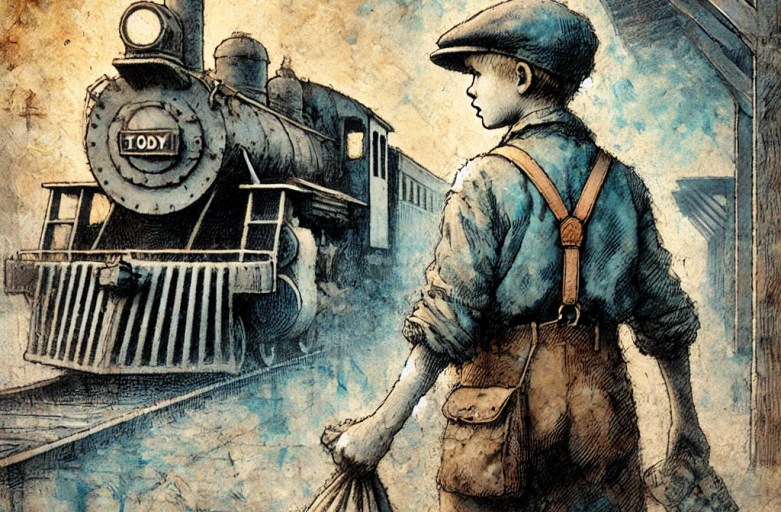
MILLTOWN YOUTH STARTS TO CROSS CONTINENT ON $30


Elmer Brown Disappears from Milltown After Telling Friends That He is Going to California—His Family Alarmed—

Elmer Brown, age 15, well known and well liked in both Milltown, his home, and in this city, is missing. He had frequently expressed a desire to see the West and friends state that there is where he must have gone.

Last Monday Elmer departed from his home in Milltown to go to his work in New Brunswick. At least that is what his parents thought, for he didn’t give them an inkling that he was going to set out to make his mark in the world single-handed. He formerly worked for the New Brunswick Printing Company and later secured a position with another firm in this city.

Within six months he had saved thirty dollars and with this he started for California to enjoy life in the sunny western land. Brown met several of his companions in Milltown Monday morning and told them the secret. He said he was going to California and that he had thirty dollars with which to pay his expenses. If that wasn’t sufficient he was going to “beat” his way.

The youthful companions thought nothing more of the incident until yesterday when Brown’s parents became alarmed over his disappearance. Brown came to this city and boarded a train for New York. Since then all trace of him has been lost. His parents are now making every effort to locate the youthful adventurer.

Brown was seen aboard a train bound for New York by a resident of Milltown, who reported it to Brown’s parents. The police have been asked to aid in their search for him.

Young Brown often saw letters from his married sister living in California. Frequently she wrote to her parents, telling of the beauty of California and urged that they make their home with her. These letters fell into Brown’s hands and he could not wait any longer for his parents to make up their minds and set out himself to locate his sister. The lad had no experience in traveling and his parents are greatly disturbed fearing that some harm may come to him.


This Day in History: February 14, 1924

This Day in History: February 14, 1924

Only One Woman Votes in Milltown

MILLTOWN, Feb. 14.—At the school election last night the regular candidates, George Heyl, Conrad Geer and Christian Jensen, were elected. A total of forty ballots were cast, which was just about five times as many as last year. The direct cause of this was that the borough firemen turned out almost to a man to vote for the resolution, turning over a portion of the school ground to the borough for the erection of a fire house. This passed with only one dissenting vote. The appropriations likewise were approved almost unanimously.

Only one woman voted, she being Mrs. W. Kuhlthau, who is a member of the Board of Education.