This Day in History: August 29th, 1905

This Day in History: August 29th, 1905

Woman Falls Through Bridge –


Milltown Bridge Gives Object Lesson on Its Rottenness.

While members of the Board of Freeholders were busy testifying before Supreme Court Commissioner Van Cleef yesterday morning about the rotten condition of the Milltown bridge, the bridge was giving a practical exhibition of its rottenness on its own account.

Mrs. George Roeder, the widow of the late postmaster of Milltown, was walking across the bridge yesterday morning when a plank broke, and she fell partly through the structure. Her screams brought help from the trolley power house, and she was assisted to a firm part of the bridge. She was not injured beyond some scratches.

Street Commissioner Booraem, of Milltown, repaired the damaged plank. He declares that the bridge is not safe for travel. He fears that a trolley car will go through someday.

Mrs. Roeder may bring suit against the county for the accident.


This Day in History: August 28th, 1905

This Day in History: August 28th, 1905

BLOCKING THE BRIDGE AT MILLTOWN


Freeholder DeHart Dodges Question About Award of the Contract on Bridge Company Plans.

The probe into the Milltown bridge contract award to Dean, Schweirs, Sutton & Company, was commenced this morning before Supreme Court Commissioner James H. Van Cleef at his office. Testimony was taken on the writ of certiorari taken out by Charles A. Bloomfield. The morning was devoted to examining James DeHart, the chairman of the Milltown Bridge Committee, and Engineer Lehay, of the Public Service Corporation. The case was still on this afternoon.

Willard P. Voorhees represented Mr. Bloomfield. Alan H. Strong represented the county, with County Solicitor Willis. Judge J. Clarence Conover, of Freehold, appeared for Dean, Schweirs, Sutton & Co., who have the contract for building the bridge.

“Do you think it fair to the bidder to invite bids on one set of plans and then award the contract according to another set of plans?” asked Lawyer Voorhees.

“All of the acts of the committee had to be ratified by the whole Board,” replied Mr. DeHart.

Mr. Voorhees inquired minutely into the award of the contract, which was made at the office of the Public Service Corporation in the Prudential Building at Newark on July 1. Freeholders Fountain, Jackson, and DeHart, with Engineer Dougherty, met Col. Hine and Engineer Lehay there that day. The engineers approved of the plan of Dean, Schweirs, Sutton & Co., and it was approved there. Mr. DeHart was unable to point out the advantages of the plan selected, saying that he took the engineer’s word on that point.

He admitted on cross-examination that he had received a letter from the West Virginia Bridge Company, after the award of the contract, offering to build a bridge according to the Dean, Schweirs, Sutton & Co. plans for $100 less than the contract price, $8,900, and that he had not reported this letter to the Board, as he had thought the incident closed. He said that he did not think a man would make a statement of that kind in earnest when he had not seen the plans.

He was followed on the stand by Engineer Lehay.

Among the Freeholders present at the hearing were Messrs. James DeHart, Arthur O’Neill, Asbury Fountain, Michael Concannon, Joseph Allgaier, and Mr. Rusher. Director Logan and Engineer Doughty, of the Somerville Freeholders, were also present as witnesses.

Freeholder DeHart testified that when the bids were opened the Board found that the bid of the West Virginia Bridge Company was the lowest. He had been advised against giving this company any work, he said. In Somerset County, the county had given a contract to this company and had had trouble with it and had been compelled to withdraw the work. Director Logan, of Somerset, he said, had warned him against this company. For that reason, the contract was not given to this company.

He held that the contract had been given to Dean, Schweirs, Sutton & Co., because the plan which they had presented seemed to be superior to the plans which the county had adopted and which had been approved by the Public Service. Mr. Voorhees brought out in cross-examination that the county had invited plans which had been approved by the county and the Public Service Corporation, and that after bids had been received on these plans, the bids were not considered because Dean, Schweirs, Sutton & Co. had submitted a plan of their own which the Freeholders thought superior, as the weight seemed to be more evenly distributed and because it provided for concrete sidewalks.

Mr. DeHart explained that the Freeholders had at first intended to let the bidders in on an offer of the Public Service Corporation to sell scrap steel to the successful bidder at cost but had abandoned this plan because it did not think the arrangement fair to the bidders, as one might be located nearer to the steel than the other.


This Day in History: August 27th, 1907

This Day in History: August 27th, 1907

MILLIONS BEING SPENT ON NEW TIRE INDUSTRY


WORK BEING RUSHED ON THE MICHELIN TIRE PLANT DAY AND NIGHT—THE BOROUGH’S BIGGEST BOOM IS NOW ON.

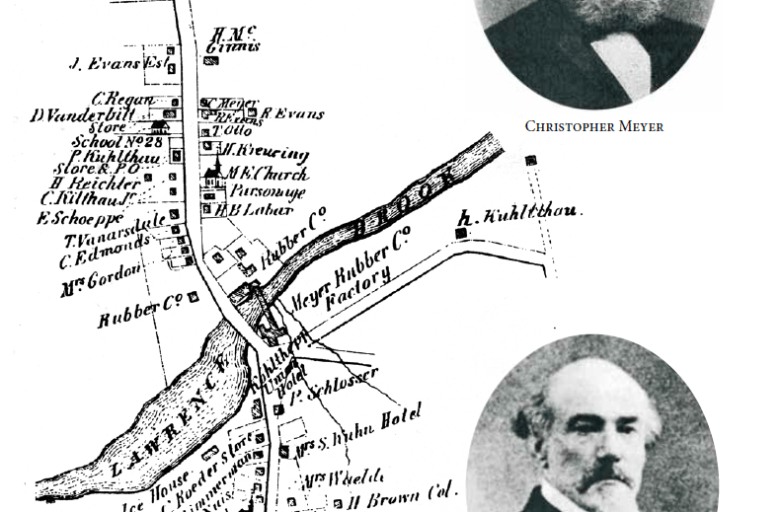
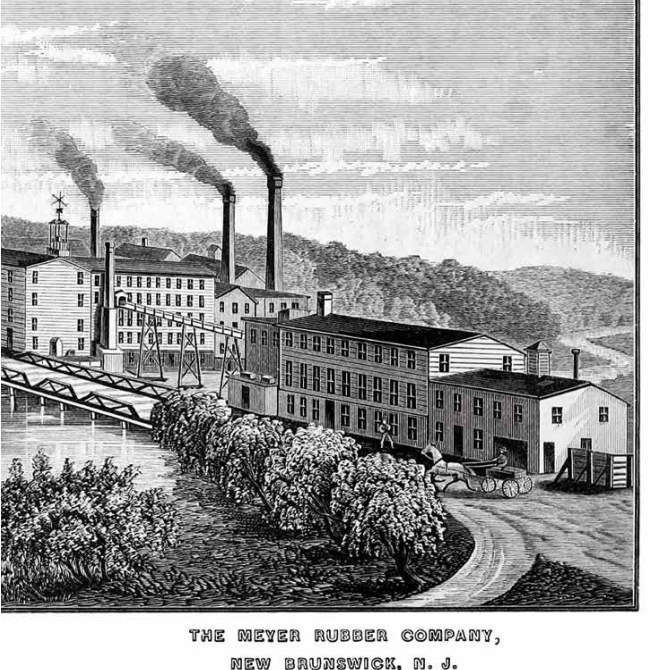
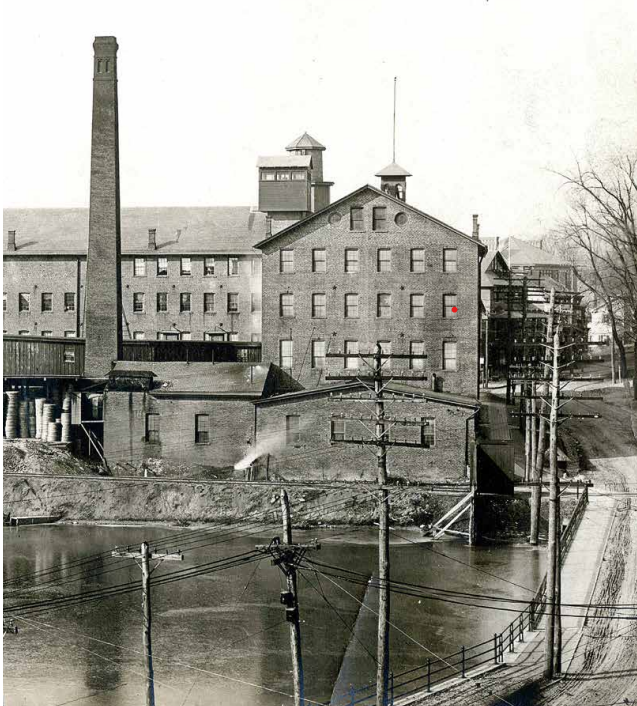
The greatest boom that the borough of Milltown has seen is on foot at the present time with the completion of a part of the new Michelin Tire factory. People are hurrying about and the current gossip is, “What’s going to happen next?” About five hundred men are busy on the job, divided into a day shift and a night shift, hence the work never ceases. The first four sections of the factory, which were begun on June 2 last, and which were specified to be finished about September 1, are well under way and will be in readiness by that date.

People are rushing to Milltown daily in quest of rooms, and these are only to be had at a very high rental.

The new sections will be adjacent to the present structure used by the International A. & V. Tire Co. They are designated as sections Nos. 4, 5, 6, and 7, and their dimensions are: 276 feet by 104 feet; 109 feet by 69 feet; 51 feet by 137 feet; and 81 feet by 104 feet, respectively. Two other buildings, which are to be used in the manufacture of the company’s tires, are known as sections No. 12 and 13. Their dimensions are 82 feet by 104 feet and 124 feet by 104 feet, respectively.
Section No. 8 is a small brick structure used for storage purposes; section No. 9 is to be the engine room; section No. 10 will be the power house of the plant, in which there will be four 500-horsepower boilers and two powerful turbine engines. Section No. 11 will be a repository for benzine.

Machinery from France.

Five large presses and five lathes have been shipped from France to the scene of activity, and the machinery that has been received is being erected with the same rapidity as has characterized the erection of the buildings.

The new additions will give about 80,000 square feet of floor space, and buildings will be erected from time to time as more room is required.

The work is being done by the John W. Ferguson Contracting Co. of Paterson, and George L. Kyle, the company’s superintendent, is supervising the work.

With the completion of the work after the merger with the French company is consummated, the offices of the firm will be moved from Ford Avenue, where they are now located, to the second floor at the corner of Ford Avenue and Main Street.

In all, nine sections have been added to the present plant, whereas only four sections were contemplated when ground was broken on June 2 last. The factory will be run night and day, and will be illuminated at night by 8,000 powerful lamps.

Branch offices of the company will be established in all the leading cities throughout the United States.

Houses will be erected by the firm for employees that they will bring here and every advantage will be offered to those who will make Milltown their future home and engage in work at the factory. Some 2,500 hands will be required when the factory is completed.

The cost of the factory and machinery included will run well up in the millions, but as yet no definite figure will be given out.


This Day in History: August 20th, 1914

This Day in History: August 20th, 1914

THREE BARNS DESTROYED IN $20,000 FIRE

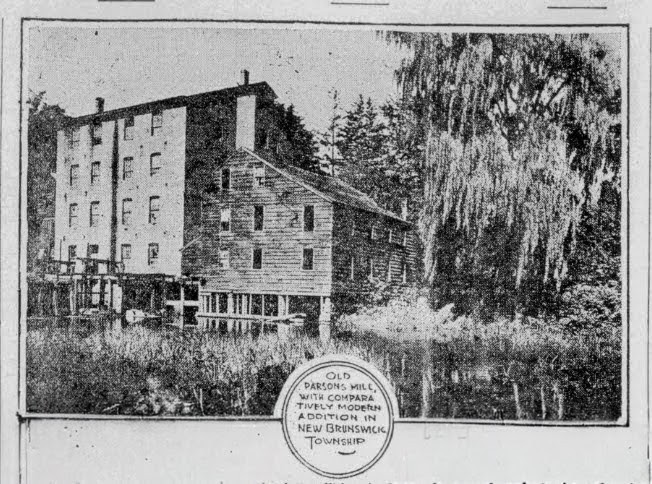
Local and Milltown Firemen, in Heroic 3-Hour Battle, Saved Beautiful Home and Snuff Mills of Jas. M. Parsons in North Brunswick – Origin is Unknown – All Live Stock Employees Save

Heroic work on the part of Captain George J. Kuhn, Jr., and his men of Engine Co. No. 1, saved the beautiful home and the big snuff mills of James M. Parsons, in North Brunswick township from being destroyed by fire yesterday afternoon, when fire was discovered in one of the barns nearby, at 3:30 o’clock. Workmen at the place quickly formed a bucket brigade in an effort to check the fire, but it was soon seen that they were unable to handle the fire which was quickly enveloping the barn, and fearing that it would spread to the big snuff mills and to the Parsons home, word was sent to this city and Milltown for help.

Assistant Chief Sass, who was on duty yesterday, Chief Francis being away, received the message and under the rule recently adopted by Common Council it was understood that no fire apparatus was to be sent out of the city, was unable to give any assurance as to whether or not they could do anything but he promptly got in touch with the new fire commissioners and they dispatched Liberty Engine Co. No. 1, with Captain Kuhn and five men to the scene. It took the big Waterous auto just eight minutes to make the run and running the engine close to the Parsons pond, soon had water on the fire, which by this time had spread to another barn.

Milltown firemen also responded with their chemical automobile and did excellent work about the other buildings, but the big engine pumping a stream of water on the flames was the means of saving the big snuff mills, the tobacco house, and the Parsons home, and for three hours, without a hitch, she worked like a charm.

Assistant Chief Sass went with the firemen and directed the work for a time, but on account of the absence of Chief Francis he had to return to this city after the work had been started and Captain Kuhn and his men worked like trojans, receiving very little assistance from those about the place, and when they had completed their work they were pretty well exhausted. Five men to work an engine, take care of the nozzle, pull the hose here and there was no easy task, but they never flinched once to the duty they had been called to perform, but clearly demonstrated that more men are needed in the department.

Just how the fire started is a mystery. The buildings being of frame it did not take long for the fire to eat its way through the building and leap to the next building. The contents of the barn that were movable were all saved by the men of the snuff mills, but a large quantity of wheat was destroyed.

The barns were completely burned to the ground. It was about six o’clock when the local firemen had stopped work on the fire and they returned about 8 o’clock.

Commissioners Harry J. Rolfe and James M. Barkelew were out to the fire in the automobiles and looked after the local firemen.

Damage Near $20,000.


There were three buildings burned to the ground. All were closely located. Louis Rebeck, in conversation with a Home News reporter last night said that he could give no cause for the fire. He said the mill employees fought the fire with pails of water after it had been discovered by Theodore Applegate. Mr. Applegate smelled smoke, and investigated and found the barn aflame. He called the others. The flames soon spread and then the employees got busy and saved all the live stock. They met with considerable difficulty in saving the pigs, which darted for the flames. A number of handsome sleighs belonging to Mr. Parsons were destroyed.

Mr. Parsons was away at the shore near Atlantic City, and last night had not yet been notified of the fire. Communication with him failed because he was out on his yacht. The damage, as was estimated last night, will be about $20,000, covered by insurance.

About twenty men are employed in the snuff mill, which was saved.

Big Kick


Considerable comment was expressed by many on the fact that the commissioners had allowed the apparatus to go outside of the city limits, it having been clearly understood that no city apparatus should leave the city to help outside communities. This was done because of the attitude of several townships towards the city when they wanted something and if help did go it was felt that the township should pay for the services.

Recently in Elizabeth, the Keans asked for help from the Elizabeth department, but they were refused, being out of the city limits.

The commissioners however are now in charge and they of course felt that it was a case of giving help or the burning down of the mills and other property, which would have thrown out of work a large number of men.

Ruins Aflame All Night.


Though the firemen left the scene between 7:30 and 8 o’clock, there was still plenty of fire in the ruins, and every gust of wind stirred up the fire again and sent showers of sparks in all directions, endangering the Parsons’ home and the mill. Shortly after 9 o’clock last night the Milltown firemen were again called to the scene.

The flames from the ruins illuminated the sky all night, and there was still fire this morning.

The engine of Co. No. 1, of this city, almost pumped the pond dry of water.

Michelin Sounds Alarm.


The Michelin fire whistle was sounded at 12 minutes of four yesterday and before four minutes had elapsed the Eureka Fire truck was passing the Michelin Tire factory bound for the scene of the disaster. The truck was driven by Chris Jensen, a member of the Milltown patrol. Foreman Elwood Boice, first assistant J. M. Brindle and second assistant Martin Mueller, of Eureka Fire Company, were among the first to appear on the scene.

It was a fortunate occasion that the wind was west yesterday and in case it had been blowing in the opposite direction the damage would undoubtedly have been very much greater.

Some of the Milltown firemen that were unable to get on the fire truck ran all the way to Parsons’ and by the time they reached there were about exhausted. Foreman Boice and Charles Christ were the first to climb a ladder on one of the buildings used as a storehouse. They stuck to their post fighting the fire from one side of the roof until the opposite side caved in and they were forced to move. C. Christ had his arm cut while sliding down a ladder.

The firemen realized that it was useless to try to save the main barn and wagon shed where the fire first started and thus played on the surrounding buildings until they felt sure it would not spread any further.

Among the Milltown fire fighters other than those already mentioned were ex-fireman Aubrey Kuhlbau, Oscar Harkins, of the Patrol, Messrs. Charles Christ, William Beecher, George Crabiel, George Lowne, Daniel Brown, John Miller, George Hoffer, George Heyl, John Deutsch, H. Christ, Aurendon, Charles Anderson, Charles Denhard, and George Knoll.

John Christ, Charles Denhard, proprietor of the Hotel Denhard, was hit in the head with a flying board at the fire yesterday, but the injury is not serious.
This Day in History: August 19th, 1905

This Day in History: August 19th, 1905

MILLTOWN BRIDGE IS FALLING DOWN

MILLTOWN, Aug. 19—The Milltown bridge is being torn down now. Start was made yesterday. Look out for “an injunction which will act as a stay of proceedings,” when it gets so we will have to jump over from pole to pole, or walk over on the ice. Nearly every large structure has to go through the courts before completion, you know.

The German church picnic was a great success in every way. We are told “Everything was eaten up except some bottles of soda water.”

Rev. W. T. Barny will preach in his German church both morning and evening.

In the Methodist Church, Rev. George S. Sorber, of the Dutch Reformed church at York, Pa., will preach in the morning and the pastor, Rev. J. E. Shaw, will preach in the evening.

Rev. Mr. Shaw attended the opening of the camp meeting services at Ocean Grove, Friday.

Mrs. Jos. A. Headley and her niece, Miss Mabel Hagaman, of Blackwell’s Mills, visited relatives in Elizabeth this week and enjoyed as best they could the long trolley ride in the rain.

The J. A. C. Club of Milltown will hold their first grand picnic in the Milltown grove opposite Parsons Grove, on Saturday, September 2.


This Night in History: June 27th, 1906

This Night in History: June 27th, 1906

Prize Fight To-Night

Mayor Heustis, of Milltown, Alerts Sheriff of Planned Mill in Parsons Grove

Mayor Heustis of Milltown and Borough Attorney Edward W. Hicks visited Sheriff Church this morning. The Mayor notified the Sheriff that he had information indicating that some New Brunswick sportsmen proposed to hold a prize fight in Parsons’ Grove this evening.

One of the principals, according to the Milltown officials’ information, is a well-known New Brunswick boxer in the lightweight class, and his opponent is an out-of-town bruiser.

Prosecutor Berdine was notified, and it was decided to have officers on hand to break up the “mill” if it starts. If the promoters decide to hold it elsewhere, detectives will be busy watching to trail them and make arrests if found advisable.