Milltown’s Splendid Possibilities for Adoption of Beautiful Civic Plan Shown by Architect and Town Planner of U. S. Housing Corporation
(By H. M. Olmsted, Architect and Town Planner of U. S. Housing Corporation.)
Six months ago the writer was asked by one of the engineers of the U. S. Housing Corporation, what kind of a place Milltown was for one to make it his home. Not having then visited Milltown, I could not answer him. A passer-by overhearing the question, promptly and officiously answered by stating that the town was a mill-hand section and not fit to live in. So Milltown lost the opportunity of gaining one more good citizen.
At the request of the editor, the writer visited Milltown several days ago. The few intervening miles between New Brunswick and Milltown were covered rapidly and comfortably. Arriving at the north end of Main street, we drove to Kuhlthau Avenue and alighting there proceeded on foot over the village.
For a town of which I had heard unfavorable reports, I can only say that I was delightfully surprised at everything I saw, from the moment of my arrival upon its well-paved sidewalks. On every hand one finds substantial and attractive homes—real homes, not imitation ones—real lawns, gardens, orchards, with trees and shrubbery of all kinds in profusion. To add to the effect, there is much water, many brooks, and the lake with its interesting waterfall just below the Main street bridge.
My first, hence lasting, impression of Milltown is that it occupies an envious and unique position in the ranks of suburban towns, as well as in its natural and beautiful surrounding country.
A Stroll Through the Town
Our way led down Main to Sand street, thence through the woods, south of the lake, to Bogs Brook, back along the shore of the lake, to Main street bridge and waterfalls and from there out over the portion of the town lying north of the bridge.
We saw about 500 real homes with 100-foot square lawns, having gardens, orchards, and grape arbors. We saw some dozen or more substantial stores, several churches, schools, factories, etc.
On every hand the properties are well laid out and excellently maintained. Along north Main street there are many homes which might be called pretentious, were it not for the fact that their owners evidently placed more importance on the value of a “real home place” than on pretentiousness. Holding the same opinion, I agree with that policy.
A “home” is better than a pretense. When one sees so many uniformly charming houses, lawns, and gardens, it is evident that the citizens have not only high civic pride but an excellent knowledge of how a home and a town should be conducted.
We saw but one building actually needing paint and minor repairs, and I strongly suspect that that one was deserted.
Almost without exception, front and rear yards were charming. The arrangement of trees and shrubs was natural and pleasing.
As we passed house after house and found solely trim lawns and gardens, our surprise grew steadily, because here was a town of which we had heard just the opposite of the reality.
Splendid Views Obtainable
Milltown is located in a hilly country of considerably higher altitude than her neighbor, New Brunswick. From these hills and in between them, charming glimpses of the setting of the town are obtainable. The soil is a rich sandy loam and on the sides of the slopes in the woodland are a number of good gravel and sand pits. Water is abundant as evidenced by the lake and its tributary brooks. On every side the eye of the artist and nature lover may drink in sight of a country that charms and delights. At the west end of Sand street along the slopes of the hill there, leading down 100 feet or so to the lake, picturesque views of the lake and its setting may be had. A clever artist could reproduce that scene upon his canvas and command practically his own price for the work.
Standing on the bridge or below the waterfalls, another pleasing view is had of the valley and rising hillside off to the southeast. It was at about such a spot that my business eye lingered for considerable time, on account of its possibilities for the location of a villa building and grounds, which the public might decide to erect and use as a holiday and evening dining place.
On the trestle below the waterfalls, another pleasing view is of Lawrence Brook, as it leaves the falls and winds in and out across one of the prettiest of little valleys, until it finds its way outside the town limits under the railroad bridge, some distance from the falls. Another delightful valley crosses the line of Vanderbilt avenue; its center line carrying a small stream leading into Lawrence Brook. A number of attractive cottages dot the hillside between the Raritan River railroad and Ryder’s Lane.
Along northern Main street are located many spacious and charming homes surrounded by large, well-trimmed lawns. Here, as elsewhere, equal refinement and beauty predominate. I judge the larger places belong to the most substantial citizens of Milltown. These homes are indeed charming.
The Small Cottages
Along Ford avenue or rather boulevard—for in reality, it is a 100-foot or more wide boulevard—with its stately rows of trees, we walked to the ballpark and thence north along South street, past the Michelin line of frame cottages. It is remarkable that here, too, even in these factory properties, with their plots of 50 by 150 feet, we found none but pretty lawns and gardens and all seemed filled with a bounteous supply of flowers and vegetables, sufficient to keep the average family all summer and longer.
A Part of the Secret of Beauty
After repeated exclamations from my wife, she had me inquire of a friendly citizen as to the reason for the unusual uniformity of the beauty of the gardens and homes.
Said the native: “Friend, I hardly know just how to answer your question, because I have lived here so long that it has not seemed unusual to me, however, now that you point it out, I must admit, that it is an unusual sight, when compared with many other villages. I believe the sights which you compliment are due to a number of different causes. First, the citizens of this town take a big civic pride in their town, its government, and their homes. These things mean a great deal to them. Then, too, the town authorities and leading business men as well as the stores and factories have taken a keen interest in having this town a home-like and beautiful place, and they have succeeded. The people are united and back of the movement.”
Prizes for Gardens and Homes
Continuing, the citizen informed us that the authorities and factories had a regularly constituted prize committee, and that it was the custom to make unannounced visits to the homes and gardens of the citizens and award substantial prizes, not only for the best lawn and garden but for the best-kept house, both exterior and interior.
This competition, aided by a strong spirit of civic pride, had caused a wonderful change in the town. He told us that twelve years ago, the streets of the village were overgrown with grass and weeds. If this is correct, then indeed, a miracle has been wrought and it is doubtless due not only to the cooperation of citizens and their authorities but to a much bigger and finer thing, namely, a refinement of brain and heart, which evidently exists throughout the village, else all we witnessed, could not have been accomplished in so brief a period.
Improvements Contemplated
Another citizen stated that a number of improvements were in contemplation. In the main, these consisted of a new pavement on Main street, both north and south of the bridge, and a brand new theater building where only first-class pictures will be shown and at merely a nominal cost as compared with the prices obtained in other towns.
Sidewalks and curbs are being laid in the town as fast as necessity demands. As to the roads, I judge the sandy-gravelly earth where no pavement exists prevents a muddy condition, so that unpaved roadways are not such a bad feature as one might be led to suppose. Even without more concrete roadways the city is pretty well off as it is in this respect. It would be an unusual condition, indeed, if the town should determine to concrete pave all of its streets, but I would not be surprised to learn that such a step was contemplated.
Government of Milltown
I was informed that the town is governed by a mayor and board of councilmen, and that the town owns the power plant, a perfect sewer system and water plant as well. The sewer system cost over $100,000 to construct.
Milltown is exceedingly thrifty. It maintains a good bonding margin and is, I believe, practically free of indebtedness. This shows excellent management. Should a new pavement be laid in Main street, there will doubtless be a straightening and realignment of all curbs and gutters. In connection with curbing, it is worthy of comment that in the thirty or more U. S. housing projects, erected during the war, the streets of such projects invariably had installed a one-piece concrete curb and gutter, curb being six inches thick with an 18-inch wide gutter. This was made for pleasing effect and perfect alignment.
What the Future Might Bring
It would not be surprising to learn that the citizens of Milltown had decided to take a stronger grip on their opportunities for home and civic advancement and would soon start a larger campaign to utilize all of their storehouse of opportunities surrounding the town. If such a movement is once started, then in my opinion, their village will assume rightfully a leading place throughout the entire state in the matter of prosperity, civic progressiveness and attractiveness.
From the viewpoint of the town planner and landscape architect, Milltown has a long way to go ‘ere the possibilities for further advancement be exhausted. This is due to Milltown’s natural resources and her surroundings.
Town Planner’s Viewpoint
Regarding Milltown from this point of view, I should say that her future is fraught with excellent possibilities. I noticed that the center of town seems to be at the bridge and here almost nothing in the nature of real town planning or improvement has been done. The bridge, Main street, the lake, brooks, falls, and woods south of the lake present an excellent array of points upon which a good start might be made if such were the wish of the citizens.
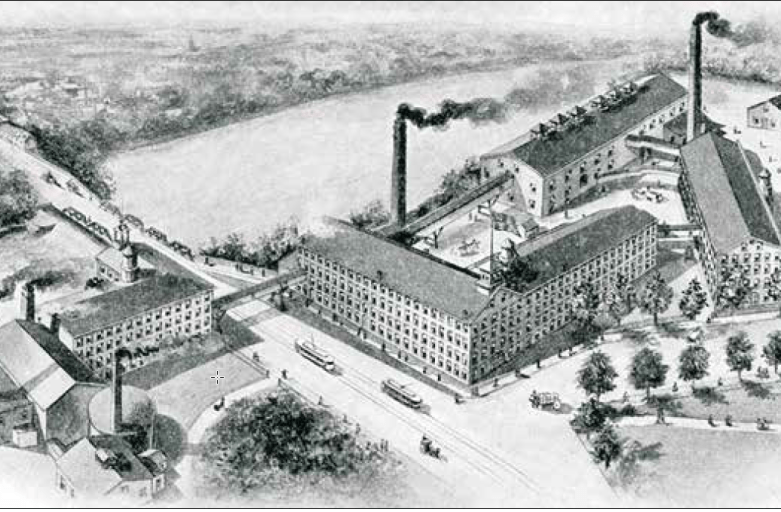
As your town grows in population and prosperity it must progress, as every thinking man knows, or it will lapse upon itself and go backwards. So along the thought of a progressive policy, naturally, it occurs to anyone engaged in town planning that after the repaving and realigning of curbs etc., along Main street, a natural thing to do would be to erect along that street electric light standards at intervals of, say, 15 feet, each one having a cluster of globe lights. This one step would transform the street into a beautiful boulevard—make of it a delightful promenade in the evening and would have the effect of advancing prosperity by attracting more business to stores in the town. Another thought, which will occur to everyone, is that all of the large buildings near the bridge might, with almost no expense, plant English ivy and shrubbery across the front, sides, and rear of these buildings, and thus make them pleasing and charming to the eye of the citizen and the motorists who pass that way in ever-increasing numbers. This refers particularly to the Michelin factories, the power plant, car barns, and two large hotel buildings just south of the bridge.
I am sure my readers will not think me guilty of naming any superior knowledge or too personal assertiveness in this matter, because no doubt the people and authorities of Milltown have long thought of these possibilities and may even now have them in process of installation, but as one requested to write on the subject, I am sure no offense will be taken in exposing the natural thoughts likely to occur to everyone at the same time.
The Bridge and Water Falls
What an artistic setting for a town bridge of concrete with separated pedestrian and vehicle passages. With clusters of globe electric lights strung along each side of it and to add to the effect, an eastern and western walkway, leading on either side and from the summit, below the waterfalls. With a few concrete benches and concrete flower boxes properly arranged, that spot would be indeed artistic and effective as a natural center of the town.
A Site for the Theater
Doubtless such a site has been decided upon, ‘ere this, but the thought came to me unaided, that rose bespied by the old mill building or remnants at the waterfalls. The lot north of the power plant also might be cleaned up and made very charming.
A Site for a City Park
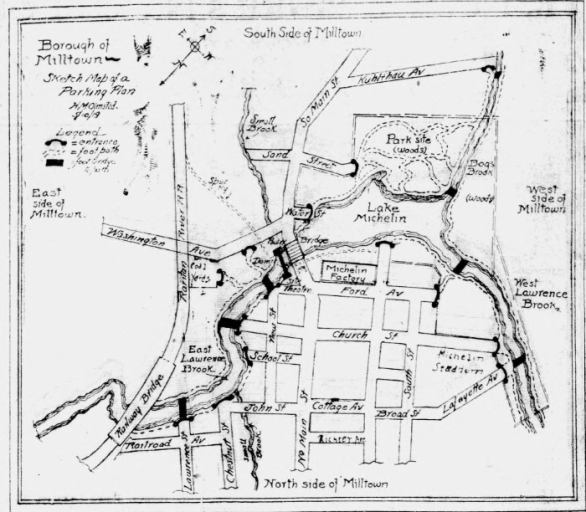
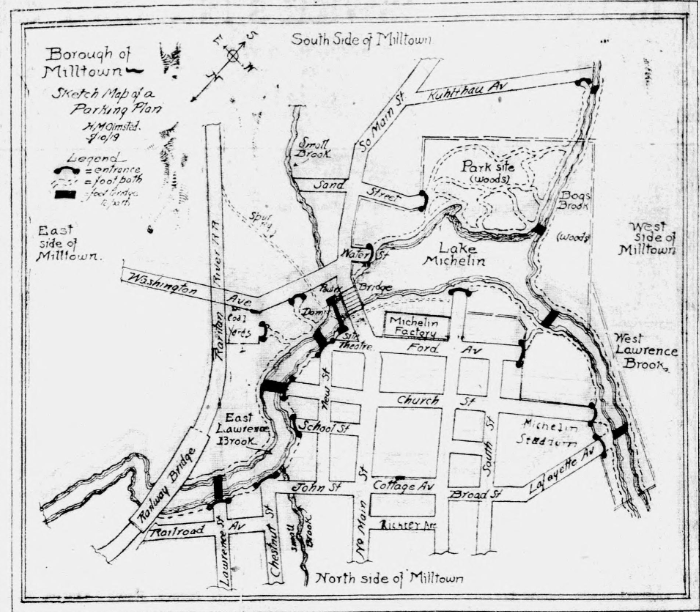
I feel certain that the idea has long since been advanced to build a city park in the large woodlands south of the lake. It is an ideal place, and I have endeavored to roughly complete my thought in this matter in the drawing accompanying this article. This plan illustrates a parking system devised to take in both branches of Lawrence Brook, and using both would also take in Bogs Brook, besides three sides of the lake, the bridge, and waterfalls, and all of the woods west of Main street and other land west of the lake as well as Lawrence Brook to the Raritan River railroad tracks. The plan would afford three Main street entrances to the woods, namely Pond, Sand, and Bogs street, besides would be entrances to the public along the brook from no less than 10 streets and areas.
Of course, the average citizen will throw up his hands and say that such a project is impracticable and that other rights are involved and that it cannot be done and all the comment will be against it, but then, it could be done, providing all of the people agreed upon it and the plan was wanted. As for the expense, it would be practically nominal, for the work to be done, outside of the securing of the land. The land requirement might prove a stumbling block, but under intelligent cooperative direction all of the people could be brought into accord on the plan and the project would attract the state’s attention with interest over the newness and attractiveness of the scheme. Besides this, I was assured that the 500 people of Milltown would take pride and happiness. It would bring to Milltown a desirable number of new citizens with their scale of prosperity.
I know of no plan so effective and so slight in cost to place Milltown in the center of all New Jersey in point of progressiveness and attractiveness. I am not Job’s comforter when I write this because I also have under contract to help better a city like the one which the Housing Corporation has built in New Brunswick, and which is now tenanted, though only so completed after a month of hard work. I am writing this because of love of the work, and because we and all the corporations run by and for their city’s happiness.
In next Sunday’s Times, the writer will continue the foregoing article and tell of the unique history of this fine water supply, the importance of street lighting, bounteous trees and shrubs, beautifying the factories, thought of a restaurant, and summary of the advantages of the borough.
A Stranger’s First Impressions of Milltown Borough
Briefly put, here are the impressions that came to H. M. Olmsted, architect and town planner, when he visited Milltown, our neighbor, to give The Sunday Times his ideas of its possibilities for the adoption of a civic plan. He found:
A clean, orderly, tidy place attractively situated on high ground with unusually pretty surrounding country.
A town with remarkably easily adaptable advantages including a pretty lake, which could be a feature of a charming park.
A town with a fine street for the principal thoroughfare to be ideally set off by the use of clusters of electric lights on street poles, etc.
Plenty of civic pride, and encouragement to keep it up on the part of town officials.
Well-maintained homes and pretty gardens, vastly improved through the stimulus of prizes offered.
Plenty of plans for future improvements in the town that show an interest in making Milltown grow.
Big possibilities that would follow the adoption of a new name for the village.
A healthful place with a climate that holds great possibilities for making it an ideal residence place.
That beautifying factories would do a whole lot to promote the town’s attractiveness.
An idea for a wayside restaurant that could be run on a cooperative plan.