This Day in History: August 19th, 1905

This Day in History: August 19th, 1905

MILLTOWN BRIDGE IS FALLING DOWN

MILLTOWN, Aug. 19—The Milltown bridge is being torn down now. Start was made yesterday. Look out for “an injunction which will act as a stay of proceedings,” when it gets so we will have to jump over from pole to pole, or walk over on the ice. Nearly every large structure has to go through the courts before completion, you know.

The German church picnic was a great success in every way. We are told “Everything was eaten up except some bottles of soda water.”

Rev. W. T. Barny will preach in his German church both morning and evening.

In the Methodist Church, Rev. George S. Sorber, of the Dutch Reformed church at York, Pa., will preach in the morning and the pastor, Rev. J. E. Shaw, will preach in the evening.

Rev. Mr. Shaw attended the opening of the camp meeting services at Ocean Grove, Friday.

Mrs. Jos. A. Headley and her niece, Miss Mabel Hagaman, of Blackwell’s Mills, visited relatives in Elizabeth this week and enjoyed as best they could the long trolley ride in the rain.

The J. A. C. Club of Milltown will hold their first grand picnic in the Milltown grove opposite Parsons Grove, on Saturday, September 2.


This Day in History: May 18th, 1919

This Day in History: May 18th, 1919

Milltown’s Splendid Possibilities for Adoption of Beautiful Civic Plan Shown by Architect and Town Planner of U. S. Housing Corporation

(By H. M. Olmsted, Architect and Town Planner of U. S. Housing Corporation.)

Six months ago the writer was asked by one of the engineers of the U. S. Housing Corporation, what kind of a place Milltown was for one to make it his home. Not having then visited Milltown, I could not answer him. A passer-by overhearing the question, promptly and officiously answered by stating that the town was a mill-hand section and not fit to live in. So Milltown lost the opportunity of gaining one more good citizen.

At the request of the editor, the writer visited Milltown several days ago. The few intervening miles between New Brunswick and Milltown were covered rapidly and comfortably. Arriving at the north end of Main street, we drove to Kuhlthau Avenue and alighting there proceeded on foot over the village.

For a town of which I had heard unfavorable reports, I can only say that I was delightfully surprised at everything I saw, from the moment of my arrival upon its well-paved sidewalks. On every hand one finds substantial and attractive homes—real homes, not imitation ones—real lawns, gardens, orchards, with trees and shrubbery of all kinds in profusion. To add to the effect, there is much water, many brooks, and the lake with its interesting waterfall just below the Main street bridge.

My first, hence lasting, impression of Milltown is that it occupies an envious and unique position in the ranks of suburban towns, as well as in its natural and beautiful surrounding country.

A Stroll Through the Town

Our way led down Main to Sand street, thence through the woods, south of the lake, to Bogs Brook, back along the shore of the lake, to Main street bridge and waterfalls and from there out over the portion of the town lying north of the bridge.

We saw about 500 real homes with 100-foot square lawns, having gardens, orchards, and grape arbors. We saw some dozen or more substantial stores, several churches, schools, factories, etc.

On every hand the properties are well laid out and excellently maintained. Along north Main street there are many homes which might be called pretentious, were it not for the fact that their owners evidently placed more importance on the value of a “real home place” than on pretentiousness. Holding the same opinion, I agree with that policy.

A “home” is better than a pretense. When one sees so many uniformly charming houses, lawns, and gardens, it is evident that the citizens have not only high civic pride but an excellent knowledge of how a home and a town should be conducted.

We saw but one building actually needing paint and minor repairs, and I strongly suspect that that one was deserted.

Almost without exception, front and rear yards were charming. The arrangement of trees and shrubs was natural and pleasing.

As we passed house after house and found solely trim lawns and gardens, our surprise grew steadily, because here was a town of which we had heard just the opposite of the reality.

Splendid Views Obtainable

Milltown is located in a hilly country of considerably higher altitude than her neighbor, New Brunswick. From these hills and in between them, charming glimpses of the setting of the town are obtainable. The soil is a rich sandy loam and on the sides of the slopes in the woodland are a number of good gravel and sand pits. Water is abundant as evidenced by the lake and its tributary brooks. On every side the eye of the artist and nature lover may drink in sight of a country that charms and delights. At the west end of Sand street along the slopes of the hill there, leading down 100 feet or so to the lake, picturesque views of the lake and its setting may be had. A clever artist could reproduce that scene upon his canvas and command practically his own price for the work.

Standing on the bridge or below the waterfalls, another pleasing view is had of the valley and rising hillside off to the southeast. It was at about such a spot that my business eye lingered for considerable time, on account of its possibilities for the location of a villa building and grounds, which the public might decide to erect and use as a holiday and evening dining place.

On the trestle below the waterfalls, another pleasing view is of Lawrence Brook, as it leaves the falls and winds in and out across one of the prettiest of little valleys, until it finds its way outside the town limits under the railroad bridge, some distance from the falls. Another delightful valley crosses the line of Vanderbilt avenue; its center line carrying a small stream leading into Lawrence Brook. A number of attractive cottages dot the hillside between the Raritan River railroad and Ryder’s Lane.

Along northern Main street are located many spacious and charming homes surrounded by large, well-trimmed lawns. Here, as elsewhere, equal refinement and beauty predominate. I judge the larger places belong to the most substantial citizens of Milltown. These homes are indeed charming.

The Small Cottages

Along Ford avenue or rather boulevard—for in reality, it is a 100-foot or more wide boulevard—with its stately rows of trees, we walked to the ballpark and thence north along South street, past the Michelin line of frame cottages. It is remarkable that here, too, even in these factory properties, with their plots of 50 by 150 feet, we found none but pretty lawns and gardens and all seemed filled with a bounteous supply of flowers and vegetables, sufficient to keep the average family all summer and longer.

A Part of the Secret of Beauty

After repeated exclamations from my wife, she had me inquire of a friendly citizen as to the reason for the unusual uniformity of the beauty of the gardens and homes.

Said the native: “Friend, I hardly know just how to answer your question, because I have lived here so long that it has not seemed unusual to me, however, now that you point it out, I must admit, that it is an unusual sight, when compared with many other villages. I believe the sights which you compliment are due to a number of different causes. First, the citizens of this town take a big civic pride in their town, its government, and their homes. These things mean a great deal to them. Then, too, the town authorities and leading business men as well as the stores and factories have taken a keen interest in having this town a home-like and beautiful place, and they have succeeded. The people are united and back of the movement.”

Prizes for Gardens and Homes

Continuing, the citizen informed us that the authorities and factories had a regularly constituted prize committee, and that it was the custom to make unannounced visits to the homes and gardens of the citizens and award substantial prizes, not only for the best lawn and garden but for the best-kept house, both exterior and interior.

This competition, aided by a strong spirit of civic pride, had caused a wonderful change in the town. He told us that twelve years ago, the streets of the village were overgrown with grass and weeds. If this is correct, then indeed, a miracle has been wrought and it is doubtless due not only to the cooperation of citizens and their authorities but to a much bigger and finer thing, namely, a refinement of brain and heart, which evidently exists throughout the village, else all we witnessed, could not have been accomplished in so brief a period.

Improvements Contemplated

Another citizen stated that a number of improvements were in contemplation. In the main, these consisted of a new pavement on Main street, both north and south of the bridge, and a brand new theater building where only first-class pictures will be shown and at merely a nominal cost as compared with the prices obtained in other towns.

Sidewalks and curbs are being laid in the town as fast as necessity demands. As to the roads, I judge the sandy-gravelly earth where no pavement exists prevents a muddy condition, so that unpaved roadways are not such a bad feature as one might be led to suppose. Even without more concrete roadways the city is pretty well off as it is in this respect. It would be an unusual condition, indeed, if the town should determine to concrete pave all of its streets, but I would not be surprised to learn that such a step was contemplated.

Government of Milltown

I was informed that the town is governed by a mayor and board of councilmen, and that the town owns the power plant, a perfect sewer system and water plant as well. The sewer system cost over $100,000 to construct.

Milltown is exceedingly thrifty. It maintains a good bonding margin and is, I believe, practically free of indebtedness. This shows excellent management. Should a new pavement be laid in Main street, there will doubtless be a straightening and realignment of all curbs and gutters. In connection with curbing, it is worthy of comment that in the thirty or more U. S. housing projects, erected during the war, the streets of such projects invariably had installed a one-piece concrete curb and gutter, curb being six inches thick with an 18-inch wide gutter. This was made for pleasing effect and perfect alignment.

What the Future Might Bring

It would not be surprising to learn that the citizens of Milltown had decided to take a stronger grip on their opportunities for home and civic advancement and would soon start a larger campaign to utilize all of their storehouse of opportunities surrounding the town. If such a movement is once started, then in my opinion, their village will assume rightfully a leading place throughout the entire state in the matter of prosperity, civic progressiveness and attractiveness.

From the viewpoint of the town planner and landscape architect, Milltown has a long way to go ‘ere the possibilities for further advancement be exhausted. This is due to Milltown’s natural resources and her surroundings.

Town Planner’s Viewpoint

Regarding Milltown from this point of view, I should say that her future is fraught with excellent possibilities. I noticed that the center of town seems to be at the bridge and here almost nothing in the nature of real town planning or improvement has been done. The bridge, Main street, the lake, brooks, falls, and woods south of the lake present an excellent array of points upon which a good start might be made if such were the wish of the citizens.

As your town grows in population and prosperity it must progress, as every thinking man knows, or it will lapse upon itself and go backwards. So along the thought of a progressive policy, naturally, it occurs to anyone engaged in town planning that after the repaving and realigning of curbs etc., along Main street, a natural thing to do would be to erect along that street electric light standards at intervals of, say, 15 feet, each one having a cluster of globe lights. This one step would transform the street into a beautiful boulevard—make of it a delightful promenade in the evening and would have the effect of advancing prosperity by attracting more business to stores in the town. Another thought, which will occur to everyone, is that all of the large buildings near the bridge might, with almost no expense, plant English ivy and shrubbery across the front, sides, and rear of these buildings, and thus make them pleasing and charming to the eye of the citizen and the motorists who pass that way in ever-increasing numbers. This refers particularly to the Michelin factories, the power plant, car barns, and two large hotel buildings just south of the bridge.

I am sure my readers will not think me guilty of naming any superior knowledge or too personal assertiveness in this matter, because no doubt the people and authorities of Milltown have long thought of these possibilities and may even now have them in process of installation, but as one requested to write on the subject, I am sure no offense will be taken in exposing the natural thoughts likely to occur to everyone at the same time.

The Bridge and Water Falls

What an artistic setting for a town bridge of concrete with separated pedestrian and vehicle passages. With clusters of globe electric lights strung along each side of it and to add to the effect, an eastern and western walkway, leading on either side and from the summit, below the waterfalls. With a few concrete benches and concrete flower boxes properly arranged, that spot would be indeed artistic and effective as a natural center of the town.

A Site for the Theater

Doubtless such a site has been decided upon, ‘ere this, but the thought came to me unaided, that rose bespied by the old mill building or remnants at the waterfalls. The lot north of the power plant also might be cleaned up and made very charming.

A Site for a City Park

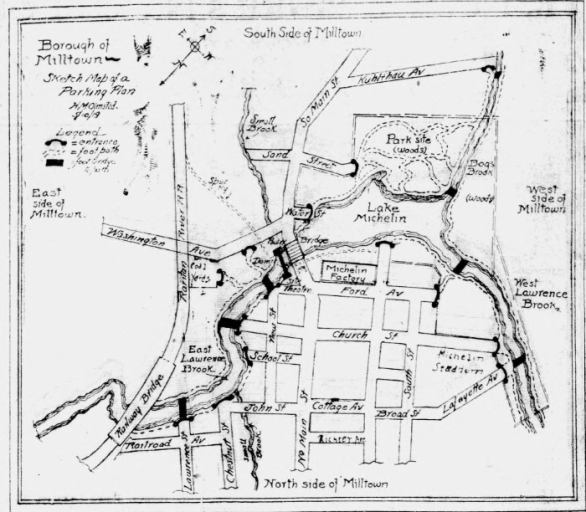
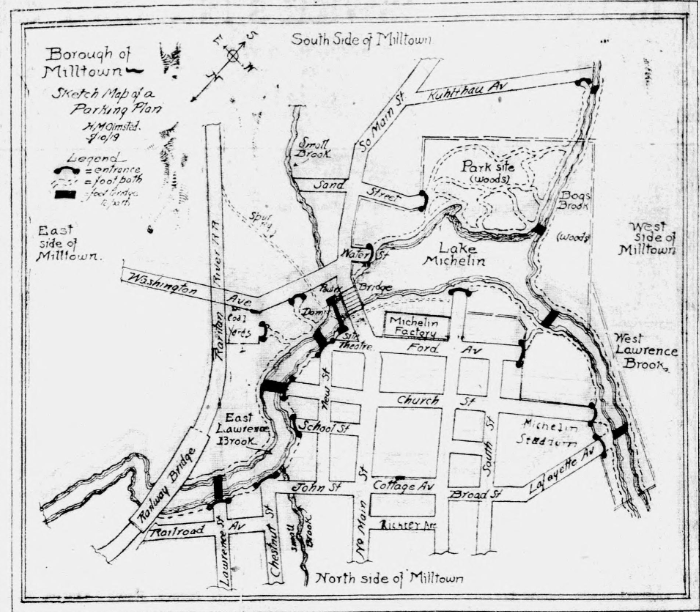
I feel certain that the idea has long since been advanced to build a city park in the large woodlands south of the lake. It is an ideal place, and I have endeavored to roughly complete my thought in this matter in the drawing accompanying this article. This plan illustrates a parking system devised to take in both branches of Lawrence Brook, and using both would also take in Bogs Brook, besides three sides of the lake, the bridge, and waterfalls, and all of the woods west of Main street and other land west of the lake as well as Lawrence Brook to the Raritan River railroad tracks. The plan would afford three Main street entrances to the woods, namely Pond, Sand, and Bogs street, besides would be entrances to the public along the brook from no less than 10 streets and areas.

Of course, the average citizen will throw up his hands and say that such a project is impracticable and that other rights are involved and that it cannot be done and all the comment will be against it, but then, it could be done, providing all of the people agreed upon it and the plan was wanted. As for the expense, it would be practically nominal, for the work to be done, outside of the securing of the land. The land requirement might prove a stumbling block, but under intelligent cooperative direction all of the people could be brought into accord on the plan and the project would attract the state’s attention with interest over the newness and attractiveness of the scheme. Besides this, I was assured that the 500 people of Milltown would take pride and happiness. It would bring to Milltown a desirable number of new citizens with their scale of prosperity.

I know of no plan so effective and so slight in cost to place Milltown in the center of all New Jersey in point of progressiveness and attractiveness. I am not Job’s comforter when I write this because I also have under contract to help better a city like the one which the Housing Corporation has built in New Brunswick, and which is now tenanted, though only so completed after a month of hard work. I am writing this because of love of the work, and because we and all the corporations run by and for their city’s happiness.

In next Sunday’s Times, the writer will continue the foregoing article and tell of the unique history of this fine water supply, the importance of street lighting, bounteous trees and shrubs, beautifying the factories, thought of a restaurant, and summary of the advantages of the borough.

A Stranger’s First Impressions of Milltown Borough

Briefly put, here are the impressions that came to H. M. Olmsted, architect and town planner, when he visited Milltown, our neighbor, to give The Sunday Times his ideas of its possibilities for the adoption of a civic plan. He found:

A clean, orderly, tidy place attractively situated on high ground with unusually pretty surrounding country.

A town with remarkably easily adaptable advantages including a pretty lake, which could be a feature of a charming park.

A town with a fine street for the principal thoroughfare to be ideally set off by the use of clusters of electric lights on street poles, etc.

Plenty of civic pride, and encouragement to keep it up on the part of town officials.

Well-maintained homes and pretty gardens, vastly improved through the stimulus of prizes offered.

Plenty of plans for future improvements in the town that show an interest in making Milltown grow.

Big possibilities that would follow the adoption of a new name for the village.

A healthful place with a climate that holds great possibilities for making it an ideal residence place.

That beautifying factories would do a whole lot to promote the town’s attractiveness.

An idea for a wayside restaurant that could be run on a cooperative plan.


This Day in History: April 22nd, 2024

This Day in History: April 22nd, 2024

Bagonye’s Chapel Is Weirdly Fitted Up For His Seances With Spirits

Milltown Man, Held on Witchcraft Charge, Tells of His Psychic Powers – Declares Woman’s Charge to Be Unfounded.

“Professor” Eugene I. Bagonye, head of the “First Christian Spiritualist Chapel of All Denominations” at Milltown, was released from the county jail late yesterday afternoon after a stay of several hours when his father, Stephen Bagonye of Milltown, furnished $1,000 bail for his appearance when wanted.

A charge of pretending to practice sorcery, conjuration, and enchantment will be threshed out by the Middlesex county grand jury next Friday.

The complaint is based on Section 71 of the New Jersey Crimes Act which provides that any person who “pretends to exercise conjuration, sorcery, and enchantment and pretends from his skill or knowledge to give good luck” shall be guilty of a misdemeanor.

The complaining witness, Mrs. Hilda Hobsholt of 145 Codwise Avenue, this city, claims that Bagonye not only did this but that he sold her a “good luck” powder for $5 and that he took her pocketbook containing $13 in addition. Bagonye claims that the case is simply a matter of persecution because he spurned Mrs. Hobsholt’s advances. He declares that she told him she was unhappy with her husband and that she wanted his help but that he told her he could work only through prayer.

The spiritualist is quite serious about his psychic powers. The chapel in which he holds his seances is weirdly fitted up. It is a room twelve feet long and eight feet wide on the ground floor of his “sanitarium,” Begonia Health House on Ryder’s Lane, Milltown, midway between the front porch and the back entry.

Red and Yellow Candles.

It has an altar before which yellow tapers burn while the “professor” is giving his seances and holding services and on the wall is his private creed before which a red candle burns.

These are the only lights in the room. The walls are decorated with religious pictures and figures and testimonials from grateful patients. There are figures of the Virgin Mary, the Sacred Heart of Jesus, St. John, St. Joseph, St. Anthony, and others, and there is a photograph of a bald-headed man living in Chicago who drew pictures on the back of it of spooks which Bagonye had summoned from the other world for his enlightenment.

Bagonye went over the collection last night with a reporter and named the person who had given him each of the decorations in the room. A cross sprouting miraculously from a turbulent ocean, with an attractive young woman clinging to one of the arms, was the gift of a man whom he had rescued from religious doubt, he said, and returned to his church. A figure of the Virgin Mary stamping on the head of a snake was a present from the parents of a seven-year-old boy whom Bagonye had cured of epilepsy.

The young man spoke with intense conviction of his supernatural powers but said he never did any levitation or table rapping or pretended to tell fortunes or cast horoscopes.

“The spirit takes control of me,” he said. “I go into a trance and I say what my spirit guide discloses to me and I interpret it to my patients. Sometimes the spirits of the loved ones of my patients take hold of me.”

Chauffeur and Secretary.

Begonia Health House is situated in the midst of large grounds, fairly well kept up. Bagonye says he gained possession of it in the course of his real estate business. He owns a powerful motor car and employs a chauffeur to drive it. He also employs a youth of this town as his secretary.

He intimates that he has vast resources at his command, but says that his present apparent affluence is the result merely of his success in the real estate business and that of the store which he turned over to relatives to run for him and recently sold.

Men of wealth and prominence, he says, are ready to back him in turning Begonia Health House into a spiritualistic sanatorium, but he is not sure whether he will take up their offer, as he fears they may be making it from selfish motives, and not with a desire to benefit humanity. If he does not take up that offer, he says, he may accept one to adopt a career in the motion pictures, appearing only in spiritualistic pictures.

Felt Psychic Power.

Bagonye, according to his own account, was born in Hungary twenty-six years ago and has been in this country since he was five years old. He is dark, with brilliant black eyes and wears a small mustache. He denies that he ever pretended to practice witchcraft or that he ever took any money from Mrs. Hobsholt or from any

others of his congregation except what was given to him freely.

He studied in a chiropractic school in Davenport, Iowa, but entered the army before being graduated. He always had felt that he possessed psychic power and spiritual healing power, he said, and when on November 1, 1918, when he was an instructor in cooking at Camp Raritan he involuntarily announced that the war would end within the next two weeks, he became convinced that this power should not be neglected.

The conviction grew upon him, and last August he gave up the confectionery store and real estate office he was running here and established Begonia Health House, the big yellow structure under Hungry Hill, in which his chapel, the First Christian Spiritualist Chapel of All Denominations, is situated.

He has about 25 regular “Communicants,” and a large transitory clientele.

Woman Tells Story.

Mrs. Hobsholt, whose parlor table decorated with a copy of Cupid’s Messenger, explained this morning to a reporter how she came to make a charge against Bagonye. She was interested in spiritualism, she said, and with others had been attending seances given by him since last December.

At various times, she said, she had given him sums of money for which he had asked her, the total being about $50, including $5 for a “good luck” powder. Recently, she said, she demanded her money back, and it was refused. This convinced her, she said, that Bagonye was a faker and that the factory employees, mostly of foreign birth, who attended the seances in his chapel, were his dupes.

In justice to them, she asserted, she obtained a warrant for Bagonye’s arrest. She showed a letter dated April 11, to which Bagonye’s name was signed, in which the writer admitted loans aggregating $38, but put forward counterclaims amounting to $80 for automobile trips to Newark and Trenton.

Under Modern Statute.

The complaint is not drawn under the old common law witchcraft charges, but is under a modern statute against those who pretend to practice the black art.

In colonial times, when New Jersey was under English kings, the law against sorcery and witchcraft was strictly enforced. The nearest reference to the old law, taken from an act of Parliament in the reign of Charles I., reads as follows:

“All women of whatever age, rank, profession or degree, whether virgins, maids or widows, that shall from after the passing of this act impose upon and betray into matrimony any of His Majesty’s male subjects by scents, paints, cosmetics, washes, artificial teeth, false hair, Spanish wool, iron stays, hoops, high-heeled shoes or bolstered hips, shall incur the penalty of the laws now in force against witchcraft, sorcery and such like misdemeanors, and that the marriage, upon conviction, shall stand null and void.”

Defendant’s Statement.

In an interview with a reporter of the Home News at the office of his attorneys, Kalteissen & Danbery, “Professor” Bagonye related the circumstances of his meeting with Mrs. Hilda Hobsholt, more familiarly known by the name of Ferguson, who has brought about his arrest. He stated that the first time he met Mrs. Hobsholt was some time last December when Mrs. Hobsholt, in company with her husband and a Mrs. O’Connell, came to him for a spiritualistic seance. Mrs. Hobsholt explained to him that she was having considerable matrimonial trouble and came with her husband to seek relief if possible through the spirit world.

“Professor” Bagonye stated that the message he received from the seance with Mr. Hobsholt came from the former wife of Mr. Hobsholt, who told him to have courage in his marital troubles, as his present wife was controlled by evil spirits. As a result of the seance with Mrs. Hobsholt, the “Professor” says that the spirit of the deceased child and former husband of Mrs. Hobsholt gave messages that urged her to be different and more home-abiding. He stated that at this meeting, Mrs. Hobsholt requested not to be called by the name of Hobsholt “as I won’t want to be known as the wife of a Hun.”

“Professor” Bagonye stated that he claims no power to tell fortunes or cast horoscopes, nor does he claim any power of witchcraft or sorcery. He stated that he simply communicates with the spirits of deceased ones and returns the message to his hearer. No fee is paid for any of the seances thus rendered, and if money is left it is only as a contribution, he declared.


This Day in History: April 20th, 1921

"Michelin Top Notchers” at the 1927 meeting. - Michelin Cafeteria Main Street

Milltown Has “Clean-Up” Slogans

MILLTOWN, April 20 – The Perry-Worthage Post of the American Legion will meet tonight in Red Men’s Hall. All discharges turned in with the applications for State bonus will be returned to their owners. It is, therefore, very necessary that all members be present.

The Girls’ Crescent Club at their meeting Monday evening at the home of Mrs. Clarence Hill made arrangements to hold a social at the home of Miss Ida Kuhlthau, Main Street, next Monday night.

“Clean-up Week.”

The Board of Health at a recent meeting made plans for a “Clean-up Week,” beginning May 2. In connection with this endeavor, they adopted a number of slogans:

  • “A Reputation Worth While—Milltown a Healthy Place.”
  • “Clean-up Week May 2 to 7. The cooperation of each and every citizen is urgently requested.”
  • “Protect your own health and the health of your neighbor by cleaning up your own backyard.”
  • “For its size, Milltown is the best industrial town, the best residential town, the best sporting town, the best social town, the best commercial town, and will be the cleanest town in the State of New Jersey with the cooperation of each and every citizen during Clean-up Week.”

Newsy Briefs:

Mr. and Mrs. Orville Lonsdale of Trenton spent the weekend with Mr. and Mrs. Albert Moore of Main Street.

Mr. and Mrs. Harry Hartman and Mrs. Anna Gill of Ford Avenue spent Sunday with friends in Newark.

It would be very kind of the party finding the small black leather case containing several school articles lost by Miss Mildred Wilson on Main Street Monday noon, to return it to her at 471 Main Street.


COMMUNITY BOWLERS TAKE ODD GAME

MILLTOWN, April 20 – On the Michelin alleys last night, the Community House team took the odd game from the Hungarian A.C. of New Brunswick.

With the exception of the first game, which the locals easily romped away with by a large margin, the match was hotly contested. The winners of the second and third games were not decided until the last frames.

In the deciding game, the home lads started off in great style with Mullins, lead-off man, getting a quartet of strikes, and Evans following with a triple, assisted by the rest of the team with marks, while the visitors were unable to locate the headpin, each making breaks for several frames.

Before many frames, however, tables were turned and after locating the headpin each man struck for doubles, while the locals ran into a number of splits, which made the game anybody’s until the last frame when Mullins doubled, rolling 221 and Evans spared out for an even 200.

The scores follow:

Community House,

  • Mullins: 185, 120, 221
  • H. Evans: 160, 183, 200
  • Dunn: 159, 168, 145
  • Ritter: 176, 188, 169
  • Kohrherr: 210, 151, 176
  • Totals: 890, 810, 911

Hungarian A.C.

  • Boehn: 166, 154, 204
  • Hensperger: 145, 162, 140
  • Gross: 142, 176, 194
  • Ference: 168, 162, 170
  • Kocsis: 191, 152
  • Totals: 769, 806, 860

Howe Team to Roll

Tomorrow night, this Community House team will roll against the Howe Rubber Co. team of New Brunswick on the local alleys. The local team is selected from the ten men having the highest average rolling at least six games during the past week.

All candidates for the Michelin baseball team this season are requested to be on hand Saturday afternoon at the park for further limbering up.


This Day in History: April, 18th 1919

This Day in History: April, 18th 1919

Oil Stove Explodes and Threatens Home

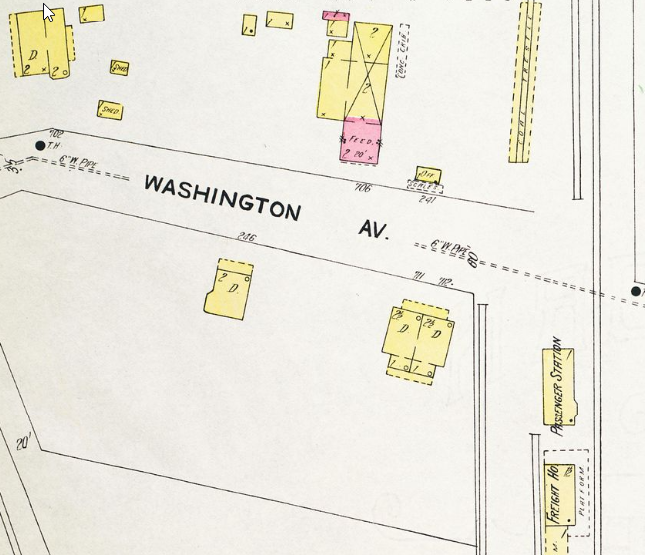
MILLTOWN, April 18 – What looked for a time as though it would spread into a dangerous fire and necessitate the calling of the fire company started yesterday morning at 10:30 a.m. at the home of Frank Reed, on Washington Avenue, when an oil stove exploded on the second floor of the building. Miss Helen Zogg, a sister of Mrs. Reed, who was in the room at the time, showed her thoughtfulness and grabbed the stove and threw it out of the open window, but in doing so the flames set fire to the weatherboards and then Miss Zogg gave the alarm. Luckily, Chester Okeson, an employee of Russell’s Card Company, and Percy Lias, chauffeur for Dr. Forney, were in front of the house at the time and they rushed to the Raritan River Railroad station, which is next to the place, and got the big fire extinguisher from the railroad and did splendid work, assisted by the Raritan River railroad employees, so the fire got no headway as only the outside boards of the house were burnt. The place is owned by Henry Kuhlthau.

Paying Taxes

Borough Tax Collector John Christ calls attention to the collection of taxes this year which is to be made by installments of two payments, in accordance with the Pierson Act. The payments are due on June 1st, and December 1st. Owing to the new law, the tax bills may be late in being sent out but as soon as the people receive their first bill they will know that it immediately becomes due, for if it is not paid by June 1st, it becomes delinquent.

Warriors Degree Ceremony Tonight

Eight candidates will be given the Warriors degree at the Improved Order of Red Men’s lodge room tonight by the warrior’s degree team, which promises to be another good night in lodge circles. Those who will receive the degree are: Oscar Christ, Frank Witkowski, George Wilson, Howard Moore, Charles Crabiel, Miles Geer, Elbwin Matlack, and George Whittle.

Personal Mention

Ground has been broken by Charles Lins on the Kuhlthau Terrace, upper Main Street, for the erection of a beautiful homestead.

Miss Dora Harkins was a Newark visitor yesterday.

Mrs. Jacob Delart, of School Street, has been called to the bedside of her aunt, Mrs. Cottrell, of Jamesburg, who is well-known here.

Mrs. Charles Lins spent Thursday with friends in Newark.


This Day in History: March 22nd, 1905

This Day in History: March 22nd, 1905

TIRE WORKS FIRE WON’T STOP WORK

The storehouse of the International at Milltown was destroyed, but the main works are saved—the damage well covered by insurance.

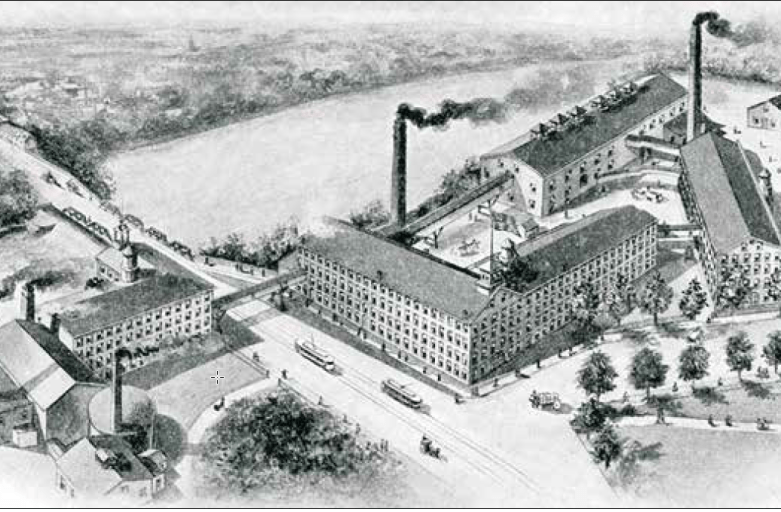
The six-story frame structure, approximately 70 by 100 feet, which was the plant of the original Meyer Rubber Co., situated at Milltown, burned last night. So great was the danger to surrounding property that help was sought from this city, with Raritan Engine Company and Liberty Hose Company responding.

Although the building destroyed was the real factory in the time of Christian Meyer, it had only been used as a storehouse for some years past by the International Automobile Vehicle and Tire Company. The brick structure opposite, where active manufacturing is carried out, was not harmed, even though it seemed at risk as the flames were moving across the covered bridge connecting the old building with the new brick structure.

The origin of the flames is a mystery, but it is thought to have started on the fifth floor around 6:30 PM when the employees were leaving, spreading rapidly due to the building’s age and the inflammable nature of the stock. The fourth floor was used as storage by the Jersey Rubber Specialty Company.

The assistance of the New Brunswick firemen was pivotal in controlling the fire. Sergeant Kelly, upon receiving the news and call for help, notified Chief Kidney, who dispatched the Raritan Engine Company and Liberty Hose Company. The latter made remarkable time, and the route taken was via Livingston avenue, recently cut through to the Cranbury Turnpike, and on to Milltown.

Raritan Engine Company’s engine, drawn by Walter Flavel’s horses, went out in record time. Second Assistant Chief Puerschner, in charge at Milltown, deployed a crew to the connecting bridge, beating back the flames despite suggestions to tear it down. Fire shutters on the main building helped contain the danger until the firemen arrived.

The plant’s overhead sprinkling system activated upon the fire’s start, with three streams from the building’s fire connections playing on the flames, although their impact was limited. Minor explosions occurred when the fire reached particularly flammable materials, necessitating continued water application until nearly midnight.

The electrical current for trolleys was shut off due to the fire’s proximity to the overhead bridge and feed wire. No. 4 engine was stationed on the other side, with hoses crossing the tracks. Water was pumped from a pond, and the stationary engine in the brick building, installed for firefighting, proved effective. The dense smoke from burning rubber products and appliances made the firefighters’ work more difficult.

The building, valued at $15,000 and built quickly after its predecessor’s destruction, was part of the original rubber factory of Christian Meyer. Insurance, managed by Weed and Kennedy in New York, covered the entire property at $500,000. The destroyed building was insured for $125,000 across several companies.

Howard DeHart, a trolley conductor, was the first to see the flames, raising the alarm as he crossed the old wooden bridge to North Milltown.