This Day in History: August 20th, 1914

This Day in History: August 20th, 1914

THREE BARNS DESTROYED IN $20,000 FIRE

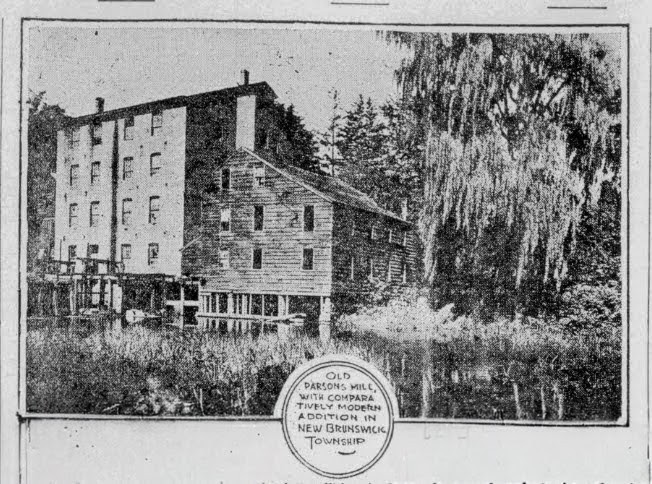
Local and Milltown Firemen, in Heroic 3-Hour Battle, Saved Beautiful Home and Snuff Mills of Jas. M. Parsons in North Brunswick – Origin is Unknown – All Live Stock Employees Save

Heroic work on the part of Captain George J. Kuhn, Jr., and his men of Engine Co. No. 1, saved the beautiful home and the big snuff mills of James M. Parsons, in North Brunswick township from being destroyed by fire yesterday afternoon, when fire was discovered in one of the barns nearby, at 3:30 o’clock. Workmen at the place quickly formed a bucket brigade in an effort to check the fire, but it was soon seen that they were unable to handle the fire which was quickly enveloping the barn, and fearing that it would spread to the big snuff mills and to the Parsons home, word was sent to this city and Milltown for help.

Assistant Chief Sass, who was on duty yesterday, Chief Francis being away, received the message and under the rule recently adopted by Common Council it was understood that no fire apparatus was to be sent out of the city, was unable to give any assurance as to whether or not they could do anything but he promptly got in touch with the new fire commissioners and they dispatched Liberty Engine Co. No. 1, with Captain Kuhn and five men to the scene. It took the big Waterous auto just eight minutes to make the run and running the engine close to the Parsons pond, soon had water on the fire, which by this time had spread to another barn.

Milltown firemen also responded with their chemical automobile and did excellent work about the other buildings, but the big engine pumping a stream of water on the flames was the means of saving the big snuff mills, the tobacco house, and the Parsons home, and for three hours, without a hitch, she worked like a charm.

Assistant Chief Sass went with the firemen and directed the work for a time, but on account of the absence of Chief Francis he had to return to this city after the work had been started and Captain Kuhn and his men worked like trojans, receiving very little assistance from those about the place, and when they had completed their work they were pretty well exhausted. Five men to work an engine, take care of the nozzle, pull the hose here and there was no easy task, but they never flinched once to the duty they had been called to perform, but clearly demonstrated that more men are needed in the department.

Just how the fire started is a mystery. The buildings being of frame it did not take long for the fire to eat its way through the building and leap to the next building. The contents of the barn that were movable were all saved by the men of the snuff mills, but a large quantity of wheat was destroyed.

The barns were completely burned to the ground. It was about six o’clock when the local firemen had stopped work on the fire and they returned about 8 o’clock.

Commissioners Harry J. Rolfe and James M. Barkelew were out to the fire in the automobiles and looked after the local firemen.

Damage Near $20,000.


There were three buildings burned to the ground. All were closely located. Louis Rebeck, in conversation with a Home News reporter last night said that he could give no cause for the fire. He said the mill employees fought the fire with pails of water after it had been discovered by Theodore Applegate. Mr. Applegate smelled smoke, and investigated and found the barn aflame. He called the others. The flames soon spread and then the employees got busy and saved all the live stock. They met with considerable difficulty in saving the pigs, which darted for the flames. A number of handsome sleighs belonging to Mr. Parsons were destroyed.

Mr. Parsons was away at the shore near Atlantic City, and last night had not yet been notified of the fire. Communication with him failed because he was out on his yacht. The damage, as was estimated last night, will be about $20,000, covered by insurance.

About twenty men are employed in the snuff mill, which was saved.

Big Kick


Considerable comment was expressed by many on the fact that the commissioners had allowed the apparatus to go outside of the city limits, it having been clearly understood that no city apparatus should leave the city to help outside communities. This was done because of the attitude of several townships towards the city when they wanted something and if help did go it was felt that the township should pay for the services.

Recently in Elizabeth, the Keans asked for help from the Elizabeth department, but they were refused, being out of the city limits.

The commissioners however are now in charge and they of course felt that it was a case of giving help or the burning down of the mills and other property, which would have thrown out of work a large number of men.

Ruins Aflame All Night.


Though the firemen left the scene between 7:30 and 8 o’clock, there was still plenty of fire in the ruins, and every gust of wind stirred up the fire again and sent showers of sparks in all directions, endangering the Parsons’ home and the mill. Shortly after 9 o’clock last night the Milltown firemen were again called to the scene.

The flames from the ruins illuminated the sky all night, and there was still fire this morning.

The engine of Co. No. 1, of this city, almost pumped the pond dry of water.

Michelin Sounds Alarm.


The Michelin fire whistle was sounded at 12 minutes of four yesterday and before four minutes had elapsed the Eureka Fire truck was passing the Michelin Tire factory bound for the scene of the disaster. The truck was driven by Chris Jensen, a member of the Milltown patrol. Foreman Elwood Boice, first assistant J. M. Brindle and second assistant Martin Mueller, of Eureka Fire Company, were among the first to appear on the scene.

It was a fortunate occasion that the wind was west yesterday and in case it had been blowing in the opposite direction the damage would undoubtedly have been very much greater.

Some of the Milltown firemen that were unable to get on the fire truck ran all the way to Parsons’ and by the time they reached there were about exhausted. Foreman Boice and Charles Christ were the first to climb a ladder on one of the buildings used as a storehouse. They stuck to their post fighting the fire from one side of the roof until the opposite side caved in and they were forced to move. C. Christ had his arm cut while sliding down a ladder.

The firemen realized that it was useless to try to save the main barn and wagon shed where the fire first started and thus played on the surrounding buildings until they felt sure it would not spread any further.

Among the Milltown fire fighters other than those already mentioned were ex-fireman Aubrey Kuhlbau, Oscar Harkins, of the Patrol, Messrs. Charles Christ, William Beecher, George Crabiel, George Lowne, Daniel Brown, John Miller, George Hoffer, George Heyl, John Deutsch, H. Christ, Aurendon, Charles Anderson, Charles Denhard, and George Knoll.

John Christ, Charles Denhard, proprietor of the Hotel Denhard, was hit in the head with a flying board at the fire yesterday, but the injury is not serious.


This Day in History: June 28th, 1916

This Day in History: June 28th, 1916

Factory League Rules Kelleher Ineligible to Play With Michelin

Kelleher will not play with Michelin any more this season, unless he changes his employment. This action was taken by the board of managers at a meeting last night. Kelleher has been catching for the Tires and was rated as the best in the league. He was a sure thrower to the bases and a dangerous man with the stick.

In reporting upon the players of the circuit, it was brought out that Kelleher was not actually employed at the Michelin plant at Milltown, but instead held a position with the Michelin Co. at Philadelphia. When this was learned it was voted unanimously to strike his name from the Michelin roster.

In the discussion that followed, it was stated by the respective managers that to permit Kelleher to continue on the Michelin roster would be an injustice to the other teams.

This is a serious blow to the Michelin contingent, as they had great faith in Kelleher and with his services were dependent on capturing the bunting, as they were impressed with Phillip’s twirling and felt sure of his ability to hold the competitors of the circuit in check with Kelleher receiving.

Another important step taken was the abolishment of the trade rule. That is one player jumping from one team to another. This was a defect of the old factory league and the present circuit is to be congratulated upon taking this action. Hereafter no player will be permitted to play with any other team once he is registered as a bona fide player of any team at present.

The league meeting was attended by all managers with the exception of the Union representative. It was also decided to call off the games scheduled for Fourth of July and to play them at some later date.

One of the most interesting games and one of the hardest fought will be that on Saturday in this city. The Simplex nine will oppose Johnson-Neverslip on the Easton Avenue oval. Manager Wilson, of the Autolats has signed Jake Deinzer and last night he added his name to the roster which makes him eligible for the next game.

Every available minute will be put in at practice by the respective nines for this game, for much depends upon the outcome. The winner of this conflict will capture the New Brunswick following.

The local fans haven’t been able to get a line on any of the teams, but in this game, the two strongest teams of the city will fight it out, and to the victor will belong the spoils, which will be the patronage.

Manager Samuel Shultise stated last night that he feels highly confident of his team’s ability to down the Simplex club. With Simonson and Walsh as a battery, Shultise says “there’s nothing to it.” Walsh caught for Carleton Academy the past year and has been delivering the goods for the Red Crossers, Simonson is a Perth Amboy-lan and a pitcher of merit.

It will fall upon Jake Deinzer to hold down the Johnson-Neverslip crowd from belting the pill hard. The Red Crossers are clouting the ball as they never did before. Ochs is one of the heaviest stickers on the team. In the Du Pont conflict, he bagged a triple and a double. Against Michelin he hit for three sacks.

Johnsons and Simplex have each played two games. Simplex won against the Indians and dropped a 2-0 game to Michelin. The Johnsons won from the Du Ponters, but lost like the Simplexers, to Michelin in a ten inning contest. The winner of this game will either forge into the lead or else drop to a lower berth. There is a triple tie for first place with Michelin, DuPont and Union.

MICHELIN MAN WILL TRY FOR TRACK RECORDS

MILLTOWN, June 28 – This evening at seven o’clock the athletes of the Michelin Athletic Association will flock to the athletic park and compete for the establishment of the first track record of the association.

As a beginning marks will be set tonight for a 100-yard dash, a 220-yard run, one-quarter mile run, and a mile run.

Since the meeting of the athletes a week or ten days ago there has been more or less practice among the runners and it is believed that some marks will be established tonight that will make other members of the club get out and hustle.

The idea of having a club record to determine the champion in the various lines of sport is indeed a good one and the movement should be given every possible encouragement.

Five marks will be set tonight in order to get the matter under way and it will no doubt be surprising to note the advancement made by the athletes between this opening event and the closing events in the fall.

Eleven of the local athletes have entered in the meet which is to be conducted in conjunction with New Brunswick’s safe and sane celebration on Fourth of July. Eight of the locals have been entered in the five mile race.

Prof. H. R. B. Meyers, who has the boys under his care for the season, believes that he has some champs within the fold although there are yet a few on the outside that he would like to get in.

Milltown Red Men’s Picnic Was Big Attraction

MILLTOWN, June 28 – The picnic held under the auspices of the Warrior’s Degree Team of the Improved Order of Red Men at Parson’s Grove on Saturday evening was attended by some two hundred and fifty people and a general good time was enjoyed. An orchestra of New Brunswick furnished the music.

The Girls Crescent Club were very pleasantly entertained at the home of Miss Bertha Snedecker, of Ford Avenue, last evening.

Dorell Sanderson, of this place, who has been employed with the Dupont Powder Co. at Parlin, has assumed the duties as a life saver at Bradley Beach.

Mr. and Mrs. George Seiple are on a vacation visiting with friends at Allentown and Stroudsburg, Pa.

Walter Worthge of the Michelin Tire Company is enjoying a vacation.


This Day in History: May 18th, 1919

This Day in History: May 18th, 1919

Milltown’s Splendid Possibilities for Adoption of Beautiful Civic Plan Shown by Architect and Town Planner of U. S. Housing Corporation

(By H. M. Olmsted, Architect and Town Planner of U. S. Housing Corporation.)

Six months ago the writer was asked by one of the engineers of the U. S. Housing Corporation, what kind of a place Milltown was for one to make it his home. Not having then visited Milltown, I could not answer him. A passer-by overhearing the question, promptly and officiously answered by stating that the town was a mill-hand section and not fit to live in. So Milltown lost the opportunity of gaining one more good citizen.

At the request of the editor, the writer visited Milltown several days ago. The few intervening miles between New Brunswick and Milltown were covered rapidly and comfortably. Arriving at the north end of Main street, we drove to Kuhlthau Avenue and alighting there proceeded on foot over the village.

For a town of which I had heard unfavorable reports, I can only say that I was delightfully surprised at everything I saw, from the moment of my arrival upon its well-paved sidewalks. On every hand one finds substantial and attractive homes—real homes, not imitation ones—real lawns, gardens, orchards, with trees and shrubbery of all kinds in profusion. To add to the effect, there is much water, many brooks, and the lake with its interesting waterfall just below the Main street bridge.

My first, hence lasting, impression of Milltown is that it occupies an envious and unique position in the ranks of suburban towns, as well as in its natural and beautiful surrounding country.

A Stroll Through the Town

Our way led down Main to Sand street, thence through the woods, south of the lake, to Bogs Brook, back along the shore of the lake, to Main street bridge and waterfalls and from there out over the portion of the town lying north of the bridge.

We saw about 500 real homes with 100-foot square lawns, having gardens, orchards, and grape arbors. We saw some dozen or more substantial stores, several churches, schools, factories, etc.

On every hand the properties are well laid out and excellently maintained. Along north Main street there are many homes which might be called pretentious, were it not for the fact that their owners evidently placed more importance on the value of a “real home place” than on pretentiousness. Holding the same opinion, I agree with that policy.

A “home” is better than a pretense. When one sees so many uniformly charming houses, lawns, and gardens, it is evident that the citizens have not only high civic pride but an excellent knowledge of how a home and a town should be conducted.

We saw but one building actually needing paint and minor repairs, and I strongly suspect that that one was deserted.

Almost without exception, front and rear yards were charming. The arrangement of trees and shrubs was natural and pleasing.

As we passed house after house and found solely trim lawns and gardens, our surprise grew steadily, because here was a town of which we had heard just the opposite of the reality.

Splendid Views Obtainable

Milltown is located in a hilly country of considerably higher altitude than her neighbor, New Brunswick. From these hills and in between them, charming glimpses of the setting of the town are obtainable. The soil is a rich sandy loam and on the sides of the slopes in the woodland are a number of good gravel and sand pits. Water is abundant as evidenced by the lake and its tributary brooks. On every side the eye of the artist and nature lover may drink in sight of a country that charms and delights. At the west end of Sand street along the slopes of the hill there, leading down 100 feet or so to the lake, picturesque views of the lake and its setting may be had. A clever artist could reproduce that scene upon his canvas and command practically his own price for the work.

Standing on the bridge or below the waterfalls, another pleasing view is had of the valley and rising hillside off to the southeast. It was at about such a spot that my business eye lingered for considerable time, on account of its possibilities for the location of a villa building and grounds, which the public might decide to erect and use as a holiday and evening dining place.

On the trestle below the waterfalls, another pleasing view is of Lawrence Brook, as it leaves the falls and winds in and out across one of the prettiest of little valleys, until it finds its way outside the town limits under the railroad bridge, some distance from the falls. Another delightful valley crosses the line of Vanderbilt avenue; its center line carrying a small stream leading into Lawrence Brook. A number of attractive cottages dot the hillside between the Raritan River railroad and Ryder’s Lane.

Along northern Main street are located many spacious and charming homes surrounded by large, well-trimmed lawns. Here, as elsewhere, equal refinement and beauty predominate. I judge the larger places belong to the most substantial citizens of Milltown. These homes are indeed charming.

The Small Cottages

Along Ford avenue or rather boulevard—for in reality, it is a 100-foot or more wide boulevard—with its stately rows of trees, we walked to the ballpark and thence north along South street, past the Michelin line of frame cottages. It is remarkable that here, too, even in these factory properties, with their plots of 50 by 150 feet, we found none but pretty lawns and gardens and all seemed filled with a bounteous supply of flowers and vegetables, sufficient to keep the average family all summer and longer.

A Part of the Secret of Beauty

After repeated exclamations from my wife, she had me inquire of a friendly citizen as to the reason for the unusual uniformity of the beauty of the gardens and homes.

Said the native: “Friend, I hardly know just how to answer your question, because I have lived here so long that it has not seemed unusual to me, however, now that you point it out, I must admit, that it is an unusual sight, when compared with many other villages. I believe the sights which you compliment are due to a number of different causes. First, the citizens of this town take a big civic pride in their town, its government, and their homes. These things mean a great deal to them. Then, too, the town authorities and leading business men as well as the stores and factories have taken a keen interest in having this town a home-like and beautiful place, and they have succeeded. The people are united and back of the movement.”

Prizes for Gardens and Homes

Continuing, the citizen informed us that the authorities and factories had a regularly constituted prize committee, and that it was the custom to make unannounced visits to the homes and gardens of the citizens and award substantial prizes, not only for the best lawn and garden but for the best-kept house, both exterior and interior.

This competition, aided by a strong spirit of civic pride, had caused a wonderful change in the town. He told us that twelve years ago, the streets of the village were overgrown with grass and weeds. If this is correct, then indeed, a miracle has been wrought and it is doubtless due not only to the cooperation of citizens and their authorities but to a much bigger and finer thing, namely, a refinement of brain and heart, which evidently exists throughout the village, else all we witnessed, could not have been accomplished in so brief a period.

Improvements Contemplated

Another citizen stated that a number of improvements were in contemplation. In the main, these consisted of a new pavement on Main street, both north and south of the bridge, and a brand new theater building where only first-class pictures will be shown and at merely a nominal cost as compared with the prices obtained in other towns.

Sidewalks and curbs are being laid in the town as fast as necessity demands. As to the roads, I judge the sandy-gravelly earth where no pavement exists prevents a muddy condition, so that unpaved roadways are not such a bad feature as one might be led to suppose. Even without more concrete roadways the city is pretty well off as it is in this respect. It would be an unusual condition, indeed, if the town should determine to concrete pave all of its streets, but I would not be surprised to learn that such a step was contemplated.

Government of Milltown

I was informed that the town is governed by a mayor and board of councilmen, and that the town owns the power plant, a perfect sewer system and water plant as well. The sewer system cost over $100,000 to construct.

Milltown is exceedingly thrifty. It maintains a good bonding margin and is, I believe, practically free of indebtedness. This shows excellent management. Should a new pavement be laid in Main street, there will doubtless be a straightening and realignment of all curbs and gutters. In connection with curbing, it is worthy of comment that in the thirty or more U. S. housing projects, erected during the war, the streets of such projects invariably had installed a one-piece concrete curb and gutter, curb being six inches thick with an 18-inch wide gutter. This was made for pleasing effect and perfect alignment.

What the Future Might Bring

It would not be surprising to learn that the citizens of Milltown had decided to take a stronger grip on their opportunities for home and civic advancement and would soon start a larger campaign to utilize all of their storehouse of opportunities surrounding the town. If such a movement is once started, then in my opinion, their village will assume rightfully a leading place throughout the entire state in the matter of prosperity, civic progressiveness and attractiveness.

From the viewpoint of the town planner and landscape architect, Milltown has a long way to go ‘ere the possibilities for further advancement be exhausted. This is due to Milltown’s natural resources and her surroundings.

Town Planner’s Viewpoint

Regarding Milltown from this point of view, I should say that her future is fraught with excellent possibilities. I noticed that the center of town seems to be at the bridge and here almost nothing in the nature of real town planning or improvement has been done. The bridge, Main street, the lake, brooks, falls, and woods south of the lake present an excellent array of points upon which a good start might be made if such were the wish of the citizens.

As your town grows in population and prosperity it must progress, as every thinking man knows, or it will lapse upon itself and go backwards. So along the thought of a progressive policy, naturally, it occurs to anyone engaged in town planning that after the repaving and realigning of curbs etc., along Main street, a natural thing to do would be to erect along that street electric light standards at intervals of, say, 15 feet, each one having a cluster of globe lights. This one step would transform the street into a beautiful boulevard—make of it a delightful promenade in the evening and would have the effect of advancing prosperity by attracting more business to stores in the town. Another thought, which will occur to everyone, is that all of the large buildings near the bridge might, with almost no expense, plant English ivy and shrubbery across the front, sides, and rear of these buildings, and thus make them pleasing and charming to the eye of the citizen and the motorists who pass that way in ever-increasing numbers. This refers particularly to the Michelin factories, the power plant, car barns, and two large hotel buildings just south of the bridge.

I am sure my readers will not think me guilty of naming any superior knowledge or too personal assertiveness in this matter, because no doubt the people and authorities of Milltown have long thought of these possibilities and may even now have them in process of installation, but as one requested to write on the subject, I am sure no offense will be taken in exposing the natural thoughts likely to occur to everyone at the same time.

The Bridge and Water Falls

What an artistic setting for a town bridge of concrete with separated pedestrian and vehicle passages. With clusters of globe electric lights strung along each side of it and to add to the effect, an eastern and western walkway, leading on either side and from the summit, below the waterfalls. With a few concrete benches and concrete flower boxes properly arranged, that spot would be indeed artistic and effective as a natural center of the town.

A Site for the Theater

Doubtless such a site has been decided upon, ‘ere this, but the thought came to me unaided, that rose bespied by the old mill building or remnants at the waterfalls. The lot north of the power plant also might be cleaned up and made very charming.

A Site for a City Park

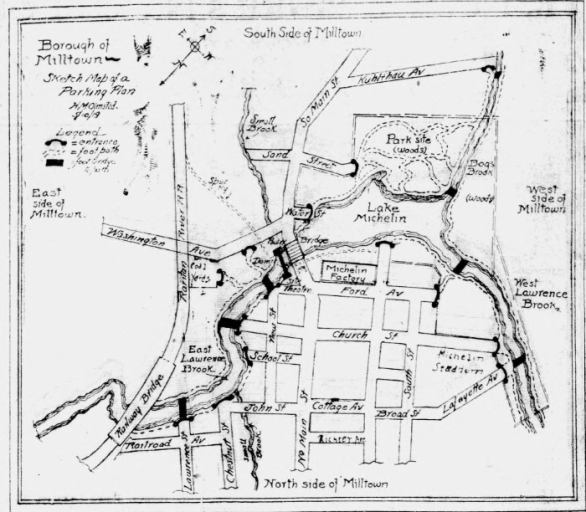
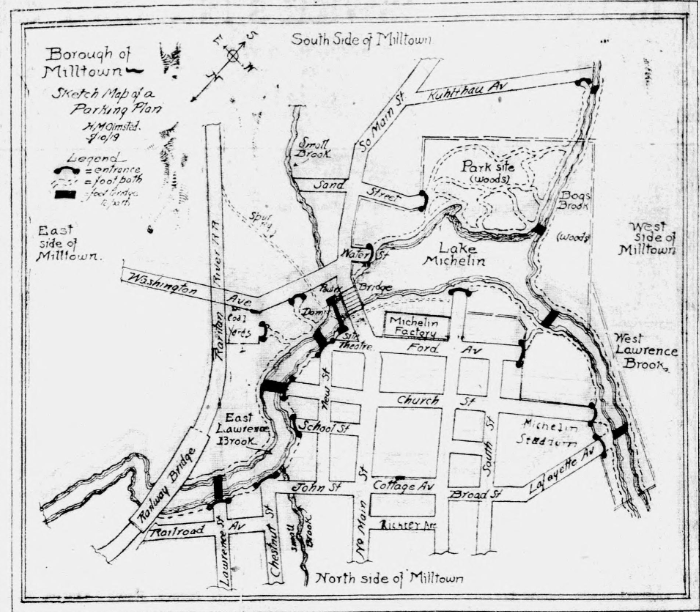
I feel certain that the idea has long since been advanced to build a city park in the large woodlands south of the lake. It is an ideal place, and I have endeavored to roughly complete my thought in this matter in the drawing accompanying this article. This plan illustrates a parking system devised to take in both branches of Lawrence Brook, and using both would also take in Bogs Brook, besides three sides of the lake, the bridge, and waterfalls, and all of the woods west of Main street and other land west of the lake as well as Lawrence Brook to the Raritan River railroad tracks. The plan would afford three Main street entrances to the woods, namely Pond, Sand, and Bogs street, besides would be entrances to the public along the brook from no less than 10 streets and areas.

Of course, the average citizen will throw up his hands and say that such a project is impracticable and that other rights are involved and that it cannot be done and all the comment will be against it, but then, it could be done, providing all of the people agreed upon it and the plan was wanted. As for the expense, it would be practically nominal, for the work to be done, outside of the securing of the land. The land requirement might prove a stumbling block, but under intelligent cooperative direction all of the people could be brought into accord on the plan and the project would attract the state’s attention with interest over the newness and attractiveness of the scheme. Besides this, I was assured that the 500 people of Milltown would take pride and happiness. It would bring to Milltown a desirable number of new citizens with their scale of prosperity.

I know of no plan so effective and so slight in cost to place Milltown in the center of all New Jersey in point of progressiveness and attractiveness. I am not Job’s comforter when I write this because I also have under contract to help better a city like the one which the Housing Corporation has built in New Brunswick, and which is now tenanted, though only so completed after a month of hard work. I am writing this because of love of the work, and because we and all the corporations run by and for their city’s happiness.

In next Sunday’s Times, the writer will continue the foregoing article and tell of the unique history of this fine water supply, the importance of street lighting, bounteous trees and shrubs, beautifying the factories, thought of a restaurant, and summary of the advantages of the borough.

A Stranger’s First Impressions of Milltown Borough

Briefly put, here are the impressions that came to H. M. Olmsted, architect and town planner, when he visited Milltown, our neighbor, to give The Sunday Times his ideas of its possibilities for the adoption of a civic plan. He found:

A clean, orderly, tidy place attractively situated on high ground with unusually pretty surrounding country.

A town with remarkably easily adaptable advantages including a pretty lake, which could be a feature of a charming park.

A town with a fine street for the principal thoroughfare to be ideally set off by the use of clusters of electric lights on street poles, etc.

Plenty of civic pride, and encouragement to keep it up on the part of town officials.

Well-maintained homes and pretty gardens, vastly improved through the stimulus of prizes offered.

Plenty of plans for future improvements in the town that show an interest in making Milltown grow.

Big possibilities that would follow the adoption of a new name for the village.

A healthful place with a climate that holds great possibilities for making it an ideal residence place.

That beautifying factories would do a whole lot to promote the town’s attractiveness.

An idea for a wayside restaurant that could be run on a cooperative plan.

This Day in History: April 20th, 1921

"Michelin Top Notchers” at the 1927 meeting. - Michelin Cafeteria Main Street

Milltown Has “Clean-Up” Slogans

MILLTOWN, April 20 – The Perry-Worthage Post of the American Legion will meet tonight in Red Men’s Hall. All discharges turned in with the applications for State bonus will be returned to their owners. It is, therefore, very necessary that all members be present.

The Girls’ Crescent Club at their meeting Monday evening at the home of Mrs. Clarence Hill made arrangements to hold a social at the home of Miss Ida Kuhlthau, Main Street, next Monday night.

“Clean-up Week.”

The Board of Health at a recent meeting made plans for a “Clean-up Week,” beginning May 2. In connection with this endeavor, they adopted a number of slogans:

  • “A Reputation Worth While—Milltown a Healthy Place.”
  • “Clean-up Week May 2 to 7. The cooperation of each and every citizen is urgently requested.”
  • “Protect your own health and the health of your neighbor by cleaning up your own backyard.”
  • “For its size, Milltown is the best industrial town, the best residential town, the best sporting town, the best social town, the best commercial town, and will be the cleanest town in the State of New Jersey with the cooperation of each and every citizen during Clean-up Week.”

Newsy Briefs:

Mr. and Mrs. Orville Lonsdale of Trenton spent the weekend with Mr. and Mrs. Albert Moore of Main Street.

Mr. and Mrs. Harry Hartman and Mrs. Anna Gill of Ford Avenue spent Sunday with friends in Newark.

It would be very kind of the party finding the small black leather case containing several school articles lost by Miss Mildred Wilson on Main Street Monday noon, to return it to her at 471 Main Street.


COMMUNITY BOWLERS TAKE ODD GAME

MILLTOWN, April 20 – On the Michelin alleys last night, the Community House team took the odd game from the Hungarian A.C. of New Brunswick.

With the exception of the first game, which the locals easily romped away with by a large margin, the match was hotly contested. The winners of the second and third games were not decided until the last frames.

In the deciding game, the home lads started off in great style with Mullins, lead-off man, getting a quartet of strikes, and Evans following with a triple, assisted by the rest of the team with marks, while the visitors were unable to locate the headpin, each making breaks for several frames.

Before many frames, however, tables were turned and after locating the headpin each man struck for doubles, while the locals ran into a number of splits, which made the game anybody’s until the last frame when Mullins doubled, rolling 221 and Evans spared out for an even 200.

The scores follow:

Community House,

  • Mullins: 185, 120, 221
  • H. Evans: 160, 183, 200
  • Dunn: 159, 168, 145
  • Ritter: 176, 188, 169
  • Kohrherr: 210, 151, 176
  • Totals: 890, 810, 911

Hungarian A.C.

  • Boehn: 166, 154, 204
  • Hensperger: 145, 162, 140
  • Gross: 142, 176, 194
  • Ference: 168, 162, 170
  • Kocsis: 191, 152
  • Totals: 769, 806, 860

Howe Team to Roll

Tomorrow night, this Community House team will roll against the Howe Rubber Co. team of New Brunswick on the local alleys. The local team is selected from the ten men having the highest average rolling at least six games during the past week.

All candidates for the Michelin baseball team this season are requested to be on hand Saturday afternoon at the park for further limbering up.


This Day in History: January 5th, 1907

This Day in History: January 5th, 1907

Noted Armless Man is Dead

John Fuchs, of Milltown, Who Hunted, Fished, and Rowed, Succumbs to Paralysis.

MILLTOWN, Jan. 5 – John Fuchs, the armless man of Milltown, died this morning at 8 o’clock. He was almost seventy-nine years of age. He was struck with paralysis on New Year’s Day and had been unconscious since. He leaves a younger brother, Michael Fuchs, of Highland Park, and his only child, Mrs. Katherine Kuhlthau, wife of the postmaster, with whom he had been living for many years.

Mr. Fuchs came from Germany some forty-one years ago and was soon employed in the old Meyer rubber grinding mill, which stood where the powerhouse now is. About a year after, both hands were drawn in between rollers; the left arm was pulled out at the socket and the right had to be cut off near the elbow.

A hook was fastened to this stump and with this, he has done marvelous things ever since. He shot four rabbits this December, one of them running. Fishing was a favorite sport each summer. For years he could be seen daily sculling his boat about the pond after the scaly inhabitants there.

Rev. W. T. Barny will have charge of the funeral services, the time of which is set for 2 o’clock Monday afternoon.


This Day in History: December 5th, 1908

This Day in History: December 5th, 1908

CRUSHED TO DEATH

Head Electrician William Duclos, of Michelin Tire Plant, Had Idea of Coming Death in Elevator Pit

Falling Weight Breaks Neck.

Crushed under an elevator weighing several hundred pounds, William Duclos, 29 years old, was almost instantly killed at the Michelin Tire works, Milltown, this morning. Death was caused by the tremendous weight on his head and back, which broke his neck.

The accident occurred shortly before 5 o’clock. Something wrong with the batteries controlling the elevator made it necessary for Duclos, who was head of the electrical department at the plant, to go into the elevator pit and discover the cause of the trouble. It is said that just before going down the shaft, Duclos had a premonition of his impending death, and turning to a fellow employee said, “I don’t know why, but something tells me I will never come out of that place alive.” Arousing his courage, however, the electrician descended and had hardly begun his investigation when the starting of the elevator caused one of the heavy weights to descend with a rapidity that made it impossible for its victim to move out of its path. He died about 15 minutes after the accident.

Dr. N. N. Forney, of Milltown, and Dr. F. M. Donohue were summoned, but upon their arrival, Duclos was beyond all earthly aid. Coroner John V. Hubbard, of this city, and Undertaker Moke were summoned and the body was removed to the dead man’s home on Vanderbilt Avenue.

Mr. Duclos had been employed at the Michelin plant for nearly two years, coming from Brooklyn in 1906 with his young bride. She alone survives him. Coroner Hubbard made a superficial examination of the circumstances surrounding the electrician’s death this morning but evidently did not satisfy himself that an inquest was unnecessary, for he went to the plant this afternoon for further investigation. There is an unconfirmed rumor that a careless employee was responsible for Duclos’ death in starting the elevator, not noticing the man in the pit.

Inquiry at the Michelin plant revealed a stubborn unwillingness on the part of those in authority to give out details regarding the tragedy. At first, an effort was made to deny that an employee had been killed.