This day in History: March 12, 1903

This day in History: March 12, 1903

A HORSE CASE IN DISTRICT COURT.

Hoboken and Milltown Mixed up in a Replevin Suit.

The Daily Home News – Thurs. March 12, 1903


A horse and wagon figured in a complicated case in the District Court this morning. The first scene of the story revealed at the trial was in Hoboken, where Mr. and Mrs. Nicholas Ehlers used to keep a grocery store. Some months ago they sold out the business to Frederick V. Gehrs, who assumed charge. Then Mr. and Mrs. Killers moved to Milltown, taking with them a horse and wagon, which Gehrs understood belonged to the business he had bought.

The next scene was in Milltown, where Andrew Hopper came from Jersey City with a claim against the Ehlers family. They gave him a bill of sale for the horse and wagon to satisfy the claim. He sold the outfit to Mrs. Ida C. Hermann, who keeps a bakery in Milltown. Later on Gehrs came for the horse and wagon and found that they were gone. He had them seized on a writ of replevin and brought suit in the District Court here for them.

This caused the third scene in the District Court room before Judge Hicks today. The case is known as Gehrs vs. Hermann, but Mrs. Hermann is really a disinterested party in the case, the suit really being against Hopper, who will have to make good to Mrs. Hermann if the plaintiff wins the case. Fred Weigel, of this city, represented Mrs. Hermann. Albert C. Gehrs and John P. Duffy, of Hoboken, represented the plaintiff, and Lawyer Fallon, of Hoboken. represented Mr. Hopper. Decision was reserved.

Judge Hicks this morning gave a judgment of $300 and costs to the plaintiff in the case of Charles W. Russell vs. Fred Stelle, on contract,


This day in History: March 11, 1904

This day in History: March 11, 1904

“FAST LINE” BUMPS A MAN ON TRACKS – Cuts Off an Arm and Nearly Kills Eugene Ellingham.

PROMPT MEDICAL ATTENTION SAVES THE FELLOWS LIFE – HE WAS ON THE TRACKS — ACCIDENT HAPPENED NEAR MILLTOWN.


Eugene Ellingham, who lives near the Red Lion tavern, was struck by a car of the Trenton and New Brunswick “Fast Line” a short distance from where the road leaves the line of the Middlesex and Somerset traction Company at Milltown last night. He was badly injured. The prompt medical assistance which he received doubtless saved his life.

The man was on the tracks when car No. 28, in charge of Motorman Kohlhepp and conductor Haley, came along at a high rate of speed. The motorman saw the man on the tracks but could not slow down quickly enough to save the fellow.

The car was stopped and the car crew picked the injured man up, put him board the car and hurried him to the office of Dr. Riva, at Milltown. Dr. Riva temporarily dressed the man’s injuries and sent him on to this city in the trolley car.

At the corner of George and Washington streets, the car was met by Dr. Schuyler Clark and the ambulance.

Dr. Clark found that the man was in a very serious condition. His right arm so badly crushed that had to be amputated at the elbow. there were several scalp wounds on the back of the head and body bruises and an injury to his spine. He ordered the man taken to the hospital as quickly as possible.

The man’s condition at the hospital to-day was more favorable and this afternoon a second operation was performed by Dr. Alsop, who amputated the arm higher up.

The injured man has been unable as yet to give any account of how the accident happened. He has been only semi-conscious.


Today in History: March 10th 1925

Today in History: March 10th 1925

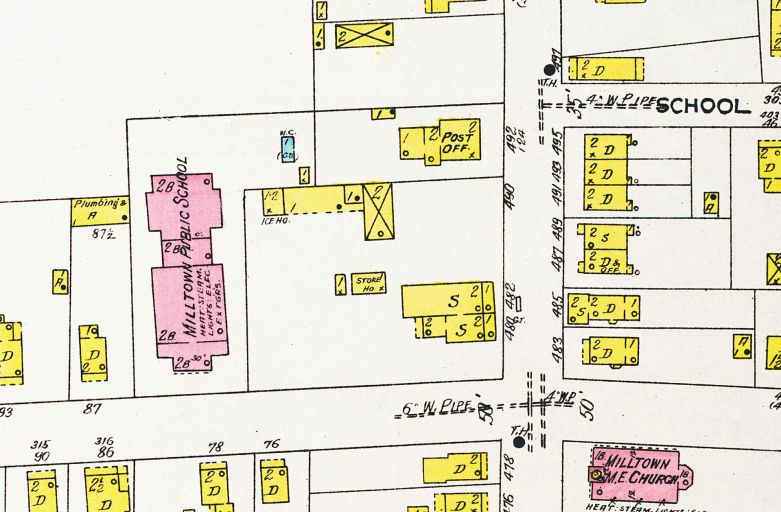
A NEW SCHOOL NEEDED?

The Daily Times: New Brunswick, N.J. Tuesday March 10th 1925


Milltown’s supervising principal’s report, read to the Board of Education on Thursday night at their monthly session, indicated that the enrollment in the school during the month of February had broken all previous records with the new figure of 587. The previous high water mark was 575, established in October of the present term. The enrollment increase in February is caused by the new classes of kindergarter children that are opened in midterm. The growth of the school is causing the members of the board considerable anxiety. At their session on Thursday, they had to consider their next move in the room proposition. Professor Mensch will give the board members at their June meeting a report of conditions he sees them at that time, and a rough sketch of what will be required for the youngsters in the fall. There seems no way to dodge the issue and it will either be a case of building an annex to the present twenty-room structure, or building, as contemplated, a temporary building of portable design that can be converted into cash when they want to dispose of it. With 587 pupils on hand now, only a small graduating class going out in June, and several youngsters coming in in September, the situation for space will be acute. The present graduating class is the smallest in years and will be the smallest in years to come.


This day in History: March 5, 1924

This day in History: March 5, 1924

MILLTOWN FIRE SIREN MUST BE HELD RESPONSIBLE FOR THIS


Old Man Weisskraks, who can always be depended upon to supply the latest gossip, supplemented by a few original comments whenever and wherever he can corner someone willing to listen to his prattle, was the victim of circumstances, last night, and will spend considerable time and energy in telling the world about it for the next few days to come.

It seems that the Old Boy Himself met with an accident yesterday that will not happen again, by gosh, if he can help it. No Unfortunately, while trying to extract a “chaw” of cut plug which he had saved for his after-dinner session at slim-Chances cut-rate  General Store, the Old Boy Himself dropped and smashed beyond any hope of future usefulness, the gold-rim- spectacles that were, figuratively, the apple of his both eyes. That in itself was a catastrophe. But, according to the old aphorism, (which by the way is a favorite, with the Old Boy) “It never rains but it pours.” the loss of his “specs” while bad enough, was only incidental: merely contributing to the general run of hard luck which followed quickly in It’s wake.

The Old Boy, it seems, is lost without his glasses. Lost, at least so far as reading the news is concerned. And reading the news is the one thing that “he Is fondest of.” Without his glasses, the Old Boy had to forego his daily session with the Daily Home News, and therefore could not really be blamed for what happened. Had he read the news in last night s paper he would have been saved considerable energy— about an hour’s.

Had he read the news he would have known that Milltown had installed a new fire siren, and had decided to give it a trial. Last night was the time set for the trial.

However, the Old Boy was completely unaware of the plans and not being able to read he decided to retire earlier than usual. Thus at 7 p. m. last night he was just about ready for bed, was. in fact, just about to turn out the light and crawl between the sheets, when, suddenly he stopped. Could It be? Had he heard aright? He stood motionless and listened. Yes there it was again. No doubt about it this time. That was the fire siren, all right. The Old Boy had no choice. There was only one thing for him to do. As a Public-Spirited-Citizen, it was his duty to at least, witness the event so that his voice might not be found wanting when the event was discussed, as it surely would be on the following day.

Hastily getting into his clothes he dashed from the house and started in the general direction of Fire Headquarters. No doubt the apparatus was well on it’s way by this time but he could learn the location of the fire and probably reach there before it was all over.

Arriving at the Fire House, breathless, and eager, he was dumb founded see all the department apparatus, still on the floor and a general appearance of ease and contentment everywhere in evidence. Evidently they had not heard the siren, thought the Old Boy, but, by ginger, he’d tell ’em. This he proceeded to do, punctuating his loud exclamations with frantically waving arms! Well. After the general laughter laid subsided and someone had mercifully told him alt about it, he sheepishly, and with a sorry attempt at his usual proud gait, started hack home murmuring sweet nothings, as he thought, of the morrow and the razzing that was in store for him.


This day in History: March 4, 1924

Location of MIlltown National Bank 1917 - 1924

MILLTOWN’S NEW FIRE SIREN WILL BE TESTED TONIGHT


Milltown. March 4, — Tonight between the hours of 5 o’clock and 10 o’clock people may expect a loud shrill gong. Fire Chief H. A. Christ advises that none should be alarmed as it will be only a test of the new fire siren. Which is here for a period of thirty days for a test. The siren was Installed yesterday and while the exact time of the test is not known, the chief wanted the people to be on the “inside” as he did not want any frightened especially those living In the district of the alarm. The siren has been installed at the disposal plant. It has not been definitely decided as to what arrangement will be made regarding the new alarm which will be installed this year, but if the test tonight of the siren proves what it is expected to, it will undoubtedly be the one adopted. Rapid progress is being made by the Eureka firemen to have everything in first class working order and a good alarm system has been lacking here for years.


This day in History: Feb. 17, 1916

This day in History: Feb. 17, 1916

The Interesting History of The Pneumatic Tire, Which Dates Way Back to 1845

(By R. B. Bramwell.)


In reply to the request of the Home News the writer takes pleasure In writing an authoritative sketch of the pneumatic tire, going away back to 1846 when the pneumatic principle was first adapted experimentally to the wheels of road vehicles, and taking up the story again forty-three, years later, when the development of the safety bicycle revived an interest in a tire more resilient than the ordinary solid rubber tire of that period, and contributing to a later era when the pneumatic was first applied to automobiles.

The story is a romantic tale, like so many stories of the early struggles of the pioneers, whether they be adventurers for adventure’s sake, or pioneers cast In the more practical mold of Industrial discovery and Invention.

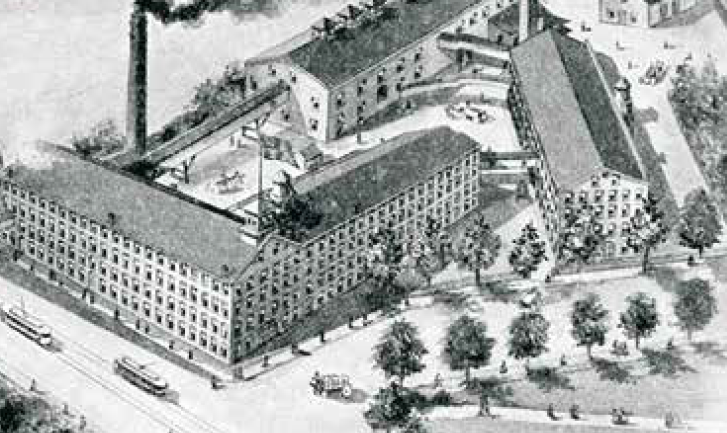
Furthermore the story of the pneumatic tire is of particular interest to New Brunswick readers, as one of the pioneers in this field whose visiou many years ago foresaw the great Importance of the pneumatic tire, and who after many reverses founded In Prance the great Industry that bears his name, has for eight years been quietly building up another great tire making factory In Milltown, our thriving neighbor to the south.

In the summer of 1913 the writer made a careful study of the early history of the pneumatic tire, and lotted down much Interesting data taken from many works of reference’, and from old flies of foreign newspapers and magazines, besides running across certain interesting exhibits in the South Kensington museum in London.

The pneumatic tire had Its origin In England, and Its birth certificate will be found in the patent registered on December 10, 1845, by R. W. Thomson. He describes it as a means of “perfecting the wheels of carriages and other rolling bodies.” Turning to the actual text of the patent we find a fuller description as follows: “The nature of my said invention consists in the application of elastic bearings round the tires of the wheels of carriages for the purpose of lessening the power required to draw the carriages, rendering their motion easier, and diminishing the noise they make then in motion.

I prefer employing for the purpose a hollow belt composed of some air and water-tight material, such as caoutchouc or gutta percha, and inflating it with air, whereby the wheels will in every part of their revolution present a cushion of air to the ground or rail or track on which they run.”

First Tried on Carriages

The invention was naturally first tried on carriages, and in the “Mechanics’ Magazine,” Nos. 1,235 and 1,239 of April and May, 147 Nearly seventy years ago we find the following announcement.

“Messrs. Whltohurst & Co., coach builders, have acquired from Mr. Thomson, the patentee of aerial wheels, the rights for applying them to all kinds of vehicles. These wheels give to carriages a gentleness of motion absolutely impossible to obtain by any sort of spring; they effectually deaden all noise from the wheels; they prevent bumping and shaking, and render traction considerably more easily than with ordinary wheels, especially on bad roads.”

We have seen that Thomson invented the pneumatic tire in 145, but we find that it fell into such complete oblivion that the Irish veterinarian, Dunlop, might well have thought that he discovered the Pneumatic principal when in 1888 he first applied his single tube tire to a bicycle.

Early Tires Not Detachable.

But the early pneumatic bicycle tire introduced by Dunlop was far from being perfect; its worst fault was that It was not detachable, so that with the first puncture it was done for and had to be torn from the rim and replaced. Numerous experiments were made by different makers, but the first practical pneumatic tire put on the market, a tire that was easily detached on the road by the rider, was made by Michelin, a large rubber goods manufacturer of France who had been in business since 1832. It was thus that Michelin earned the tittle in France of “Pere des Demintables” – father of

In 1894, Michelin tires reached their definitive and final form, the same as are used today by both bicycles and cars.  

Michelin not only perfected the bicycle tire but was also the pioneer in the application of the pneumatic to horse vehicles and automobiles. He felt that having proved its worth in the service of bicycles, his tire was capable of bigger things and believed he might succeed where Thomson had failed.

His first attack was made on the Paris cabs. On February 10, 1896, the first cab to be fitted with pneumatic tires was sent out, and so great was the added comfort, that by 1903 there were as many as 4,500 cabs in Paris using pneumatic tires, and today it is a rare thing to see one without them.

Auto Makers Shy at First.

Still Michelin was not satisfied; he sought still other conquests, and his greatest victory was in widening the scope of the pneumatic tire by applying it to motor care. But wonderful as was his conception, certain as seemed the advancement it was bound to give to the growing industry of motor car building, it shared the lot of all great discoveries— discouragement and apparent failure.

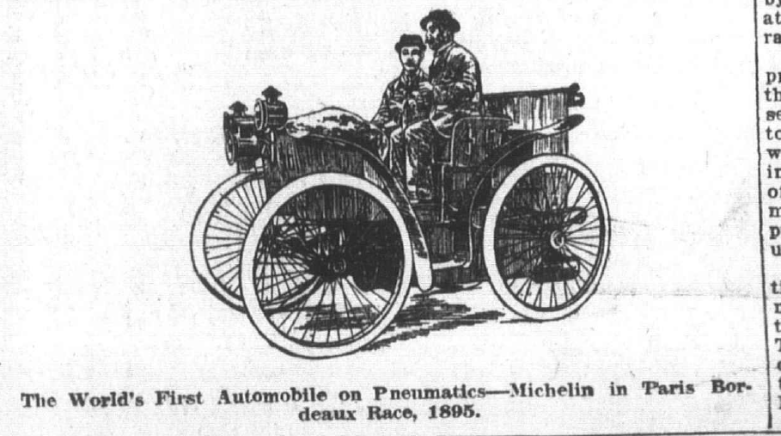
No manufacturer would risk his car by fitting it with such apparently frail tires, but Michelin did not lose confidence: he was certain of ultimate success, and in order to give a public demonstration as to what his tires could do be had to build a car for himself. The occasion was the historic Paris-Bordeaux race of 1896 when Michelin was represented by a rough sort of motor car made at his own works at Clermont-Ferrand. His triumph was complete.

From that day the progress of the pneumatic tire was coincident with the development of the motor car Itself. The story Is too well known to need repeating. Inventors the world over have worked for years to improve the old Paris-Bordeaux type of tires, and while many Improvements In details have been made, the principles laid down in 1895 remain unchanged.

One of the most recent advances In tire design has been the new rubber nonskid Just being introduced by the Michelin Company at Milltown. The French Michelin factory brought out the first pneumatic tire for automobile, but It remained for the Milltown organization to produce the latest type of tire, the new Universal Tread. This fact Is surely well calculated to develop a feeling of local pride in the minds of New Brunswick citizens.