This Day in History: June 26th, 1925

This Day in History: June 26th, 1925

Popular Teacher Of Milltown is Wed Wednesday


MILLTOWN, June 26 – One of Milltown’s popular school teachers was married Wednesday when Miss Emily Linn became the bride of Harold B. Gutterson of Rensselaer Falls at New York.
The wedding was one of the largest ever held at Milltown and was conducted in elegant style.
The bride and groom are now touring New York and Vermont on their honeymoon, after which they will live at Rensselaer Falls.

Milltown Will Hear Boys’ Band from State Home

To Play at Festival at Methodist Church July 8
MILLTOWN, June 26 – The State Home Band of Jamesburg will come to Milltown again for a concert, when they will appear at the annual cantaloupe festival of the Ushers Union of the Methodist Church on Wednesday night, July 8, on the church lawn.
The Boys’ Band made their first appearance here last year at the cantaloupe festival of the union. An immense crowd attended the affair and enjoyed the wonderful music the band played. They will render a fine concert on the eighth, and the ushers look for the affair to be another social event. Tickets for the festival will be thirty-five cents, and there will be plenty of seats arranged around the church lawn so the people may enjoy the concert comfortably.
The regular monthly meeting of the Ushers’ Union will not be held tonight, as scheduled, and the annual election of officers will be postponed.
Sunday night in the church Prof. Opec of New Brunswick will favor with special trombone music, while Miss Edna Reeves will be at the piano and Miss Elizabeth Connolly at the organ.

Celebrate Sixth Birthday

Little Paulette Crabiel celebrated her sixth birthday Wednesday afternoon on the lawn of her home in Upper Milltown, when she had a number of her school friends visit her. Outdoor games were played by the little tots and dainty refreshments were served. The youngsters showered Miss Paulette with many beautiful gifts.

Mrs. Reid’s Class Busy

The Sunday school class of Mrs. Richard Reid of the Reformed Sunday school held two enjoyable surprise parties the past two nights, at the home of Mr. and Mrs. Harvey Crawford on Wednesday, and at the home of Mr. and Mrs. Josiah Cole last night.
Both affairs were surprises for members of the class. On Wednesday night Mrs. W. Van Doren LaTerre of Plainfield, formerly Miss Grace Crawford, was surprised, and received a handsome mahogany clock from the class. Last night Mrs. Cole, formerly Miss Margaret Warner, was surprised, and she, too, received a beautiful gift from the class. Both evenings were whiled away with playing games and musical selections, after which refreshments were served.
Those attending both affairs follow: Mr. and Mrs. Richard Reid, Margaret Heimel, Evelyn Warner, Mr. and Mrs. Robert Petty, Grace DeHart, Elsie Kohler, and Nettie Deutsch.

Ground Broken

Ground was broken yesterday for the erection of Alfred Christ’s new structure on Main Street, next to Becker’s garage. Mr. Christ announced two weeks ago that he had decided to build a new home for his meat market, and while planning the building decided to have two flats on the upper floor and two stores on the first floor. The building will be erected of brick by Contractor Ferguson.


Miss Emily Lins original photo compared to an AI rendering

This Day in History: May 18th, 1919

This Day in History: May 18th, 1919

Milltown’s Splendid Possibilities for Adoption of Beautiful Civic Plan Shown by Architect and Town Planner of U. S. Housing Corporation

(By H. M. Olmsted, Architect and Town Planner of U. S. Housing Corporation.)

Six months ago the writer was asked by one of the engineers of the U. S. Housing Corporation, what kind of a place Milltown was for one to make it his home. Not having then visited Milltown, I could not answer him. A passer-by overhearing the question, promptly and officiously answered by stating that the town was a mill-hand section and not fit to live in. So Milltown lost the opportunity of gaining one more good citizen.

At the request of the editor, the writer visited Milltown several days ago. The few intervening miles between New Brunswick and Milltown were covered rapidly and comfortably. Arriving at the north end of Main street, we drove to Kuhlthau Avenue and alighting there proceeded on foot over the village.

For a town of which I had heard unfavorable reports, I can only say that I was delightfully surprised at everything I saw, from the moment of my arrival upon its well-paved sidewalks. On every hand one finds substantial and attractive homes—real homes, not imitation ones—real lawns, gardens, orchards, with trees and shrubbery of all kinds in profusion. To add to the effect, there is much water, many brooks, and the lake with its interesting waterfall just below the Main street bridge.

My first, hence lasting, impression of Milltown is that it occupies an envious and unique position in the ranks of suburban towns, as well as in its natural and beautiful surrounding country.

A Stroll Through the Town

Our way led down Main to Sand street, thence through the woods, south of the lake, to Bogs Brook, back along the shore of the lake, to Main street bridge and waterfalls and from there out over the portion of the town lying north of the bridge.

We saw about 500 real homes with 100-foot square lawns, having gardens, orchards, and grape arbors. We saw some dozen or more substantial stores, several churches, schools, factories, etc.

On every hand the properties are well laid out and excellently maintained. Along north Main street there are many homes which might be called pretentious, were it not for the fact that their owners evidently placed more importance on the value of a “real home place” than on pretentiousness. Holding the same opinion, I agree with that policy.

A “home” is better than a pretense. When one sees so many uniformly charming houses, lawns, and gardens, it is evident that the citizens have not only high civic pride but an excellent knowledge of how a home and a town should be conducted.

We saw but one building actually needing paint and minor repairs, and I strongly suspect that that one was deserted.

Almost without exception, front and rear yards were charming. The arrangement of trees and shrubs was natural and pleasing.

As we passed house after house and found solely trim lawns and gardens, our surprise grew steadily, because here was a town of which we had heard just the opposite of the reality.

Splendid Views Obtainable

Milltown is located in a hilly country of considerably higher altitude than her neighbor, New Brunswick. From these hills and in between them, charming glimpses of the setting of the town are obtainable. The soil is a rich sandy loam and on the sides of the slopes in the woodland are a number of good gravel and sand pits. Water is abundant as evidenced by the lake and its tributary brooks. On every side the eye of the artist and nature lover may drink in sight of a country that charms and delights. At the west end of Sand street along the slopes of the hill there, leading down 100 feet or so to the lake, picturesque views of the lake and its setting may be had. A clever artist could reproduce that scene upon his canvas and command practically his own price for the work.

Standing on the bridge or below the waterfalls, another pleasing view is had of the valley and rising hillside off to the southeast. It was at about such a spot that my business eye lingered for considerable time, on account of its possibilities for the location of a villa building and grounds, which the public might decide to erect and use as a holiday and evening dining place.

On the trestle below the waterfalls, another pleasing view is of Lawrence Brook, as it leaves the falls and winds in and out across one of the prettiest of little valleys, until it finds its way outside the town limits under the railroad bridge, some distance from the falls. Another delightful valley crosses the line of Vanderbilt avenue; its center line carrying a small stream leading into Lawrence Brook. A number of attractive cottages dot the hillside between the Raritan River railroad and Ryder’s Lane.

Along northern Main street are located many spacious and charming homes surrounded by large, well-trimmed lawns. Here, as elsewhere, equal refinement and beauty predominate. I judge the larger places belong to the most substantial citizens of Milltown. These homes are indeed charming.

The Small Cottages

Along Ford avenue or rather boulevard—for in reality, it is a 100-foot or more wide boulevard—with its stately rows of trees, we walked to the ballpark and thence north along South street, past the Michelin line of frame cottages. It is remarkable that here, too, even in these factory properties, with their plots of 50 by 150 feet, we found none but pretty lawns and gardens and all seemed filled with a bounteous supply of flowers and vegetables, sufficient to keep the average family all summer and longer.

A Part of the Secret of Beauty

After repeated exclamations from my wife, she had me inquire of a friendly citizen as to the reason for the unusual uniformity of the beauty of the gardens and homes.

Said the native: “Friend, I hardly know just how to answer your question, because I have lived here so long that it has not seemed unusual to me, however, now that you point it out, I must admit, that it is an unusual sight, when compared with many other villages. I believe the sights which you compliment are due to a number of different causes. First, the citizens of this town take a big civic pride in their town, its government, and their homes. These things mean a great deal to them. Then, too, the town authorities and leading business men as well as the stores and factories have taken a keen interest in having this town a home-like and beautiful place, and they have succeeded. The people are united and back of the movement.”

Prizes for Gardens and Homes

Continuing, the citizen informed us that the authorities and factories had a regularly constituted prize committee, and that it was the custom to make unannounced visits to the homes and gardens of the citizens and award substantial prizes, not only for the best lawn and garden but for the best-kept house, both exterior and interior.

This competition, aided by a strong spirit of civic pride, had caused a wonderful change in the town. He told us that twelve years ago, the streets of the village were overgrown with grass and weeds. If this is correct, then indeed, a miracle has been wrought and it is doubtless due not only to the cooperation of citizens and their authorities but to a much bigger and finer thing, namely, a refinement of brain and heart, which evidently exists throughout the village, else all we witnessed, could not have been accomplished in so brief a period.

Improvements Contemplated

Another citizen stated that a number of improvements were in contemplation. In the main, these consisted of a new pavement on Main street, both north and south of the bridge, and a brand new theater building where only first-class pictures will be shown and at merely a nominal cost as compared with the prices obtained in other towns.

Sidewalks and curbs are being laid in the town as fast as necessity demands. As to the roads, I judge the sandy-gravelly earth where no pavement exists prevents a muddy condition, so that unpaved roadways are not such a bad feature as one might be led to suppose. Even without more concrete roadways the city is pretty well off as it is in this respect. It would be an unusual condition, indeed, if the town should determine to concrete pave all of its streets, but I would not be surprised to learn that such a step was contemplated.

Government of Milltown

I was informed that the town is governed by a mayor and board of councilmen, and that the town owns the power plant, a perfect sewer system and water plant as well. The sewer system cost over $100,000 to construct.

Milltown is exceedingly thrifty. It maintains a good bonding margin and is, I believe, practically free of indebtedness. This shows excellent management. Should a new pavement be laid in Main street, there will doubtless be a straightening and realignment of all curbs and gutters. In connection with curbing, it is worthy of comment that in the thirty or more U. S. housing projects, erected during the war, the streets of such projects invariably had installed a one-piece concrete curb and gutter, curb being six inches thick with an 18-inch wide gutter. This was made for pleasing effect and perfect alignment.

What the Future Might Bring

It would not be surprising to learn that the citizens of Milltown had decided to take a stronger grip on their opportunities for home and civic advancement and would soon start a larger campaign to utilize all of their storehouse of opportunities surrounding the town. If such a movement is once started, then in my opinion, their village will assume rightfully a leading place throughout the entire state in the matter of prosperity, civic progressiveness and attractiveness.

From the viewpoint of the town planner and landscape architect, Milltown has a long way to go ‘ere the possibilities for further advancement be exhausted. This is due to Milltown’s natural resources and her surroundings.

Town Planner’s Viewpoint

Regarding Milltown from this point of view, I should say that her future is fraught with excellent possibilities. I noticed that the center of town seems to be at the bridge and here almost nothing in the nature of real town planning or improvement has been done. The bridge, Main street, the lake, brooks, falls, and woods south of the lake present an excellent array of points upon which a good start might be made if such were the wish of the citizens.

As your town grows in population and prosperity it must progress, as every thinking man knows, or it will lapse upon itself and go backwards. So along the thought of a progressive policy, naturally, it occurs to anyone engaged in town planning that after the repaving and realigning of curbs etc., along Main street, a natural thing to do would be to erect along that street electric light standards at intervals of, say, 15 feet, each one having a cluster of globe lights. This one step would transform the street into a beautiful boulevard—make of it a delightful promenade in the evening and would have the effect of advancing prosperity by attracting more business to stores in the town. Another thought, which will occur to everyone, is that all of the large buildings near the bridge might, with almost no expense, plant English ivy and shrubbery across the front, sides, and rear of these buildings, and thus make them pleasing and charming to the eye of the citizen and the motorists who pass that way in ever-increasing numbers. This refers particularly to the Michelin factories, the power plant, car barns, and two large hotel buildings just south of the bridge.

I am sure my readers will not think me guilty of naming any superior knowledge or too personal assertiveness in this matter, because no doubt the people and authorities of Milltown have long thought of these possibilities and may even now have them in process of installation, but as one requested to write on the subject, I am sure no offense will be taken in exposing the natural thoughts likely to occur to everyone at the same time.

The Bridge and Water Falls

What an artistic setting for a town bridge of concrete with separated pedestrian and vehicle passages. With clusters of globe electric lights strung along each side of it and to add to the effect, an eastern and western walkway, leading on either side and from the summit, below the waterfalls. With a few concrete benches and concrete flower boxes properly arranged, that spot would be indeed artistic and effective as a natural center of the town.

A Site for the Theater

Doubtless such a site has been decided upon, ‘ere this, but the thought came to me unaided, that rose bespied by the old mill building or remnants at the waterfalls. The lot north of the power plant also might be cleaned up and made very charming.

A Site for a City Park

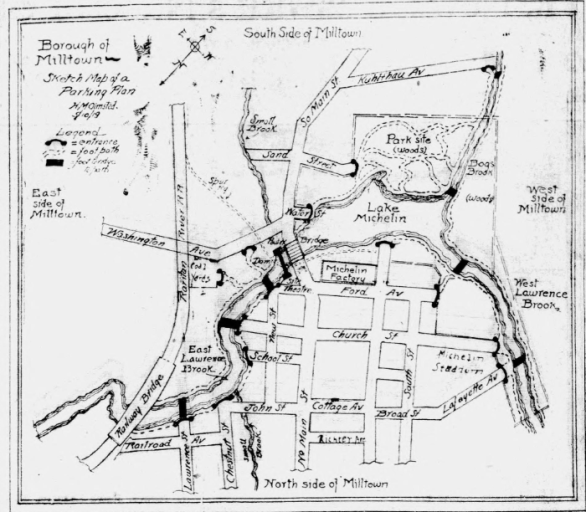
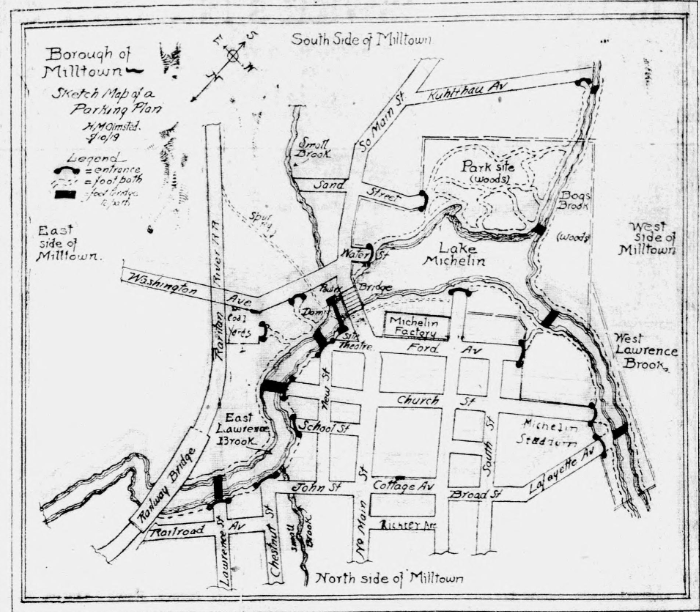
I feel certain that the idea has long since been advanced to build a city park in the large woodlands south of the lake. It is an ideal place, and I have endeavored to roughly complete my thought in this matter in the drawing accompanying this article. This plan illustrates a parking system devised to take in both branches of Lawrence Brook, and using both would also take in Bogs Brook, besides three sides of the lake, the bridge, and waterfalls, and all of the woods west of Main street and other land west of the lake as well as Lawrence Brook to the Raritan River railroad tracks. The plan would afford three Main street entrances to the woods, namely Pond, Sand, and Bogs street, besides would be entrances to the public along the brook from no less than 10 streets and areas.

Of course, the average citizen will throw up his hands and say that such a project is impracticable and that other rights are involved and that it cannot be done and all the comment will be against it, but then, it could be done, providing all of the people agreed upon it and the plan was wanted. As for the expense, it would be practically nominal, for the work to be done, outside of the securing of the land. The land requirement might prove a stumbling block, but under intelligent cooperative direction all of the people could be brought into accord on the plan and the project would attract the state’s attention with interest over the newness and attractiveness of the scheme. Besides this, I was assured that the 500 people of Milltown would take pride and happiness. It would bring to Milltown a desirable number of new citizens with their scale of prosperity.

I know of no plan so effective and so slight in cost to place Milltown in the center of all New Jersey in point of progressiveness and attractiveness. I am not Job’s comforter when I write this because I also have under contract to help better a city like the one which the Housing Corporation has built in New Brunswick, and which is now tenanted, though only so completed after a month of hard work. I am writing this because of love of the work, and because we and all the corporations run by and for their city’s happiness.

In next Sunday’s Times, the writer will continue the foregoing article and tell of the unique history of this fine water supply, the importance of street lighting, bounteous trees and shrubs, beautifying the factories, thought of a restaurant, and summary of the advantages of the borough.

A Stranger’s First Impressions of Milltown Borough

Briefly put, here are the impressions that came to H. M. Olmsted, architect and town planner, when he visited Milltown, our neighbor, to give The Sunday Times his ideas of its possibilities for the adoption of a civic plan. He found:

A clean, orderly, tidy place attractively situated on high ground with unusually pretty surrounding country.

A town with remarkably easily adaptable advantages including a pretty lake, which could be a feature of a charming park.

A town with a fine street for the principal thoroughfare to be ideally set off by the use of clusters of electric lights on street poles, etc.

Plenty of civic pride, and encouragement to keep it up on the part of town officials.

Well-maintained homes and pretty gardens, vastly improved through the stimulus of prizes offered.

Plenty of plans for future improvements in the town that show an interest in making Milltown grow.

Big possibilities that would follow the adoption of a new name for the village.

A healthful place with a climate that holds great possibilities for making it an ideal residence place.

That beautifying factories would do a whole lot to promote the town’s attractiveness.

An idea for a wayside restaurant that could be run on a cooperative plan.

This Day in History: May 13th, 1922

This Day in History: May 13th, 1922

FIND BODY OF MISSING MILLTOWNER

Believed That Aged Man Was Attacked With a Paralytic Stroke – Boy Scouts Aided in Search.

MILLTOWN, May 13.-Nicholas Heimel, sixty years old, of South Main Street, Milltown, who left his home shortly after the noon hour meal Thursday, was found drowned yesterday afternoon near Clancy’s Dock on a stream running in from the Raritan River on the estate owned by John Newmeyer, east of Weston’s Mills.

The searching party of police and Boy Scouts worked faithfully all day, in addition to a number of residents who made up a party and searched the woods in the near vicinity of the pumping station, the place where he was last seen.

The Boy Scouts had searched the surrounding property of the Newmeyer estate once during the day, but on their return Mr. Newmeyer and several other men joined in the search and soon the body of the missing man was found in the water near the dock.

The police immediately notified his wife and family.

Mr. Heimel only recently sold his farm on the outskirts of this place and moved to South Main Street to live with his son John. He had not been enjoying the best of health and was greatly worried over financial affairs, however, seemingly not really despondent. He partook of dinner at noon Thursday, and immediately afterward started out for a walk.

Failing to return late in the afternoon, his family became alarmed and soon a searching party was made up and at work.

Councilman Jos. Herbert, chairman of the police committee, sent Marshals Buehl and Stutz to work and during the night and all day yesterday carried provisions to them and others that were assisting so that no time would be lost.

There is much credit due the Boy Scouts under the leadership of Albert Heim, and the police department for their diligent efforts in finding the old man.

The deceased is survived by his wife and two sons, Conrad and John, all of this place. He also leaves a daughter, residing in Trenton.

Coroner John V. Hubbard made an investigation and expresses the belief that Mr. Heimel was attacked with a paralytic stroke, and fell into the stream. The deceased had suffered a stroke several months ago. He was accustomed to taking long walks and usually went unaccompanied.

The funeral will be held from his late home, 372 Main Street, Milltown, on Monday afternoon, and Undertaker Hubbard will direct.


This Day in History: April, 18th 1919

This Day in History: April, 18th 1919

Oil Stove Explodes and Threatens Home

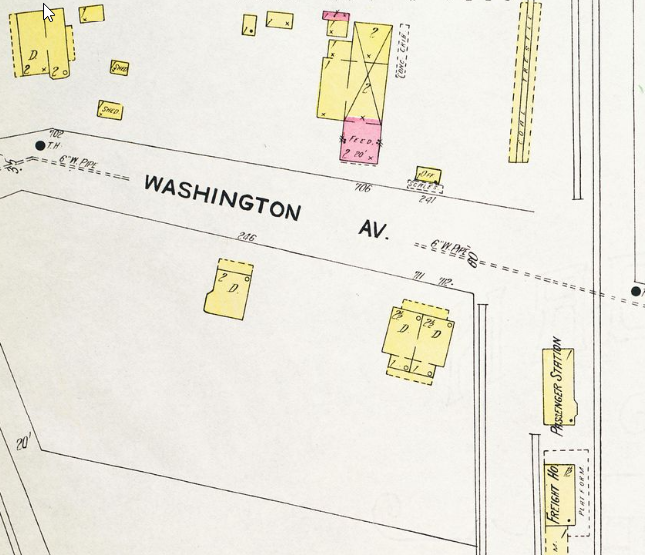
MILLTOWN, April 18 – What looked for a time as though it would spread into a dangerous fire and necessitate the calling of the fire company started yesterday morning at 10:30 a.m. at the home of Frank Reed, on Washington Avenue, when an oil stove exploded on the second floor of the building. Miss Helen Zogg, a sister of Mrs. Reed, who was in the room at the time, showed her thoughtfulness and grabbed the stove and threw it out of the open window, but in doing so the flames set fire to the weatherboards and then Miss Zogg gave the alarm. Luckily, Chester Okeson, an employee of Russell’s Card Company, and Percy Lias, chauffeur for Dr. Forney, were in front of the house at the time and they rushed to the Raritan River Railroad station, which is next to the place, and got the big fire extinguisher from the railroad and did splendid work, assisted by the Raritan River railroad employees, so the fire got no headway as only the outside boards of the house were burnt. The place is owned by Henry Kuhlthau.

Paying Taxes

Borough Tax Collector John Christ calls attention to the collection of taxes this year which is to be made by installments of two payments, in accordance with the Pierson Act. The payments are due on June 1st, and December 1st. Owing to the new law, the tax bills may be late in being sent out but as soon as the people receive their first bill they will know that it immediately becomes due, for if it is not paid by June 1st, it becomes delinquent.

Warriors Degree Ceremony Tonight

Eight candidates will be given the Warriors degree at the Improved Order of Red Men’s lodge room tonight by the warrior’s degree team, which promises to be another good night in lodge circles. Those who will receive the degree are: Oscar Christ, Frank Witkowski, George Wilson, Howard Moore, Charles Crabiel, Miles Geer, Elbwin Matlack, and George Whittle.

Personal Mention

Ground has been broken by Charles Lins on the Kuhlthau Terrace, upper Main Street, for the erection of a beautiful homestead.

Miss Dora Harkins was a Newark visitor yesterday.

Mrs. Jacob Delart, of School Street, has been called to the bedside of her aunt, Mrs. Cottrell, of Jamesburg, who is well-known here.

Mrs. Charles Lins spent Thursday with friends in Newark.


This Day in History: April 17th, 1914

Milltown Grange Recreational Group September 23 1937

Many at Spring Session of Middlesex and Somerset Pomona Granges Held Here

MILLTOWN, April 17. – A largely attended and most interesting Spring session of the Middlesex and Pomona Grange was held between the hours of 10 a.m. and 5 p.m. at the Junior Mechanics’ Hall, Milltown, yesterday, with representatives from South Branch, New Market, Middlebush, Plainsboro, and Milltown granges present. During the morning session, simply routine business was transacted. At 12 o’clock, a delightful luncheon was served by the ladies of the Milltown Grange.

During the afternoon session, resolutions of respect were drawn and read on the death of a deceased brother, B. DeWitt Giles, of the New Market Grange. Telephone messages were sent to two brothers who were unable to attend owing to illness, namely, Master Van Nest, of the Raritan Valley Grange, of South Branch, and Prof. A.L. Clark, lecturer of the Milltown Grange.

The literary program consisted of the following:

“Corn Growing in Different States” by John B. Voorhees (Of the Experiment Station of New Brunswick)
“Corn Growing Contest to Be Run by the Middlesex Board of Agriculture in Middlesex County” by Bro. George B. Redshaw
Reading, “Take No Notice,” by Mrs. Schaffer (Of the Raritan Valley Grange, South Branch)
Essay “On Bones,” written by a schoolboy and read by Mrs. H. Kline, of the Somerset Grange, of Middlebush
“Good of the Order” by David Perrine (Of New Market Grange)
Music was furnished by the Milltown Grange Orchestra, consisting of Mrs. Cosgrove, of Weston Mills, pianist; George Redshaw, of Weston Mills, violinist; John Cruit, of New Brunswick, cornetist.

Three new applications for membership were received during the session. Tonight, at the Methodist Church, the Epworthians will hold a rally, which promises to surpass any held before, as assurances have been received from a number of neighboring leagues that they will send a delegation, especially the St. James Leaguers, of New Brunswick, who will turn out strong to hear their pastor, Rev. J.P. Carman, make the principal address of the evening. As already stated, there will also probably be something interesting heard from other visiting pastors and, in addition to the usual rally speeches, there will be refreshments served in the lecture room of the church and a general social time will be enjoyed.

Walters Guards have been granted the use of the Crescent’s reading room for their dance, which is to be held in Red Men’s Hall next Wednesday evening.

Personals and Other Notes:

Charles Denhard, secretary of the Liquor Dealers’ Protective Association, attended a meeting of that body held in Carteret yesterday. Mr. Denhard is contemplating improvements to his hotel surroundings here by the removal of two large trees on the sidewalk and the laying of a concrete walk.
The Tamakwa Camp Fire Girls were entertained at the home of the Misses Glock last evening.
The L.C.S. was entertained at the home of Miss Anna Hoffer last night.
Mrs. Ernest Yahnall and Mrs. Ida Hermann were New York visitors yesterday.
William Kaiser, who has been visiting in Albany, N.Y., has again returned to his home.
The Cheerful Circle was entertained at the home of Mrs. C. Bennett in New Brunswick on Wednesday.
Jackson Barraud has returned from a visit with his parents at his home in Mt. Sinai, N.Y.
E. Jumet, of the Michelin Tire Company, recently purchased an Overland auto.


What is a grange anyway? https://newjerseygrange.com/about.html

Did you know?

The Middlesex County Fair was founded by the Milltown Grange in 1938 as a successor to their Flower and Crop Show which had been held at the Grange in 1937. Incorporated as a non-profit organization, the original Trustees had to be members of the East Brunswick Grange. The Grange had been in the process of changing their name having moved to East Brunswick in 1936 to the new Grange Hall built near the corner of Dunhams Corner Road and Ryders Lane – which was the home of the Raritan Valley YMCA until it was sold in 2003. Fred Gauntt, Master of the Grange at that time appointed H. Earl Propst as Fair Chairman and Fred C. Heyl as Secretary-Treasurer of the fair. Heyl remained Secretary-Treasurer until his death in 1956. https://middlesexcountyfair.com/history/


George McGinnis at a Loss to Know Who Robbed Him

MILLTOWN, April 17 – Upon awakening yesterday morning, George McGinnis, of South Milltown, discovered that one of the cleverest burglaries he had ever heard of had been performed during the night at his own home. The visitor or visitors made entrance through a window in his bedroom, ransacking his trousers and then going downstairs to his daughter’s apartment, Mrs. Jennie Steins, and getting away with a loot comprising some thirty-two dollars, a sum of change, and two gold watches, which Mr. McGinnis had purchased to make presents with.

Mr. McGinnis said he didn’t care so much about the money but he did care a great deal about the two watches which were engraved with the initials of the parties to whom they were to be presented. He said that one was to have been presented to his daughter and another to some other little girl.

In going through Mr. McGinnis’s trousers, the burglars secured a twenty-dollar bill, a two-dollar bill and some change, and the other ten dollars were secured from the daughter’s room downstairs.

The Entrance

The method by which the robber gained entrance was one of the cleverest stunts ever attempted hereabouts, and the methods involved would lead to suspicion. The visitors went to Mr. McGinnis’s own barn, found a stick about 3×4 inches and about 16 feet long, and on this single stick nailed about six slats forming such a ladder as would enable them to reach the second-story bedroom window on the side of the house where they had entered.

Mr. McGinnis said that his trousers were near the window and that they could have reached for them from the outside without entering the house. The front door was found open yesterday morning, as was a cellar window, but it is believed they made their exit by way of the front door.

In the shed or barn where this stick was found, whereby the burglars made their ladder, there was also a dog, but the visitors evidently made friends with this guardian and yesterday morning he was found on the front porch. It was also said that, much to the surprise of Mr. McGinnis, a lamp was found in his bedroom when he awoke yesterday morning, which he is positive was not there when he retired the night before.

Just what time the burglary occurred is not known. Mr. McGinnis said that both he and his daughter were out in the early evening and he returned to retire about 11 o’clock, and during the night he heard nothing whatever that would cause him to think there was any mischief going on.

When asked by a Home News reporter whether he suspected anyone, Mr. McGinnis replied, “Certainly, sure. But I didn’t catch them in the act, so I can’t do anything in the matter just now.”

He said, “I don’t care so much about the money, but I do care a whole lot about the watches, and whoever did get them won’t dare to wear them for they had been inscribed with initials of the parties to whom they were to be given.”


This Day in History: March 9th, 1920

This Day in History: March 9th, 1920

WILL HAVE PUBLIC HEARING ON PLAN FOR ANNEXATION

MILLTOWN, Mar. 9 – At a meeting of the Borough Council held last evening in the borough hall, a communication was received from the Chamber of Commerce asking the Council to endorse their action regarding the annexation of a portion of North Brunswick Township. Councilman C. V. L. Booream introduced the resolution requested.

A lively debate was held on the subject. The acting Mayor put the passage of the resolution before the Council, and only Messrs. Booream and Herbert responded in the affirmative.

Councilman Klotzback asked the members if they thought the sentiment of the people was for the annexation. Mr. Booream, in reply, stated that it was the apparent sentiment of the people at large as the Chamber of Commerce heartily favored it last Wednesday night at an open meeting to the public for their opinions. He continued and said that fully 75 percent of the people would favor the annexation. Councilman Jensen, misunderstanding Mr. Booream, questioned him, “Can you show us where 75 percent is in favor of it?” In reply, Mr. Booream said, “I didn’t say I could. I said 75 percent would be in favor.”

After a short debate, the acting Mayor called for the ayes and nays, and again Messrs. Booream and Herbert responded in the affirmative, while Messrs. Dorn, Jensen, and Klotzback passed.

The councilmen voiced their opinion as to a public hearing. Mr. Herbert said he was in favor of it and thought the Council should endorse the first real act of improvement for the borough that the new Chamber of Commerce has taken.

The other members refused to vote, so Councilman Booream withdrew his resolution of endorsement, and the Council decided to hold a public hearing on Thursday night to gain the sentiment of the people, and then they could vote intelligently.

Favor Daylight.

The daylight saving plan was discussed, and the Council went on record as favoring the plan and instructed Attorney Weigel to forward a letter to Senator Brown of this county, telling him of the Council’s action and asking him to vote in the affirmative.

Bids for the collection and disposing of garbage and ashes were called for, but only one was received, that of Frank C. Herbert of Dunham’s Corner for $1,488. The contract was awarded to Mr. Herbert.

The Council also decided to purchase a new flag for the Borough Hall. All the councilmen were present, including Messrs. Schlosser, Klotzback, Jensen, Dorn, Herbert, and Booream. Borough Clerk Harkins, Borough Attorney F. C. Weigel, Borough Engineer C. P. Stealle, Superintendent of the Water Department Samuel Spiers, Assistant Superintendent John Baurles, and Collector John Christ were also in attendance.

ORDERS for Painting and Paperhanging that will be left with Mr. Frank Jones, 309 Main street, will be taken care of by George A. Schnatter, Box 148, South River, N.J. All work guaranteed.