This Day in History: May 18th, 1919

This Day in History: May 18th, 1919

Milltown’s Splendid Possibilities for Adoption of Beautiful Civic Plan Shown by Architect and Town Planner of U. S. Housing Corporation

(By H. M. Olmsted, Architect and Town Planner of U. S. Housing Corporation.)

Six months ago the writer was asked by one of the engineers of the U. S. Housing Corporation, what kind of a place Milltown was for one to make it his home. Not having then visited Milltown, I could not answer him. A passer-by overhearing the question, promptly and officiously answered by stating that the town was a mill-hand section and not fit to live in. So Milltown lost the opportunity of gaining one more good citizen.

At the request of the editor, the writer visited Milltown several days ago. The few intervening miles between New Brunswick and Milltown were covered rapidly and comfortably. Arriving at the north end of Main street, we drove to Kuhlthau Avenue and alighting there proceeded on foot over the village.

For a town of which I had heard unfavorable reports, I can only say that I was delightfully surprised at everything I saw, from the moment of my arrival upon its well-paved sidewalks. On every hand one finds substantial and attractive homes—real homes, not imitation ones—real lawns, gardens, orchards, with trees and shrubbery of all kinds in profusion. To add to the effect, there is much water, many brooks, and the lake with its interesting waterfall just below the Main street bridge.

My first, hence lasting, impression of Milltown is that it occupies an envious and unique position in the ranks of suburban towns, as well as in its natural and beautiful surrounding country.

A Stroll Through the Town

Our way led down Main to Sand street, thence through the woods, south of the lake, to Bogs Brook, back along the shore of the lake, to Main street bridge and waterfalls and from there out over the portion of the town lying north of the bridge.

We saw about 500 real homes with 100-foot square lawns, having gardens, orchards, and grape arbors. We saw some dozen or more substantial stores, several churches, schools, factories, etc.

On every hand the properties are well laid out and excellently maintained. Along north Main street there are many homes which might be called pretentious, were it not for the fact that their owners evidently placed more importance on the value of a “real home place” than on pretentiousness. Holding the same opinion, I agree with that policy.

A “home” is better than a pretense. When one sees so many uniformly charming houses, lawns, and gardens, it is evident that the citizens have not only high civic pride but an excellent knowledge of how a home and a town should be conducted.

We saw but one building actually needing paint and minor repairs, and I strongly suspect that that one was deserted.

Almost without exception, front and rear yards were charming. The arrangement of trees and shrubs was natural and pleasing.

As we passed house after house and found solely trim lawns and gardens, our surprise grew steadily, because here was a town of which we had heard just the opposite of the reality.

Splendid Views Obtainable

Milltown is located in a hilly country of considerably higher altitude than her neighbor, New Brunswick. From these hills and in between them, charming glimpses of the setting of the town are obtainable. The soil is a rich sandy loam and on the sides of the slopes in the woodland are a number of good gravel and sand pits. Water is abundant as evidenced by the lake and its tributary brooks. On every side the eye of the artist and nature lover may drink in sight of a country that charms and delights. At the west end of Sand street along the slopes of the hill there, leading down 100 feet or so to the lake, picturesque views of the lake and its setting may be had. A clever artist could reproduce that scene upon his canvas and command practically his own price for the work.

Standing on the bridge or below the waterfalls, another pleasing view is had of the valley and rising hillside off to the southeast. It was at about such a spot that my business eye lingered for considerable time, on account of its possibilities for the location of a villa building and grounds, which the public might decide to erect and use as a holiday and evening dining place.

On the trestle below the waterfalls, another pleasing view is of Lawrence Brook, as it leaves the falls and winds in and out across one of the prettiest of little valleys, until it finds its way outside the town limits under the railroad bridge, some distance from the falls. Another delightful valley crosses the line of Vanderbilt avenue; its center line carrying a small stream leading into Lawrence Brook. A number of attractive cottages dot the hillside between the Raritan River railroad and Ryder’s Lane.

Along northern Main street are located many spacious and charming homes surrounded by large, well-trimmed lawns. Here, as elsewhere, equal refinement and beauty predominate. I judge the larger places belong to the most substantial citizens of Milltown. These homes are indeed charming.

The Small Cottages

Along Ford avenue or rather boulevard—for in reality, it is a 100-foot or more wide boulevard—with its stately rows of trees, we walked to the ballpark and thence north along South street, past the Michelin line of frame cottages. It is remarkable that here, too, even in these factory properties, with their plots of 50 by 150 feet, we found none but pretty lawns and gardens and all seemed filled with a bounteous supply of flowers and vegetables, sufficient to keep the average family all summer and longer.

A Part of the Secret of Beauty

After repeated exclamations from my wife, she had me inquire of a friendly citizen as to the reason for the unusual uniformity of the beauty of the gardens and homes.

Said the native: “Friend, I hardly know just how to answer your question, because I have lived here so long that it has not seemed unusual to me, however, now that you point it out, I must admit, that it is an unusual sight, when compared with many other villages. I believe the sights which you compliment are due to a number of different causes. First, the citizens of this town take a big civic pride in their town, its government, and their homes. These things mean a great deal to them. Then, too, the town authorities and leading business men as well as the stores and factories have taken a keen interest in having this town a home-like and beautiful place, and they have succeeded. The people are united and back of the movement.”

Prizes for Gardens and Homes

Continuing, the citizen informed us that the authorities and factories had a regularly constituted prize committee, and that it was the custom to make unannounced visits to the homes and gardens of the citizens and award substantial prizes, not only for the best lawn and garden but for the best-kept house, both exterior and interior.

This competition, aided by a strong spirit of civic pride, had caused a wonderful change in the town. He told us that twelve years ago, the streets of the village were overgrown with grass and weeds. If this is correct, then indeed, a miracle has been wrought and it is doubtless due not only to the cooperation of citizens and their authorities but to a much bigger and finer thing, namely, a refinement of brain and heart, which evidently exists throughout the village, else all we witnessed, could not have been accomplished in so brief a period.

Improvements Contemplated

Another citizen stated that a number of improvements were in contemplation. In the main, these consisted of a new pavement on Main street, both north and south of the bridge, and a brand new theater building where only first-class pictures will be shown and at merely a nominal cost as compared with the prices obtained in other towns.

Sidewalks and curbs are being laid in the town as fast as necessity demands. As to the roads, I judge the sandy-gravelly earth where no pavement exists prevents a muddy condition, so that unpaved roadways are not such a bad feature as one might be led to suppose. Even without more concrete roadways the city is pretty well off as it is in this respect. It would be an unusual condition, indeed, if the town should determine to concrete pave all of its streets, but I would not be surprised to learn that such a step was contemplated.

Government of Milltown

I was informed that the town is governed by a mayor and board of councilmen, and that the town owns the power plant, a perfect sewer system and water plant as well. The sewer system cost over $100,000 to construct.

Milltown is exceedingly thrifty. It maintains a good bonding margin and is, I believe, practically free of indebtedness. This shows excellent management. Should a new pavement be laid in Main street, there will doubtless be a straightening and realignment of all curbs and gutters. In connection with curbing, it is worthy of comment that in the thirty or more U. S. housing projects, erected during the war, the streets of such projects invariably had installed a one-piece concrete curb and gutter, curb being six inches thick with an 18-inch wide gutter. This was made for pleasing effect and perfect alignment.

What the Future Might Bring

It would not be surprising to learn that the citizens of Milltown had decided to take a stronger grip on their opportunities for home and civic advancement and would soon start a larger campaign to utilize all of their storehouse of opportunities surrounding the town. If such a movement is once started, then in my opinion, their village will assume rightfully a leading place throughout the entire state in the matter of prosperity, civic progressiveness and attractiveness.

From the viewpoint of the town planner and landscape architect, Milltown has a long way to go ‘ere the possibilities for further advancement be exhausted. This is due to Milltown’s natural resources and her surroundings.

Town Planner’s Viewpoint

Regarding Milltown from this point of view, I should say that her future is fraught with excellent possibilities. I noticed that the center of town seems to be at the bridge and here almost nothing in the nature of real town planning or improvement has been done. The bridge, Main street, the lake, brooks, falls, and woods south of the lake present an excellent array of points upon which a good start might be made if such were the wish of the citizens.

As your town grows in population and prosperity it must progress, as every thinking man knows, or it will lapse upon itself and go backwards. So along the thought of a progressive policy, naturally, it occurs to anyone engaged in town planning that after the repaving and realigning of curbs etc., along Main street, a natural thing to do would be to erect along that street electric light standards at intervals of, say, 15 feet, each one having a cluster of globe lights. This one step would transform the street into a beautiful boulevard—make of it a delightful promenade in the evening and would have the effect of advancing prosperity by attracting more business to stores in the town. Another thought, which will occur to everyone, is that all of the large buildings near the bridge might, with almost no expense, plant English ivy and shrubbery across the front, sides, and rear of these buildings, and thus make them pleasing and charming to the eye of the citizen and the motorists who pass that way in ever-increasing numbers. This refers particularly to the Michelin factories, the power plant, car barns, and two large hotel buildings just south of the bridge.

I am sure my readers will not think me guilty of naming any superior knowledge or too personal assertiveness in this matter, because no doubt the people and authorities of Milltown have long thought of these possibilities and may even now have them in process of installation, but as one requested to write on the subject, I am sure no offense will be taken in exposing the natural thoughts likely to occur to everyone at the same time.

The Bridge and Water Falls

What an artistic setting for a town bridge of concrete with separated pedestrian and vehicle passages. With clusters of globe electric lights strung along each side of it and to add to the effect, an eastern and western walkway, leading on either side and from the summit, below the waterfalls. With a few concrete benches and concrete flower boxes properly arranged, that spot would be indeed artistic and effective as a natural center of the town.

A Site for the Theater

Doubtless such a site has been decided upon, ‘ere this, but the thought came to me unaided, that rose bespied by the old mill building or remnants at the waterfalls. The lot north of the power plant also might be cleaned up and made very charming.

A Site for a City Park

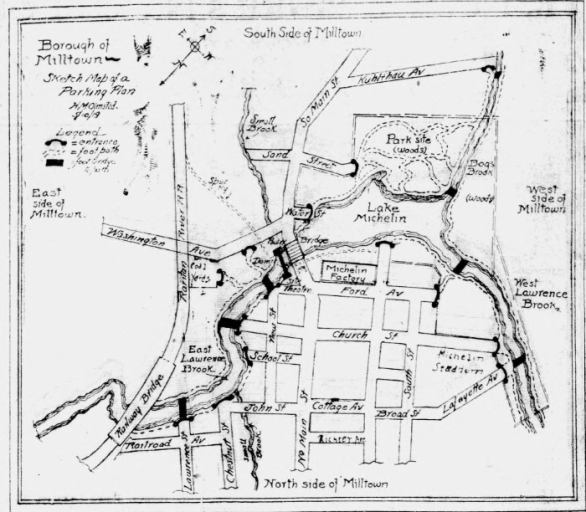
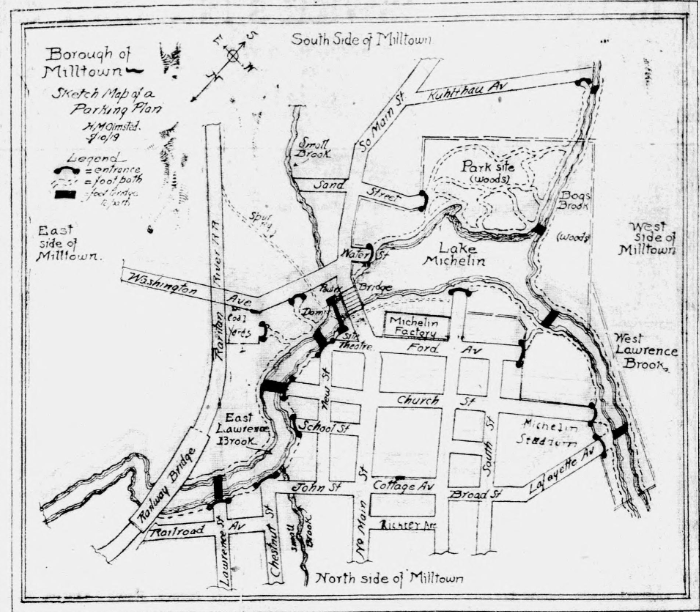
I feel certain that the idea has long since been advanced to build a city park in the large woodlands south of the lake. It is an ideal place, and I have endeavored to roughly complete my thought in this matter in the drawing accompanying this article. This plan illustrates a parking system devised to take in both branches of Lawrence Brook, and using both would also take in Bogs Brook, besides three sides of the lake, the bridge, and waterfalls, and all of the woods west of Main street and other land west of the lake as well as Lawrence Brook to the Raritan River railroad tracks. The plan would afford three Main street entrances to the woods, namely Pond, Sand, and Bogs street, besides would be entrances to the public along the brook from no less than 10 streets and areas.

Of course, the average citizen will throw up his hands and say that such a project is impracticable and that other rights are involved and that it cannot be done and all the comment will be against it, but then, it could be done, providing all of the people agreed upon it and the plan was wanted. As for the expense, it would be practically nominal, for the work to be done, outside of the securing of the land. The land requirement might prove a stumbling block, but under intelligent cooperative direction all of the people could be brought into accord on the plan and the project would attract the state’s attention with interest over the newness and attractiveness of the scheme. Besides this, I was assured that the 500 people of Milltown would take pride and happiness. It would bring to Milltown a desirable number of new citizens with their scale of prosperity.

I know of no plan so effective and so slight in cost to place Milltown in the center of all New Jersey in point of progressiveness and attractiveness. I am not Job’s comforter when I write this because I also have under contract to help better a city like the one which the Housing Corporation has built in New Brunswick, and which is now tenanted, though only so completed after a month of hard work. I am writing this because of love of the work, and because we and all the corporations run by and for their city’s happiness.

In next Sunday’s Times, the writer will continue the foregoing article and tell of the unique history of this fine water supply, the importance of street lighting, bounteous trees and shrubs, beautifying the factories, thought of a restaurant, and summary of the advantages of the borough.

A Stranger’s First Impressions of Milltown Borough

Briefly put, here are the impressions that came to H. M. Olmsted, architect and town planner, when he visited Milltown, our neighbor, to give The Sunday Times his ideas of its possibilities for the adoption of a civic plan. He found:

A clean, orderly, tidy place attractively situated on high ground with unusually pretty surrounding country.

A town with remarkably easily adaptable advantages including a pretty lake, which could be a feature of a charming park.

A town with a fine street for the principal thoroughfare to be ideally set off by the use of clusters of electric lights on street poles, etc.

Plenty of civic pride, and encouragement to keep it up on the part of town officials.

Well-maintained homes and pretty gardens, vastly improved through the stimulus of prizes offered.

Plenty of plans for future improvements in the town that show an interest in making Milltown grow.

Big possibilities that would follow the adoption of a new name for the village.

A healthful place with a climate that holds great possibilities for making it an ideal residence place.

That beautifying factories would do a whole lot to promote the town’s attractiveness.

An idea for a wayside restaurant that could be run on a cooperative plan.


This Day In History: April 13, 1919

This Day In History: April 13, 1919

HOW MILLTOWN COULD BE TRANSFORMED: SUGGESTION THAT IT BE MADE TO REPRESENT “A LITTLE BIT OF FRANCE TRANSPLANTED TO AMERICA”

(By HELEN McCALLUM)


Ever since the time General Lafayette came across the ocean with his army and held out a helping hand to America in Revolutionary days, there has been a bond of friendship between America and France and it has been doubly, yes trebly cemented by the events of the recent war.

One of the results of this is bound to be an interchange of ideas, customs and manners between French and American people. It is shown already in many ways; our “doughboys” returning from France tell us in glowing phrases of the beauty of the French villages and cities – those that escaped the fury of the enemy – while many who have been abroad before and seen the pretty communities that have been devastated. Find no words to express their regret that such beauty should be lost.

People who have been in France say that Milltown possesses the natural physical elements that go to make up these cozy French towns and this idea suggests the possibility of converting New Brunswick’s suburb into a really and truly villa patterned after the best in France.

People who have been in France say that Milltown possesses the natural physical elements that go to make up these cozy French towns

Hellen mccallum -1919

There are a number of French families in Milltown now; there are French people coming to America constantly who would be attracted to a place that suggested home to them. Needless to say these people would probably be only too glad to keep up the idea of combining their efforts to inoculate France beautiful into New Jersey.

Milltown can afford to grow, to expand. The opportunities and possibilities are there and perhaps this plan is just the incentive needed to start the wheels of progress turning” towards a big destiny. There are hundreds of ways this could be done. Start a few civic features with the French idea predominating, follow this with French architecture for the houses, encourage French ideas in the  shows revamp the hotels with a French “menage” then watch Milltown grow!

Of course it would take time and some money, but with the natural advantages already there, these would he a secondary and third consideration in comparison to the investment for the future. Think of the towns that have no foundation to build a distinctive reputation on, then of the splendid one Milltown has to achieve an international reputation if a little initiative and effort are used to establish a French “atmosphere” there.

The Michelin Tire factory has an opportunity to expand, to treble or quadruple its present capacity through the adoption of this idea. Then, too, other industries would be attracted to the place and the first thing you know instead of running over to Paris for their season’s wardrobe, New Yorkers might be taking a Gray bus or trolley to Milltown for the same purpose.

Yes, Milltown (I think I’d change that name perhaps I’d call it “Michelin”) might endearingly be referred to as a “bit of France transplanted to America.”

Slight alterations to many of the homes would give them much of the sought French effect. A little touch here and there would do the trick.

Slight alterations to many of the homes would give them much of the sought French effec

Hellen mccallum -1919

It would be a good thing for the other Milltown industries as well as the Michelin. a good thing for the stores and shops and I would not be surprised if the Raritan River Railroad would contribute liberally to the carrying out of the plan.

Milltown has a real French millinery with a French madame in charge now. Maybe she is to be a pioneer in a new field. There is room for the French and the other industrious folk there now to get along splendidly in Milltown and to greatly increase the size and attractiveness of the place. It is a very nice town now.


This Day in History: April 18th, 1924

This Day in History: April 18th, 1924

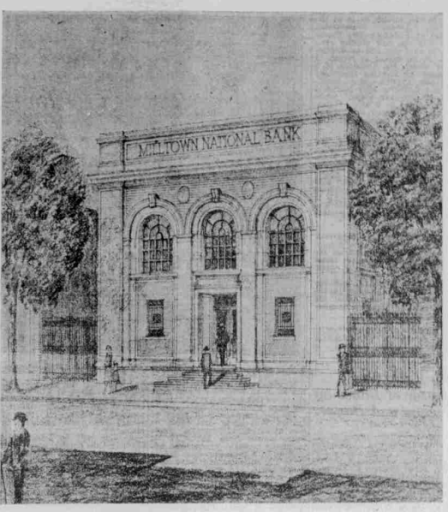
MILLTOWN’S MODERN NEW BANK BUILDING WILL BE OPENED FOR INSPECTION TOMORROW

MILLTOWN, April 18-In recent years the growth of banking institutions in small towns has been most creditable. Tomorrow, however, Milltown opens the way for other communities when it will present the First National Bank for inspection; a structure equipped with practically all the labor-saving and protection devices of the Metropolitan bank. By these innovations, the local bank has opened up possibilities which will grow daily for the convenience of the population, and in a short while it is believed that the local institution will become an instrument of still greater service to the community. The new building is centrally located and makes a striking appearance with its front of Imitation granite. The exterior of the bank is readily understood by referring to the accompanying reproduction. Doors will be opened at 9 a.m., and will remain open until 9 p.m., for the general survey of the building, and a close Inspection of all the modern ideas which have been combined in this handsome structure.

The entire banking force of workmen will be on hand tomorrow to assist in the inspection as well as many of the directors. Souvenirs will be given away by the bank as a remembrance of the opening and it is expected that hundreds will avail themselves of the opportunity to view this magnificent new home of a fast growing organization. The bank directors make the invitation a most cordial one, and none should feel backward about making a call during the course of the day.

Wonderfully Well Arranged

Upon entering the bank, the vestibule and lobby with walls paneled off in Mycenian marble are attractive. To the right of the lobby is the president’s room, neatly decorated with walls of old ivory, making it an inviting place for business. An entrance is also made to this room from the information room which adjoins in the main banking space.

To the left of the lobby, will be found the ladies’ room, fully equipped dressed in the identical design as the president’s room.

The main banking room offers a picture of exquisite taste with plaster cornices set off with pilasters. This decoration refers to the upper part of the walls while the lower section is marked off and finished In Caen stone. The public space and the vestibule as well as the lobby carry a terrazzo flooring. To the right of the public space is the Information room, which has a flooring of natural cork, with checker board design. The floors of the president’s room, ladies’ room, and the working space provided for the employes is also laid off with cork flooring with checker board designs. Two check desks are in the public space and made of marble with heavy glass tops and pivoted windows.

Business Windows

The tellers’ windows comprise polished plate glass with wickets of solid bronze, while the counter looks handsome composed of Tavernelle and Mycenian marble. Five windows are placed in the screen to accommodate the customers, and each window carries a certain booth for the employe. The space alloted for the working force is ample and gives sufficient room for the transaction of all business. The lower banking room and public space is supplied with a wonderfully arranged lighting system, with eight large windows throwing down sunlight from the upper section, as well as several smaller windows in the lower section. Aside from this, five medium-large windows afford excellent light from over the mezzanine in the rear of the building.

The vault, built by the Herring-Hall-Marvin Safe Company of New York, is located directly to the left of the building next to the public space. Entrance to the section where the vault is located is through a bronze gate and grille. The vault carries a reinforced concrete shell. as well as a steel lining with a network of burglar alarm wires properly attached to a signal on the outside of the building. The door of the vault is a large circular one, supported on massive hinges with a combination time lock. The door is ten inches thick. Inside of the vault are several hundred steel safe deposit boxes as well as a large round magazine for the safe keeping of securities and cash. A large size mirror takes in the entire back of the vault. To the right of the larger vault, a smaller one is erected for the storage of records and books which, similar to the large one, is heavily reinforced.

Adjoining this vault, is a coupon booth of frosted glass where customers may be escorted to go over their papers, which are taken from the vault. On the extreme right of this is the men’s locker. Over the vaults is the mezzanine, which has been prepared in case of additional working space being needed. This is a very pretty part of the building, for a colonnade of heavy plaster columns, with an ornamental railing, gives an excellent set off. to the rear of the interior.

In depleting the artist’s taste In this interior decoration, one must not leave out the mahogany furniture and fixtures. The lofty celling is twenty feet high which affords an unusual chance for the light and air to come into the room. Over the front lobby and side rooms, is the board of directors department. It is a specious room in which to transact business. This room is paneled in several tones of pleasing colors with four large windows supplying light. A casement window overlooks the entire banking floor and from this position, one may get a full glance of the excellent taste of architecture used in the making of the building. In the large basement of the bank are located the boiler room, coal bunker, and two large vaults for the storage of records and the like. The bank will be heated by vacuum steam.

Directors Well Pleased

Every members of the Board of Directors of the bank is well pleased with the new home. The building should meet all requirements for years to come and has been erected at great expense.

President J. Burr Herbert and the other directors feel indebted to the architect and the contractors for the beautiful touch given the building. The architect apparently tried primarily for dignity of design and this was attained by study of the proportions of the building.

1917-1924

The First National Bank was Instituted in 1917, and with business of seven years in back of it, has advanced to the stage now where it has been able to accomplish much. The Iate J. V. L. Booream was the first president of the charter officials, and after his death J. Burr Herbert now president, was elected and has held the reign ever since. Of the original Board of Directors only the late Mr. Booream has been taken from the official body and his place has been taken by Cashier H. J. Booream. The bank has made wonderful strides in the past seven years and was compelled to Increase the capital stock from $25,000 to $50,000. The directors are a body of men with many business qualities, while the workers in the Institution are well versed in banking fundamentals. H. J. Boeream, the cashier, has been in this work for nineteen years, coming here from the First National Bank of New Jersey of New Brunswick. His interests in the local organization are keep and he devotes much time to making the bank one of the leaders in the county circles. Edwin M. Kuhlthau, assistant cashier, was also connected with the First National Bank of New Jersey of New Brunswick, and has been prominent figure in the advancement of the affairs of Milltown’s institution. Miss Helen Lindstrom and Miss Edith Lins are very capable members of the business staff and gained banking knowledge through the School of Banking in Elizabeth.

View this beautiful home tomorrow, and admire the tasty designs, Alexander Merchant of Highland Park was the architect in charge of the building, while the general construction work was under the supervision of the Milltown Realty Company, with Earl Seaman, a practical manager In charge of the work. The lighting system was Installed by Richard Perry, Plumbing work was done by L. Zach and Co., the masonry work by Robert Ferguson, heating by the Milltown Engineering Company and the painting by John Kemp.

The officers and directors of the bank are: President, J. B. Herbert: vice presidents, Christian Kuhlthau, and N. N. Forney; cashier, H. J. Booream: assistant cashier, Edwin M. Kuhlthau: directors. George Kuhlthau, Elmer E. Connolly, Spencer Ferry, C. C. Richter. and Fred W. De Voe, solicitor.


This Day in History: March 31st, 1914

This Day in History: March 31st, 1914

FIRST STEP FOR FREE PUBLIC LIBRARY IN THE BOROUGH

Will Be Benefit Entertainment Given by the Public

School Children Here on Friday Red Men and Friends Meet To-night.

MILLTOWN, March 31-On Friday evening of this week, beginning at 8.15, at the Public School, a musical comedy entitled, “The Minister’s Honey- moon,” will be rendered, under the auspices of the local school, the proceeds of which will be used as the first step towards a free public library in Milltown.

Four of the local teachers, who are also connected with the entertainments of this sort given in the Methodist Church, of New Brunswick, will appear in the cast. They are the Misses Emma Groner, Alta Ehrgood, Hazel Hughes and Edna Vail.

It is believed that many townspeople are greatly interested in this movement towards the establishment of a free public library in Milltown, and that they will co-operate with the teachers and the Board of Education by giving their support in attending the entertainment, for which the price of admission will be 25 cents to all.

The present library at the school consists of some four hundred volumes, and it is believed that with the proceeds that will be derived from the entertainment there can be purchased a sufficient number of books to supply the citizens of the town who may wish to take advantage of this opportunity to secure reading material.

Principal H. R .B. Meyers recently suggested this subject to the Board of Education, and it met with their approval, and if the plans materialize be has stated that he will be at the school at least one night a week and will act in the capacity of librarian.

If ten dollars is made on the entertainment held by the school the State will appropriate an additional ten dol- lars toward the cause and will continue to make this appropriation once a year on similar occasions.

Property Sales.

The property as recently advertised in the Home News for sale on account of taxes, was sold on the date specified, the Schwendemann premises being purchased by Frank Rudnitskie, of Fresh Ponds, and the Whitehead property by Mayor William Kuhlthau, Jr.

To Organize Pocahontas To-night.

To-night, in the rooms of the Wickatunk Tribe, No. 135, Improved Order of Red Men, the members of this lodge, their wives, daughters, sweethearts, and in fact all those that care to attend, whether connected with the lodge in any way or not are invited to a social evening, at which time matter of organization of a Pocahontas degree will be one of the main points for discussion.

As stated in last night’s Home News there are already some forty or forty- five that have pledged their names as members of the charter roll, and it is expected by the close of to-night’s program there will be a still greater number.

Dont’ forget, it’s to-night at eight o’clock. Come out, bring one or more: with you and hear what the officers of the Great Council have got to say about the benefits that may be derived from the organization of such a degree as hereinabove named.

Reception for Dr. Hand.

To-night at the Methodist Church, in connection with the regular weekly prayer service, a reception will be given Rev. L. L. Hand, on his return to the local pastorate. It is expected a large number will turn out.

Juniors to Initiate.

To-night Goodwill Guards, of New Brunswick, will confer the third in- Itiatory degree of patriotism upon the seven candidates that Charles L. Wal- ters Council, Jr. O. U. A. M., have in tow. The ceremony will be performed in Walter’s council chamber, and will be followed by a luncheon.

Michelin A. A. Directors Meet To-night.

A meeting of the Directors of the Michelin Athletic Club will be held at the French Club this evening.

Personals.

Messrs. Ralph Thompson and Allen Otis, of New Brunswick, were Sunday visitors in the borough.

Mr. and Mrs. Clarence Horner en- tertained out of town friends Sunday. To-morrow evening the Misses Helen and Mamie Glock will entertain the Methodist Bible Class in the room of that edifice.

Rescue Council Notes.

At a meeting of Rescue Council held last evening, four beautiful pictures of Washington at Prayer at Valley Forge, as seen and described by Isaac Potts, March 1778, taken from the bronze by J. E. Kelly, on the Sub-Treasury, Wall street, New York, were received from William R. Ricker, a member of Rescue Council, formerly of this place, now of Elizabeth, with instructions that the council keep one for their own use and present one to each of the churches of the borough, and also one to the public school. The trustees of Rescue Council have been instructed to procure a suitable frame for the picture, and that it be placed in a prominent place in the lodge room, and it is likely that the other three will also be framed and placed where especially the children may get a prominent view of the same.

State Vice Councilor Howard S. DeHart has extended an invitation to the members of the local order to accompany him to Royal Council, No. 77, of Plainfield, on Wednesday evening of this week, where he will make an ad-1 dress, as well as the State Councilor William P. Thompson, of Moorestown, N. J. Anyone desiring to make the journey is welcome to go along.

Next Monday evening the first degree will be conferred upon Messrs. John Heinz and Alfred Hoffer.

Much regret was expressed by several members of the order last night on the demise of A. J. Cook, of New Brunswick, who was always a faithful, worker in the O. U. A. M.

In the Quolt League of Rescue Council last night Schlosser and Wolff gained a firmer hold on the first place, when they defeated Gerland and Hoelzer three straight, and Junker and Kohrherr two out of three.

Emens and Meyers defeated Evans Evans and Selover two out of three and lost two out of three to the DeHart brothers.

Evans and Selover defeated Gerland and Hoelzer three straight.

Evans and Junker defeated DeHart brothers two out of three, and also defeated Junker and Kohrherr three straight.

Mrs. Caroline Van Hise Dies at Newark.

Mrs. Caroline Van Hise, who sided in the borough up to a short time ago, passed away at the home of her sister, in Newark, yesterday morning.

More Personals.

Mrs. Charles Denhard and son have returned after a sojourn to New York. Paul Matzke is confined to his home with tonsilitis. He was unable to talk yesterday.

G. Geipel recently moved from the corner of Broad and Clay streets to the Kuhlthau apartments on Main street.

Jos. Cchorke is ill at his home in Fresh Ponds with the mumps.

The factory of the Michelin Tire Company was closed in part yesterday and to-day for the purpose of taking Inventory.

Monsieur Jacobs resumed his duties at the Michelin tire factory yesterday, after being confined to his, home for several days with the grip.

Mrs. James Townsend is ill at her home on School street. with pleurisy. A meeting of the old Board of Education will be held at the school Thurs- day evening. And on next Monday evening it is expected to hold another meeting when the organization of the new board will take place.

An informal dance will be held by members of the A. A. A. in Red Men’s Hall to-morrow evening.

Would Benefit by Sewers.

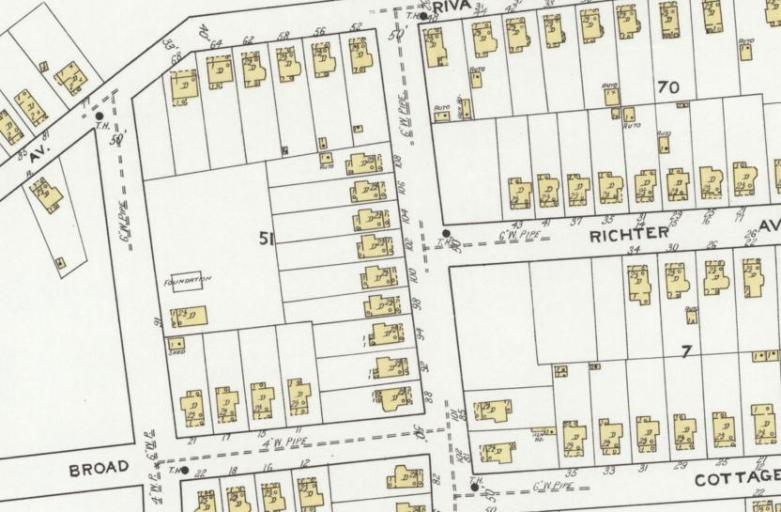
In many of the cellars of the homes in the neighborhood of Broad street, Clay street and Riva avenue, there has been as much as three or four feet of water, all of which no doubt will be easily overcome should the new sewer system be installed, and which no doubt will be a matter very seriously, considered, especially by the residents of this section.

A copy of the deed for the transfer of a property belonging to John Richter and wife, and located on the south side of Clay street, 155 feet north from Broad street, Milltown, has been filed in the County Record building, New Brunswick. The purchasers are Simon Fournier and wife.


This Day in History: November 22, 1913

This Day in History: November 22, 1913

ORDINANCE TO WIDEN RIVE AVE. IS PASSED


MILLTOWN, Nov. 22.-An adjourned meeting of the Borough Council was held last evening. Mayor Conrad Richter presided. Councilmen Chas. Baurles, Henry Kuhlthau, Geo. E. Crabiel, Al Skewis, B. Miller, Clerk R. A. Harkins, Messrs. C. W. Waddington and R. B. Sheppard of the water commission board were present.

The following bills were ordered paid:

Chas. Hoffman. . . . . . . . . . . . . . . . $ 2.00

Home Insurance Co. . . . . . . . . . . $12.80

C. P. Stelle. . . . . . . .  . . . . . . . . . . $239.35

Mrs. John Lins was permitted to remove two trees in front of her property on Clay and Church streets The trees had been damaged by lightning.

A resolution approving the plans and specifications of the Sewer and Water Commission was adopted.

An ordinance regarding the widening of Riva avenue, from Main to Clay street was introduced passed on the first reading.

The ordinance provided that the borough would remunerate property owners for any damage that might be incurred and if agreement could not be made the Borough will have the right to condemn such property as may be necessary to obtain the desired width.

Prior to introduction of the above ordinance a petition from several property owners along the avenue was presented.

A resolution was adopted that the borough clerk post notice of intention for widening of the avenue in five of the most prominent places in the borough.

On motion the clerk was authorized to notify the railroad as to the condition of the crossing at Main street near the Michelin Tire Co.

The clerk was also authorized to notify the Board of Freeholders as to the condition of the bridge crossing Lawrence Brook.

The light committee was authorized to purchase a transformer for use in connection with the ventilating system at the school.

On motion the clerk was authorized to send a special notice to the property owners along Riva avenue, who have not as yet signed petitions for widening of said avenue.

Milltown to Have New Order.

C. H. Crenning, who is well versed in lodge work, has decided to use his best efforts towards instituting an Order of Owls in the borough, provided he can secure the necessary signers to the petition, which he is about to circulate. While the Order of Owls is practically now here in the East, it was founded at South Bend, Ind., in November, 1904. During its existence the growth has been marvelous, and branches of the order have been established in nearly every State in the Union as well as through Canada. Nearly 1,900 nests have been instituted with a membership of over 300,000.

The owls have a furnished home for their orphans where they educate them, at South Bend, Ind. They also have their own hospital. They now have a bill before Congress to set aside public land for a tuberculosis hospital and camp for the members of the order. They assist deserving widows of deceased members by a monthly pension. Their ritual; is beautiful and ennobling. They advocate no creed-nothing offensive to any man’s religion.

The special charter fee is $5 per member, and any one between the ages of 13 and 55 desiring to be- come a charter member may do so by singing the petition. After the charter is closed the regular initiation fee will not be less than $10; hence you can readily see the advisability of getting in on the ground floor.

The motto of the Order of Owls is as follows:

“There’s so much bad in the best of us,

And so much good in the worst of us,

It hardly behooves any of us

To speak ill of the rest of us.

They also have a toast, which reads as follows:

“Here’s to the man whose hand Is firm when he holds your own. Like a grip of steel that makes you feel

You’re not in the world alone.”

The new home of Charles Durham is nearing completion so far as the exterior is concerned.

Other Town Topics.

William Kuhlthau, Sr., is spending a few days at Morris Park, L. I. A reward of $10 has been offered. for information that will lead to the arrest of the parties that entered the building, adjoining Red Men’s Hall, and splattered paint, about the walls and floor.

At the Churches.

At the Methodist Church there will be special revival services, both morning and evening, and in the event of Miss Annie Agnes Smith, the evangelist, not putting in an appearance, Rev. L. L. Hand will occupy the pulpit. There is, however a likelihood of Miss Smith being able to take up her duties here tomorrow.

At the German Reformed Church there will be memorial service in the morning at 10.30, and members of families that have been bereaved during the past year are especially requested to be present. Sunday school will be held at 9.30 a. m. as usual. Young People’s Society will meet at 7 o lock and usual evening service will be held at 7.30. there will be services held on thanksgiving Day at 10.30 a. m.


This Day in History: November 4th, 1915

Luigi Aquino alias Louis Quinn

QUINN FREE OF MURDER IN ITALY

Fellow Countrymen Acquit Man Charged With Murdering Mrs. Tessie Kubbery at Milltown Remarkable Ending of Tragedy That Stirred the County.


Following closely upon the conviction of Porter Charlton, an American who was tried in Italy for murder, comes the announcement in the form of a communication to Prosecutor Florance that Luigi Aquino, alias Louis Quinn, charged with the murder of Mrs. Tessie Kuberry, at Milltown on July 25, 1913, has been acquitted and set at liberty by the Court of Assise at Avelino, Italy.

Following the crime at Milltown, Quinn escaped to Italy, his native country, where he was arrested in December, 1913, through a decoy letter sent by County Detective John

CONTINUED ON PAGE SEVEN.

R. Ferguson. The prosecutor at that time was George S. Silzer and nothing was left undone to bring about the arrest of Quinn, but efforts to have him sent back here for trial failed utterly.

Sworn affidavits, however, were forwarded to Italy by Mr. Silzer and later by Prosecutor Florance, including the testimony of two eye-witnesses to the tragedy, both of whom fastened the crime upon Quran. It WIA generally felt that the CISO against the prisoner was of the strongest, hence the action of the Italian Court is all the more surprising

Mrs. Kuberry was a general favorite and was the daughter of Mr. and Mrs. Frederick Litkenhaus, of this city. She was employed at the plant of the Michelin Tire Company, in front of whose property the shooting took place. Quinn had also been an employee of the tire works and had paid attention to Mrs. Kuberry, who repulsed him. It was believed that Jealousy led to the shooting.

Charles Rick, a Syrian, who saw the murder of Mrs. Kuberry and tried to prevent Quinn’s escape, was shot in the neck and was a patient in a local hospital for some time after the killing. His testimony was among the affidavit sent to Italy and several photographs of the scene of the crime had also been forwarded.

The letter just received by Prosecutor Florance was forwarded from the office of Governor Fielder, by whom it was received from the State Department at Washington. It bore date of September 22 and set forth that Quinn’s trial took place on July 9 last.

A remarkable feature of the communication was the statement that the Quinn case is the fifth case within the past twelve months in which Italians, tried in Italian courts for murders alleged to have been committed in the United States, have been found not guilty by the Jury and set at liberty by the courts. Not & case has been reported to the American Embassy within the past year in which a conviction for murder or manslaughter has been secured by the Royal Prosecutor.

The treaty laws between the United States and Italy are such that It is impossible for this country to secure the extradition of men arrested in Italy for murders committed in the United States, and the disadvantage resulting to the Interests of justice seem to be amply set forth In the communication referred) to above.